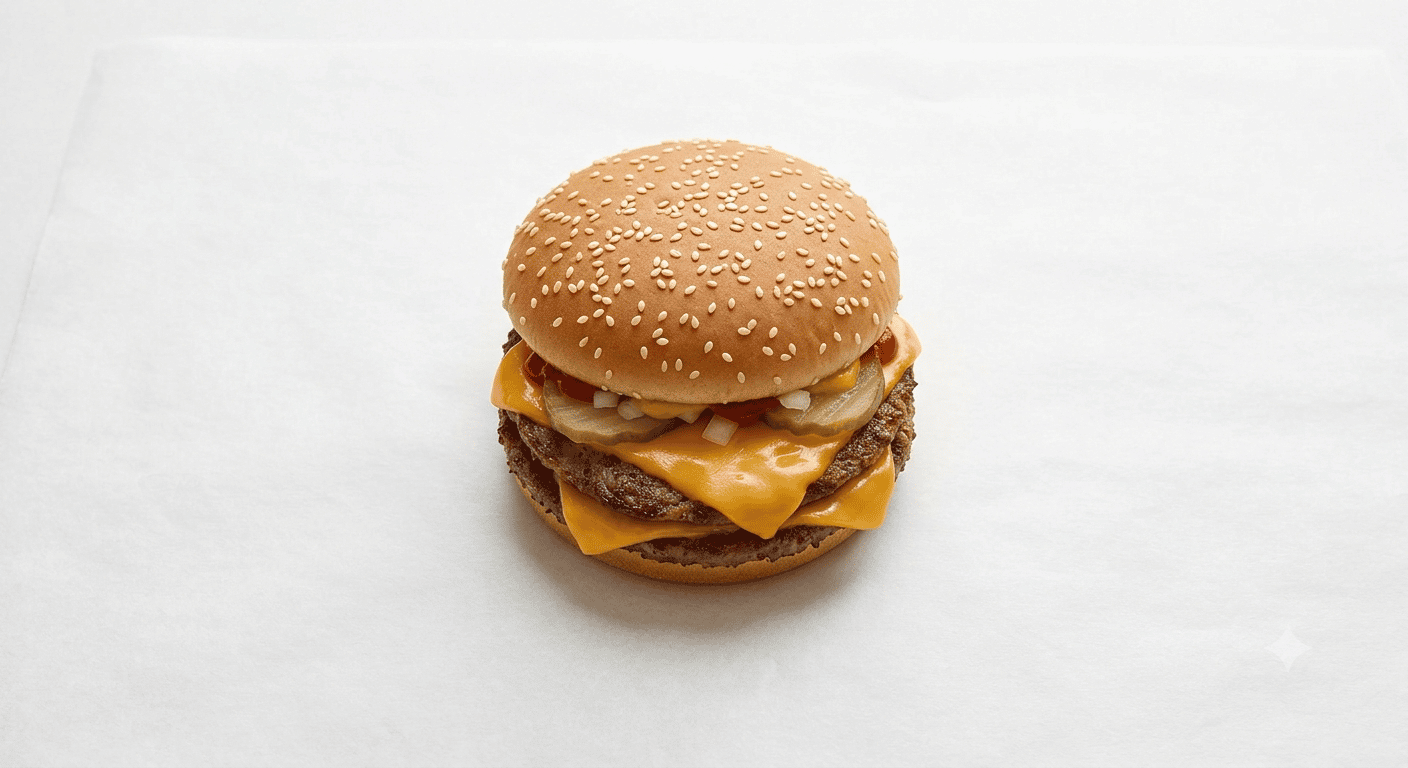
Boone’s analysis puts McDonald's Double Cheeseburger at 23% of an adult’s daily calories, 70% of the daily salt limit for a child aged 4 to 6 and 2 teaspoons of free sugar.
How many calories are in a McDonald's Double Cheeseburger? It contains 452 kcal, 24g of fat (11g saturated), 8.2g of sugar and 2.1g of salt, one of the higher-calorie items on the menu.
Build a full meal with our nutrition calculator
Use the Boone meal calculator to build a full meal rather than view this item on its own. Add fries, a drink, dips and a dessert, then choose your age and sex for a more accurate view of how a Double Cheeseburger fits into a day.
Nutrition information
Nutrition information: McDonald's Double Cheeseburger
| Energy | 452 kcal |
| Fat | 24g |
| of which saturates | 11g |
| Carbohydrate | 31g |
| of which sugars | 8.2g |
| Fibre | 2.2g |
| Salt | 2.1g |
| Protein | 27g |
Nutrition figures are McDonald’s UK published data, per item as sold and before any optional sauces or extras. Boone converts them to the portion and age comparisons on this page.
A McDonald's Double Cheeseburger contains 452 kcal, which is 23% of the 2,000 kcal adult daily reference intake. It provides 24g of total fat, of which 11g is saturated, 8.2g of sugar, 2.1g of salt, 27g of protein and 2.2g of fibre.
The saturated fat content of 11g represents 55% of the adult daily guideline of 20g.
McDonald's Double Cheeseburger is assembled from 7 separately manufactured components, combined at the point of sale. The processed cheddar cheese slice alone carries 3 different classes of additive. Across the whole item the ingredient list names anti-caking agents, colours, dextrose, emulsifiers, firming agents, flavourings, glucose or glucose-fructose syrup, maltodextrin and preservatives. None of these add nutritional value. They exist to make the item survive industrial production, freezing and transport.
McDonald's Double Cheeseburger carries a large share of a child’s daily salt
A McDonald's Double Cheeseburger contains 2.1g of salt, which is 70% of the daily limit for a child aged 4 to 6. It is also high in saturated fat.
Adult daily reference intakes (Reference Intake, RI)
Calories2,000 kcal
Total fat70g
Saturated fat20g
Carbohydrate260g
Sugars90g
Fibre30g
Salt6g
Protein50g
Sugar in McDonald's Double Cheeseburger
McDonald's Double Cheeseburger contains 8.2g of free sugar per standard serving (2.0 teaspoons). Moderate sugar
The NHS free sugar limit is 30g per day for adults, 24g for children aged 7 to 10, and 19g for children aged 4 to 6. Free sugar excludes the sugars naturally present in milk and whole fruit. The table below shows how this compares across all age groups.
Free sugar by portion: McDonald's Double Cheeseburger
| Portion | Adult (female)
30g | Adult (male)
30g | Age 11 to 17
30g | Age 7 to 10
24g | Age 4 to 6
19g |
|---|
| Per portion | 8.2g
27% | 8.2g
27% | 8.2g
27% | 8.2g
34% | 8.2g
43% |
| Teaspoons | 2.0 tsp |
Boone calculates these percentages from McDonald's UK published nutrition data against UK Dietary Reference Values and NHS free sugar and salt limits. Free sugar, salt, calories and saturated fat are limits to stay under; fibre is a target to reach, so a high percentage there is a good thing. For guidance only.
Salt in McDonald's Double Cheeseburger
McDonald's Double Cheeseburger contains 2.1g of salt per standard serving. Moderate salt
Children have lower salt limits: 3g per day for ages 4 to 6, 5g for ages 7 to 10. The table below shows how this serving compares to daily limits for adults and children.
Salt by portion: McDonald's Double Cheeseburger
| Portion | Adult (female)
6g | Adult (male)
6g | Age 11 to 17
6g | Age 7 to 10
5g | Age 4 to 6
3g |
|---|
| Per portion | 2.1g
35% | 2.1g
35% | 2.1g
35% | 2.1g
42% | 2.1g
70% |
Boone calculates these percentages from McDonald's UK published nutrition data against UK Dietary Reference Values and NHS free sugar and salt limits. Free sugar, salt, calories and saturated fat are limits to stay under; fibre is a target to reach, so a high percentage there is a good thing. For guidance only.
Calories in McDonald's Double Cheeseburger
McDonald's Double Cheeseburger contains 452 kcal per standard serving. Moderate calorie share
Daily calorie needs vary by age and sex. The table below shows how this serving compares to typical daily reference intakes.
Calories by portion: McDonald's Double Cheeseburger
| Portion | Adult (female)
2000 kcal | Adult (male)
2500 kcal | Age 11 to 17
1936 kcal | Age 7 to 10
1553 kcal | Age 4 to 6
1291 kcal |
|---|
| Per portion | 452 kcal
23% | 452 kcal
18% | 452 kcal
23% | 452 kcal
29% | 452 kcal
35% |
Boone calculates these percentages from McDonald's UK published nutrition data against UK Dietary Reference Values and NHS free sugar and salt limits. Free sugar, salt, calories and saturated fat are limits to stay under; fibre is a target to reach, so a high percentage there is a good thing. For guidance only.
Saturated fat in McDonald's Double Cheeseburger
McDonald's Double Cheeseburger contains 11g of saturated fat per standard serving. Moderate saturated fat
The saturated fat guideline is 20g a day for women and 30g for men, and lower again for children. The table below shows how this serving compares.
Saturated fat by portion: McDonald's Double Cheeseburger
| Portion | Adult (female)
20g | Adult (male)
30g | Age 11 to 17
20g | Age 7 to 10
18g | Age 4 to 6
16g |
|---|
| Per portion | 11g
55% | 11g
37% | 11g
55% | 11g
61% | 11g
69% |
Boone calculates these percentages from McDonald's UK published nutrition data against UK Dietary Reference Values and NHS free sugar and salt limits. Free sugar, salt, calories and saturated fat are limits to stay under; fibre is a target to reach, so a high percentage there is a good thing. For guidance only.
Fibre in McDonald's Double Cheeseburger
McDonald's Double Cheeseburger contains 2.2g of fibre per standard serving. Some fibre
Fibre is the one figure here that is a target to reach rather than a limit to stay under. UK guidance is 30g a day for adults, 25g for ages 11 to 17, 20g for ages 7 to 10 and 15g for ages 4 to 6. Most people in the UK fall well short. The table below shows how much of a day’s fibre this serving provides.
Fibre by portion: McDonald's Double Cheeseburger
| Portion | Adult (female)
30g | Adult (male)
30g | Age 11 to 17
25g | Age 7 to 10
20g | Age 4 to 6
15g |
|---|
| Per portion | 2.2g
7% | 2.2g
7% | 2.2g
9% | 2.2g
11% | 2.2g
15% |
Boone calculates these percentages from McDonald's UK published nutrition data against UK Dietary Reference Values and NHS free sugar and salt limits. Free sugar, salt, calories and saturated fat are limits to stay under; fibre is a target to reach, so a high percentage there is a good thing. For guidance only.
Ultra-processed food: what is really in it
Processing and additives: McDonald's Double Cheeseburger
McDonald's Double Cheeseburger is assembled from 7 separately manufactured components, combined and cooked at the point of sale. Reading the ingredient list closely, it contains anti-caking agents, colours, dextrose, emulsifiers, firming agents, flavourings, glucose or glucose-fructose syrup, maltodextrin and preservatives. These are not there to add nutritional value. They make industrial production and distribution possible.
Anti-caking agents
Stop powders and sliced products sticking together. Found in the processed cheddar cheese slice.
Colours
Restore or standardise appearance after processing. Found in the processed cheddar cheese slice.
Dextrose
A simple sugar used for browning, bulk and mild sweetness. Found in the regular bun.
Emulsifiers
Help oil-based and water-based ingredients blend and stay blended. Found in the regular bun.
Firming agents
Keep processed vegetables crisp after packing. Found in the pickle slices.
Flavourings
Add or restore taste lost during processing. Found in the processed cheddar cheese slice, pickle slices.
Glucose or glucose-fructose syrup
Sweeten and control texture more cheaply than sugar alone. Found in the tomato ketchup.
Maltodextrin
Bulk out a product and carry flavour, with little taste of its own. Found in the regular bun.
Preservatives
Slow the growth of bacteria, yeasts and moulds in centrally prepared components. Found in the beef patty, pickle slices.
Boone classifies McDonald's Double Cheeseburger as NOVA group 4, ultra-processed, based on the additives named above. NOVA groups foods by how far they are from their whole-food form, not by how nutritious they are. A group 4 food is not automatically unhealthy, and a group 1 food is not automatically healthy. Read from the published ingredient list, 17-18 August 2026.
A McDonald's Double Cheeseburger contains at least 30 distinct ingredients: 18 raw and 12 manufactured. Ordered as a full meal with a dip and a dessert that reaches 56, of which 28 are manufactured. Raw means something you could buy and cook with at home; manufactured means a substance that only exists as an output of industrial processing.
Ingredient count by order: McDonald's Double Cheeseburger
| What you order | Raw | Manufactured | Total | % manufactured |
|---|
| McDonald's Double Cheeseburger on its own | 18 | 12 | 30 | 40% |
| McDonald's Double Cheeseburger + medium fries | 20 | 12 | 32 | 38% |
| McDonald's Double Cheeseburger + fries + a dip | 22 | 21 | 43 | 49% |
| McDonald's Double Cheeseburger + fries + dip + a medium Coca-Cola | 23 | 24 | 47 | 51% |
| McDonald's Double Cheeseburger + fries + dip + drink + an Oreo McFlurry | 28 | 28 | 56 | 50% |
The 12 manufactured ingredients
dextrose, emulsifying salts, glucose-fructose syrup, maize maltodextrin, maize starch, milk protein, natural cheese flavouring, pea protein, spice extracts, wheat fibre, wheat maltodextrin, wheat starch.
The 18 raw ingredients
butter, cream yeast, gherkins, milk, mustard seed, onion, pepper, pure beef, rapeseed oil, salt, spirit vinegar, sugar, tomato puree, vegetarian cheddar, vegetarian cheese, water, wheat flour, whey or skimmed milk powder.
What those ingredients are, by type
Meat, fish, dairy and eggs7
Grains and flours6
Starches4
Sugars and syrups3
Oils and fats3
Fruit and vegetables3
Flavourings1
Acids and acidity regulators1
Salt and minerals1
Boone counts every distinct named ingredient on McDonald’s published component lists, including sub-ingredients, and removes duplicates, so salt appearing in four components counts once. Additive class names are dropped and the named substance kept, so “stabiliser (guar gum)” counts guar gum once. Raw covers whole foods and basic kitchen staples such as flour, sugar, salt and oil. Manufactured covers substances that only exist as an output of industrial processing. Where McDonald’s lists more than one approved supplier recipe only the primary one is counted, so every figure here is a minimum. The build uses a Sweet and Sour dip.
Ingredients
McDonald's Double Cheeseburger is assembled from 7 separately manufactured components.
Ingredients by component: McDonald's Double Cheeseburger
Regular bun
WHEAT flour, water, sugar, cream yeast, rapeseed oil, salt, WHEAT fibre, emulsifier, pea protein, WHEAT starch, WHEAT maltodextrin, dextrose, maize maltodextrin, maize starch.
Beef patty
100% pure beef, seasoned with salt and pepper after cooking, with no additives, fillers, binders, preservatives or flavour enhancers.
Processed cheddar cheese slice
vegetarian cheddar (51%) (MILK), water, vegetarian cheese (9%) (MILK), whey or skimmed MILK powder, butter (MILK), emulsifying salts, MILK protein, natural cheese flavouring (MILK), salt, colours, anti-caking agent.
Pickle slices
gherkins, water, spirit vinegar, salt, firming agent, natural flavouring, preservative.
Tomato ketchup
60% tomato puree (equivalent to 168g tomatoes per 100g ketchup), glucose-fructose syrup, spirit vinegar, salt, spice extracts.
Mustard
water, spirit vinegar, MUSTARD seed (14%), salt, spices, spice extract.
McDonald’s lists more than one approved supplier formulation for the regular bun and processed cheddar cheese slice; the version shown is the primary one and the allergen information covers all variants. Ingredients taken from the McDonald’s UK product pages, retrieved 17-18 August 2026. Recipes change - always check in restaurant before ordering if you have an allergy.
Allergens at a glance
McDonald's Double Cheeseburger contains wheat, milk and mustard.
Allergen information: McDonald's Double Cheeseburger
| Allergen | Status |
|---|
| Wheat | Contains |
| Rye | May contain traces |
| Barley | May contain traces |
| Oats | Not present |
| Sesame | May contain traces |
| Soya | Not present |
| Milk | Contains |
| Eggs | Not present |
| Fish | Not present |
| Crustaceans | Not present |
| Celery | Not present |
| Mustard | Contains |
| Molluscs | Not present |
| Lupin | Not present |
Contains = declared as an ingredient. May contain traces = McDonald's states the allergen cannot be excluded. McDonald's prepares food in kitchens where all 14 major allergens are present and equipment is shared, so no item can be guaranteed allergen free, even when ingredients are removed on request. Buns, rolls and tortilla wraps are toasted in the same toaster as sesame-topped buns. Retrieved 17-18 August 2026.