
Free UK delivery on all orders · At-home saliva test · Secure checkout
Free UK delivery on all orders

McDonald's McPlant: calories, nutrition, ingredients and allergens

How many calories are in a McDonald's McPlant? It contains 426 kcal, 19g of fat (3.5g saturated), 8g of sugar and 1.9g of salt. This sits in the middle of the range for the core menu.

Build a full meal with our nutrition calculator

A McPlant is rarely ordered on its own. Use the calculator below to add fries, a drink, dips and a dessert, and see what the combined order adds up to against daily guidelines for calories, saturated fat, sugar and salt.

McDonald's meal builder
Build your meal and see the totals
Choose your main, then add fries, a drink, dips and a dessert. See combined calories, fat, saturated fat, sugar and salt against daily guidelines.

Your meal
Calories
--
--
0--
--
Saturated fat
--
--
0--
--
Sugar
--
--
0--
--
Salt
--
--
0--
--

Nutrition information

Nutrition information: McPlant

Energy426 kcal
Fat19g
of which saturates3.5g
Carbohydrate41g
of which sugars8g
Salt1.9g
Protein19g

Source: McDonald’s UK nutrition information. Figures are per item as sold, before any optional sauces or extras.

A McDonald's McPlant contains 426 kcal, which is 21% of the 2,000 kcal adult daily reference intake. It provides 19g of total fat, of which 3.5g is saturated, 8g of sugar, 1.9g of salt and 19g of protein.

At 3.5g, the saturated fat content is relatively low for a hot menu item, representing 18% of the adult daily guideline of 20g.

The plant-based patty and vegan cheese are both formulated products designed to replicate animal products, built from isolated proteins, starches, oils, binders and flavourings rather than whole-food ingredients. Despite being meat-free, the McPlant is not a minimally processed option: its ingredient list is longer and more heavily formulated than the beef patty it replaces.

A moderate choice on calories and saturated fat

A McDonald's McPlant contains 426 kcal and 3.5g of saturated fat, 18% of the adult daily saturated fat guideline of 20g. The plant-based patty and vegan cheese are both formulated products designed to replicate animal products, built from isolated proteins, starches, oils, binders and flavourings rather than whole-food ingredients. Despite being meat-free, the McPlant is not a minimally processed option: its ingredient list is longer and more heavily formulated than the beef patty it replaces.

Adult daily reference intakes (Reference Intake, RI)

Calories2,000 kcal
Total fat70g
Saturated fat20g
Total sugars90g (free sugar limit: 30g)
Salt6g

Reference Intakes are EU-wide guideline daily amounts for an average adult (2,000 kcal). The free sugar limit of 30g is the NHS/SACN guideline, which is stricter than the 90g total sugars RI as it excludes naturally occurring sugars in whole foods and dairy.

Sugar, salt and protein by age group

The table below shows how the sugar, salt and protein in a McDonald's McPlant compares to daily guidelines for different age groups and life stages.

Sugar, salt and protein by age group: McDonald's McPlant

Age groupSugar (g / % limit)Salt (g / % limit)Protein (g / % target)
Age 4 to 6 8g / 42% 1.9g / 63% 19g / 95%
Age 7 to 10 8g / 33% 1.9g / 38% 19g / 68%
Age 11 to 17 8g / 27% 1.9g / 32% 19g / 45%
Adult 8g / 27% 1.9g / 32% 19g / 38%

Sugar and salt % shown against NHS/SACN daily limits. Protein % shown against estimated daily targets. Red = 75%+ of limit, amber = 20-74%, green = under 20%. Protein is beneficial and has no upper limit, shown for reference only.

Protein

McPlant provides 19g of protein. For comparison, a general guide for adult daily protein intake is around 50g, so this item alone provides 38% of that target.

Salt

McPlant contains 1.9g of salt, 32% of the adult daily limit of 6g. This is a moderate contribution, leaving room within the daily limit for sides and other meals.

Ultra-processed food: what is really in it

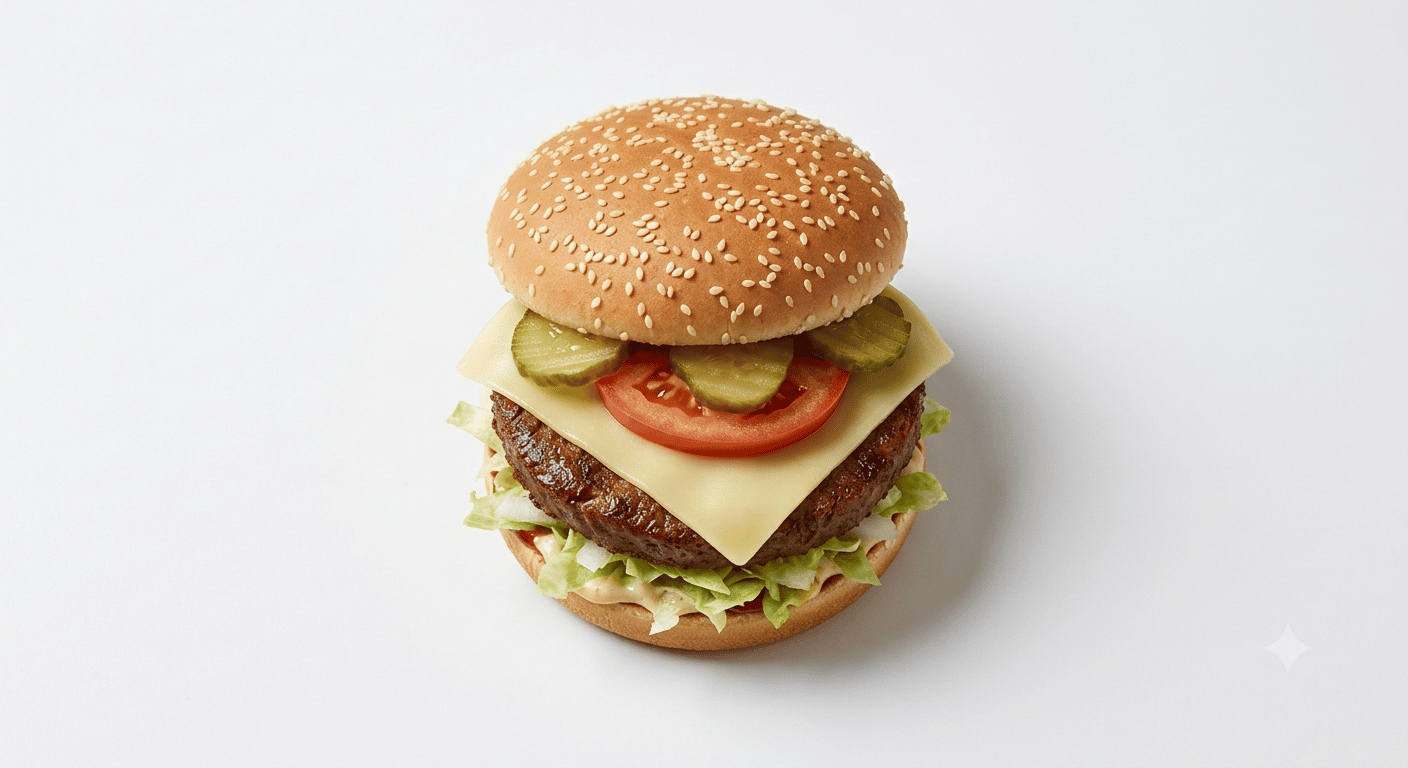
A McDonald's McPlant is assembled from 5 separate components, each manufactured and prepared separately, often at different factories, before being combined and cooked at the point of sale. The most heavily formulated of these are the sesame seed bun, plant-based patty and vegan cheese slice.

Reading the ingredient list closely, a McDonald's McPlant contains emulsifiers, colourings and flavourings. These are not used to add nutritional value. Emulsifiers help water-based and fat-based ingredients (such as oil and vinegar in a sauce, or fat and water in a bun dough) blend together and stay blended, rather than separating out. Colourings standardise the appearance of a product so it looks the same in every restaurant, regardless of natural variation in the raw ingredients. Flavourings restore or enhance taste that may be reduced during industrial processing, or replicate the taste of a traditional ingredient in a plant-based alternative.

None of this means the ingredients are unsafe; all additives used are approved for use in UK food. What it indicates is the degree of industrial formulation involved. A home-cooked equivalent, made from a small number of fresh or minimally processed ingredients prepared in one kitchen, would typically involve far fewer steps and far fewer additives. The version sold at McDonald's reaches a comparable end result using a longer list of industrially processed components, several manufacturing sites, and a number of functional additives designed to keep the product consistent across thousands of restaurants.

What's in it: McPlant

Sesame seed bun

Wheat flour, water, sugar, yeast, sesame seeds, rapeseed oil, emulsifiers

Plant-based patty

Pea protein and soya protein based patty with rapeseed oil, methylcellulose binder, and flavourings, designed to replicate the texture of a beef patty

Vegan cheese slice

Coconut oil and potato starch based, with flavourings and colours to replicate cheddar

Lettuce, tomato, onion, pickle

Fresh vegetables plus standard pickle

Vegan sandwich sauce and mustard

Plant-based mayonnaise alternative and mustard

Looking at the ingredient list rather than just the nutrition panel tells a different story. Even where individual macros (sugar, salt, calories) look moderate, the number of separately manufactured components, and the additives used to bind, emulsify, preserve, colour and flavour them, place almost every hot item on the McDonald's menu in the most processed food category under the NOVA classification system.

Processing (NOVA classification)

A McDonald's McPlant falls into NOVA group 4, ultra-processed food. The NOVA classification system groups foods by the extent and purpose of the processing involved, rather than by their individual nutrients. Group 4 covers products that are formulated mostly or entirely from substances derived from foods, plus additives, using a series of industrial processes with little or no whole food remaining recognisable in the final product. In this item, that includes emulsifiers, colourings and flavourings, on top of the breaded or formed proteins, processed cheese and multi-stage assembly typical of the menu. This classification applies to almost all hot menu items at McDonald's, and indeed to most fast food and packaged convenience food generally; it is not a finding specific to this item.

Allergens at a glance

Allergen information: McPlant

WheatContains
RyeMay contain traces
BarleyMay contain traces
OatsNot present
SesameContains
SoyaContains
MilkMay contain traces
EggsNot present
FishNot present
CrustaceansNot present
CeleryNot present
MustardContains
MolluscsNot present
LupinNot present

McDonald's UK prepares food in kitchens where allergens are present and equipment is shared. "May contain traces" reflects cross-contact risk from shared fryers, toasters and preparation areas. McDonald's cannot guarantee any item is completely allergen-free, even when ingredients are removed on request.

Frequently asked questions

A McDonald's McPlant contains 426 kcal, which is 21% of the 2,000 kcal adult daily reference intake.

Per item: 426 kcal, 19g fat (3.5g saturated), 41g carbohydrate (8g sugar), 1.9g salt, 19g protein.

A McDonald's McPlant contains 3.5g of saturated fat, 18% of the adult daily guideline of 20g, and 21% of the guideline for a child aged 11 to 17 (17g).

Yes. A McDonald's McPlant falls into NOVA group 4, ultra-processed food. It contains emulsifiers, colourings and flavourings, used to bind, preserve, stabilise or standardise the product, alongside breaded or formed proteins and processed cheese. This is a description of how the food is made and formulated, not a statement that it is unsafe to eat.

Calories, fat, sugar and salt only describe part of the picture. Two foods can have similar nutrition figures while differing substantially in how processed they are, how many ingredients they contain, and how many additives are used to replicate texture, flavour or appearance. The NOVA classification and ingredient list capture this difference, which the nutrition panel alone does not.

A McDonald's McPlant contains wheat, soya, sesame and mustard. May also contain traces of barley, rye and milk from shared kitchen equipment.

A McDonald's McPlant contains 1.9g of salt, 32% of the adult daily limit of 6g.

At 426 kcal, the McDonald's McPlant sits roughly in the middle of the range for the core menu, between the Hamburger (248 kcal) and the Double Quarter Pounder with Cheese (743 kcal).

Track how this fits your day

See exactly how this meal fits your day.

The Boone app tracks calories, fat, saturated fat, sugar, salt and 30 plus micronutrients in real time. Log meals by scanning food or searching restaurant items, and see instantly how a meal out fits into your day, adjusted for your exact age and goals.

Download the Boone app and start tracking your nutrition today.

Get started with Boone

Nutrition and allergen information from McDonald's UK official sources (allergen booklet and product pages). Figures are per item as sold, before optional sauces, dips or extras, and may vary slightly by recipe updates. Reference intakes: EU Reference Intakes for an average adult (2,000 kcal); NHS/SACN free sugar and saturated fat guidelines. For guidance only, not medical advice. Always check the McDonald's UK app or in-restaurant information for the most current data.