Tiger Nuts nutrition: calories, protein and healthy fats
Tiger Nuts is a whole food and, as a NOVA group 1 food, delivers naturally occurring energy and nutrients with no added sugar, salt or additives. It is a source of potassium, vitamin E and magnesium. Work out the numbers for any portion and age below, then see the full macro and micronutrient breakdown.
Tiger Nuts nutrition calculator
Calories, sugar and key nutrients by portion, adjusted for age and gender.
Key nutrients in this portion
Tiger Nuts nutrition per 100g and per portion
Typical values
Per 100g
Per portion (30g)
Energy
400
120
Fat
24g
7.2g
of which saturates
4.5g
1.3g
Carbohydrate
60g
18g
of which total sugars
20g
6g
of which added sugars
0g
0g
of which starch
0g
0g
Fibre
33g
9.9g
Protein
4g
1.2g
Salt
0g
0g
Sugar, fat, fibre and carbohydrate, by age
The tables below put each macronutrient against age-appropriate guidance, because what matters for a 4 year old is very different from an adult.
Sugar in Tiger Nuts: natural, not added
A small handful (about 30g) contains about 6.0g of sugar, and it is all natural (intrinsic) sugar that comes packaged with fibre and water. It has 0g of added or free sugar, so it does not count toward the daily free sugar limit the NHS sets. The table shows those limits by age; Tiger Nuts contributes nothing to them.
Age group
Daily free sugar limit
In a small handful (about 30g)
% of that
Adult
30g
0g
0%
Age 11 to 17
30g
0g
0%
Age 7 to 10
24g
0g
0%
Age 4 to 6
19g
0g
0%
Fat in Tiger Nuts: high, mostly unsaturated
Tiger Nuts is naturally high in fat, at about 7.2g per portion, though most of it is unsaturated. Only around 1.35g is saturated and there is 0g of added fat.
Age group
Max saturated fat
In a small handful (about 30g)
% of that
Adult
24g
1.35g
6%
Age 11 to 17
27g
1.35g
5%
Age 7 to 10
22g
1.35g
6%
Age 4 to 6
18g
1.35g
8%
Fibre in Tiger Nuts by age
Fibre supports healthy digestion, and most people in the UK do not get enough. A portion provides about 9.9g. Because children need less fibre than adults, that same portion covers a bigger share of a younger child's target.
Age group
Recommended fibre
In a small handful (about 30g)
% of that
Adult
30g
9.9g
33%
Age 11 to 17
25g
9.9g
40%
Age 7 to 10
20g
9.9g
50%
Age 4 to 6
15g
9.9g
66%
Carbohydrate in Tiger Nuts by age
There is about 18.0g of carbohydrate per portion. There is no single daily target, but roughly half of daily energy should come from carbohydrate; the reference values below are based on that.
Age group
Reference carbohydrate
In a small handful (about 30g)
% of that
Adult
250g
18g
7%
Age 11 to 17
275g
18g
7%
Age 7 to 10
225g
18g
8%
Age 4 to 6
188g
18g
10%
Vitamins and minerals in Tiger Nuts
Percentages are share of the daily Nutrient Reference Value (NRV). Under UK and EU rules a food is a source of a nutrient at 15% NRV per 100g and high in it at 30%.
Nutrient
Per 100g
%NRV /100g
%NRV /portion
Potassium
720mg
36%
11%
high in Potassium
Vitamin E
4mg
33%
10%
high in Vitamin E
Magnesium
85mg
23%
7%
a source of Magnesium
Iron
2.5mg
18%
5%
a source of Iron
Vitamins and minerals in Tiger Nuts, by age
These tables show how the nutrients compare to daily needs across different ages, using UK Reference Nutrient Intakes (RNIs). This differs from the source of and high in labels above, which use the single adult figure (NRV) set for food packaging. Children's needs are lower, so a portion goes further.
Potassium in Tiger Nuts by age
Potassium helps control blood pressure and supports normal muscle and nerve function. A small handful (about 30g) contains 216mg. Because children need less than adults, that same portion covers a bigger share of a younger child's daily target.
Age group
Daily need (RNI)
In a small handful (about 30g)
% of daily need
Adult
3500mg
216mg
6%
Age 11 to 17
3500mg
216mg
6%
Age 7 to 10
2000mg
216mg
11%
Age 4 to 6
1100mg
216mg
20%
Vitamin E in Tiger Nuts by age
Vitamin E is an antioxidant that helps protect cells from damage. A small handful (about 30g) contains 1.2mg. Because children need less than adults, that same portion covers a bigger share of a younger child's daily target. These figures use safe intake levels, as no formal UK RNI is set.
Age group
Daily need (RNI)
In a small handful (about 30g)
% of daily need
Adult
12mg
1.2mg
10%
Age 11 to 17
11mg
1.2mg
11%
Age 7 to 10
7mg
1.2mg
17%
Age 4 to 6
6mg
1.2mg
20%
Magnesium in Tiger Nuts by age
Magnesium supports muscle and nerve function and helps release energy from food. A small handful (about 30g) contains 26mg. Because children need less than adults, that same portion covers a bigger share of a younger child's daily target.
Age group
Daily need (RNI)
In a small handful (about 30g)
% of daily need
Adult
300mg
26mg
8%
Age 11 to 17
300mg
26mg
8%
Age 7 to 10
200mg
26mg
13%
Age 4 to 6
120mg
26mg
21%
Iron in Tiger Nuts by age
Iron is needed to make red blood cells that carry oxygen around the body. A small handful (about 30g) contains 0.75mg. Because children need less than adults, that same portion covers a bigger share of a younger child's daily target. Girls aged 11 and over and women need more iron (14.8mg) because of menstrual losses.
Age group
Daily need (RNI)
In a small handful (about 30g)
% of daily need
Adult
11mg
0.75mg
7%
Age 11 to 17
13mg
0.75mg
6%
Age 7 to 10
8.7mg
0.75mg
9%
Age 4 to 6
6.1mg
0.75mg
12%
Is Tiger Nuts processed?
No. Tiger Nuts is a NOVA group 1 whole food, the least processed category, eaten in its natural state with nothing added, which is why whole foods behave very differently in the body from ultra-processed foods.
Tiger Nuts nutrition FAQ
What are tiger nuts?+
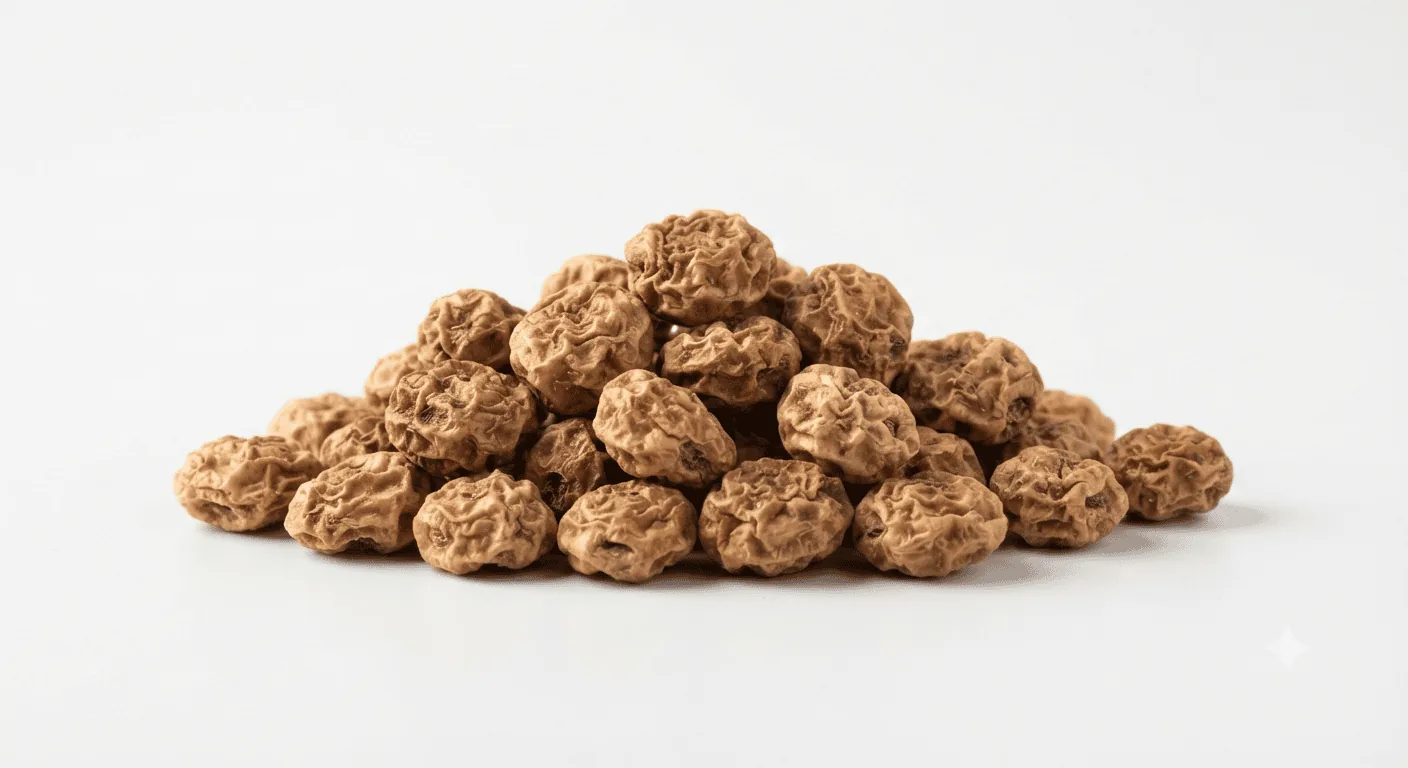
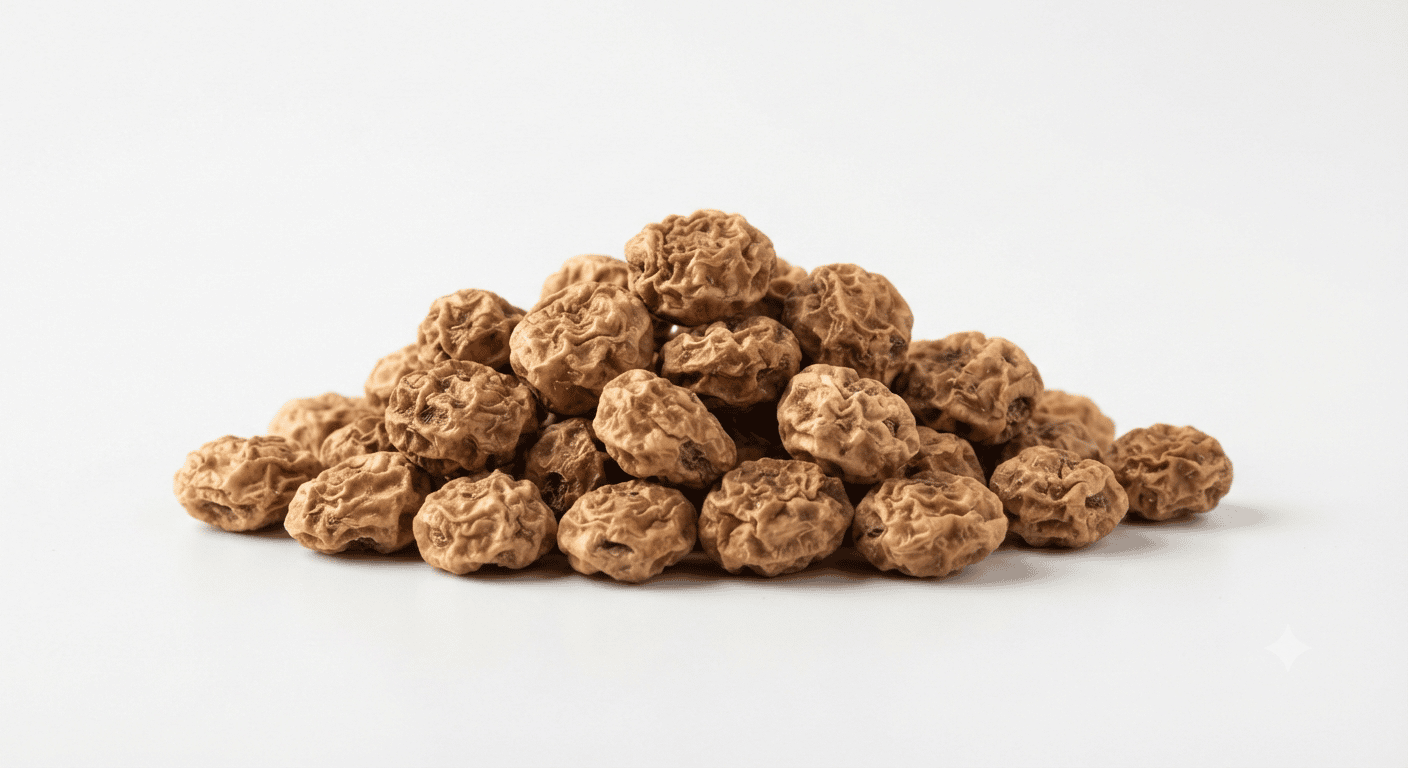
Tiger nuts are not nuts at all. They are the small dried tubers of a sedge grass called Cyperus esculentus — a root vegetable related to papyrus. They grow underground, look like small wrinkled chickpeas, and have a naturally sweet, slightly coconut-like flavour. The name comes from the tiger-stripe markings on the outer skin. Tiger nuts are one of the oldest cultivated foods in the world, historically important in ancient Egypt and still widely consumed in West Africa and Spain, where they are used to make the drink horchata de chufa. Despite the name, they contain no nut proteins and are not related to tree nuts or peanuts.
How many calories are in tiger nuts?+
Tiger nuts contain 400 kcal per 100g. A small handful of about 30g contains approximately 120 kcal — 6% of the adult 2,000 kcal daily reference intake. This is notably lower than almonds at 174 kcal per 30g and peanuts at 170 kcal per 30g, making tiger nuts one of the lower calorie options in the nut and seed snack category despite being quite filling due to their very high fibre content. The calories come mainly from carbohydrate and fat rather than protein.
How much fibre is in tiger nuts?+
Tiger nuts contain 33g of fibre per 100g — one of the highest fibre contents of any whole food. A 30g handful provides approximately 9.9g of fibre, which is 33% of the adult daily fibre target of 30g. For children the same handful covers a far larger proportion: 50% of the target for children aged 7 to 10 and 66% for children aged 4 to 6. By comparison, almonds provide 3.75g of fibre per 30g and peanuts provide 2.5g. Tiger nuts contain predominantly resistant starch and inulin — a prebiotic fibre that feeds beneficial gut bacteria. This makes them one of the most fibre-dense and gut-supportive whole foods available.
How much sugar is in tiger nuts?+
Tiger nuts contain 20g of sugar per 100g — approximately 6g per 30g handful, or about 1.5 teaspoons. This is higher than most nuts (almonds contain 4.4g/100g, peanuts 4g/100g) but all of it is intrinsic sugar, naturally occurring within the tuber's cell structure and packaged with fibre. Intrinsic sugars do not count toward the NHS daily free sugar limits of 30g for adults, 24g for children aged 7 to 10, and 19g for children aged 4 to 6. Tiger nuts contribute 0g of free sugar regardless of portion size. The natural sweetness is what gives them their distinctive flavour and makes them unusual among savoury snacks.
How much fat is in tiger nuts?+
Tiger nuts contain 24g of fat per 100g — approximately 7.2g per 30g handful. Saturated fat is 4.5g per 100g (about 1.35g per handful — 6% of the adult daily saturated fat guideline of 24g). The majority is oleic acid, the same monounsaturated fat found in olive oil, making the fat profile of tiger nuts notably similar to olive oil in composition. This is a lower total fat content than tree nuts like almonds at 49.9g/100g — tiger nuts are significantly lower in fat and calories, with more of their energy coming from carbohydrate.
How much protein is in tiger nuts?+
Tiger nuts contain 4g of protein per 100g — approximately 1.2g per 30g handful. This is low compared to true nuts and legumes: almonds contain 21.2g/100g and peanuts contain 26g/100g. Tiger nuts are not a useful protein source and should not be relied upon to meet protein needs. Their nutritional value lies in their exceptional fibre content, prebiotic properties and micronutrient profile rather than protein. Those looking to combine fibre with meaningful protein would do better pairing tiger nuts with a higher-protein food.
What vitamins and minerals are in tiger nuts?+
Tiger nuts are high in potassium (720mg per 100g, 36% of NRV) and vitamin E (4mg per 100g, 33% NRV). They are also a source of magnesium and iron. A 30g handful provides 216mg of potassium — useful for blood pressure and muscle function — and 1.2mg of vitamin E. The micronutrient profile is less dense than almonds or peanuts, but the combination of potassium and vitamin E alongside the extraordinary fibre content distinguishes tiger nuts. They do not contribute meaningful amounts of calcium, zinc, folate or B vitamins.
Are tiger nuts good for you?+
Yes. Tiger nuts are a NOVA group 1 whole food with 0g of added sugar, 0g of salt and no additives. Their primary nutritional value is their exceptional fibre content — 33g per 100g, with nearly 10g per 30g handful — making them one of the most fibre-dense whole foods available as a snack. The fibre is predominantly prebiotic (inulin and resistant starch), which supports gut bacteria diversity. They are lower in protein than tree nuts and legumes, so they are best thought of as a fibre-first food rather than a protein source. For those trying to increase their daily fibre intake, tiger nuts are one of the most efficient whole-food options available.
Are tiger nuts safe for children?+
Whole dried tiger nuts are hard and chewy and present a choking risk for very young children — they should not be given whole to children under 3. From age 3 to 5, tiger nuts should be given only with close supervision and can be softened by soaking in water first. From age 5 upwards they can be eaten normally. Tiger nuts are not one of the 14 major allergens and are not related to tree nuts or peanuts — they are a tuber, making them a useful snack for children with tree nut or peanut allergies. The very high fibre content (9.9g per 30g) means that large portions could cause digestive discomfort in children — small quantities are appropriate.
Do tiger nuts contain allergens?+
No. Tiger nuts are not one of the 14 major allergens regulated under UK food law. Despite the name, they contain no nut proteins and are not related to tree nuts or peanuts. They are a tuber — a root vegetable — making them suitable for people with tree nut allergy, peanut allergy or both. Tiger nuts are also naturally gluten-free and dairy-free. Cross-contamination remains possible if tiger nuts are packaged in facilities that handle tree nuts or other allergens — always check the label if severe allergy is a concern.
Are tiger nuts suitable for vegans?+
Yes. Tiger nuts are entirely plant-based and suitable for vegans and vegetarians. They are a naturally vegan whole food with no animal-derived ingredients. They are also gluten-free and allergen-free, making them one of the most inclusive snack foods available. Tiger nuts are particularly useful for vegans trying to increase fibre and prebiotic intake, and for those with multiple food allergies who struggle to find safe whole-food snacks.
How do tiger nuts compare to almonds and peanuts?+
Tiger nuts sit in a different nutritional category from almonds and peanuts. Tiger nuts are dramatically higher in fibre — 33g per 100g versus 12.5g for almonds and 8.5g for peanuts — but dramatically lower in protein at 4g versus 21.2g and 26g respectively. They are also lower in calories at 400 kcal per 100g versus around 570 kcal for both nuts. Tiger nuts contain significantly more natural sugar (20g/100g) than almonds or peanuts, though all of it is intrinsic. Tiger nuts are not an allergen; almonds and peanuts both are. The practical conclusion: tiger nuts are a fibre-first food; almonds and peanuts are protein-first foods. They serve different nutritional purposes and complement each other well.
What does tiger nut fibre do in the body?+
The fibre in tiger nuts is predominantly resistant starch and inulin — both prebiotic fibres that reach the large intestine largely intact and are fermented by beneficial gut bacteria. This fermentation produces short-chain fatty acids including butyrate, which supports the gut lining and is associated with reduced inflammation. Prebiotic fibres like inulin selectively feed beneficial bacteria such as Lactobacillus and Bifidobacterium. The result is that tiger nuts function as a gut health food beyond simple bulking — they actively feed the microbiome. The high total fibre also supports bowel regularity, and the 9.9g per 30g portion is a substantial contribution to the adult daily target of 30g.
Can tiger nuts cause digestive discomfort?+
Yes, particularly when first introduced. The high inulin content in tiger nuts is fermented rapidly by gut bacteria, and for people who are not used to high prebiotic fibre intake this can cause bloating, gas and loose stools. The effect is usually temporary and reduces as the gut microbiome adjusts. Starting with a small portion — 10-15g rather than a full 30g handful — and increasing gradually over one to two weeks is the recommended approach. Those with irritable bowel syndrome or FODMAP sensitivity should approach tiger nuts with caution, as inulin is a high-FODMAP compound. Soaking dried tiger nuts in water for several hours before eating softens them and may reduce the intensity of the fermentation response.
How do tiger nuts fit into a balanced diet?+
Tiger nuts fit best into a balanced diet as a fibre and prebiotic supplement — a way to significantly boost daily fibre intake from a whole food with no added sugar, salt or processing. A 30g handful provides 9.9g of fibre, 120 kcal and 0g of free sugar. For most adults, this single handful contributes a third of the daily fibre target. Because protein content is low, tiger nuts work best alongside higher protein foods rather than as a standalone snack. They are suitable for people with tree nut or peanut allergies who want a nut-style snack, and for anyone following a vegan, gluten-free or allergen-free diet. Introduce gradually to avoid digestive discomfort.
Track this in Boone
Log your food and see your macros and micronutrients in real time, personalised to your genetics.
Nutrition data from McCance and Widdowson and UK FoodData Central, per 100g raw edible portion; values are reference figures and can vary by variety and ripeness. Reference intakes: EU NRVs for labelling and UK RNIs (SACN) for age-based needs. For guidance only.