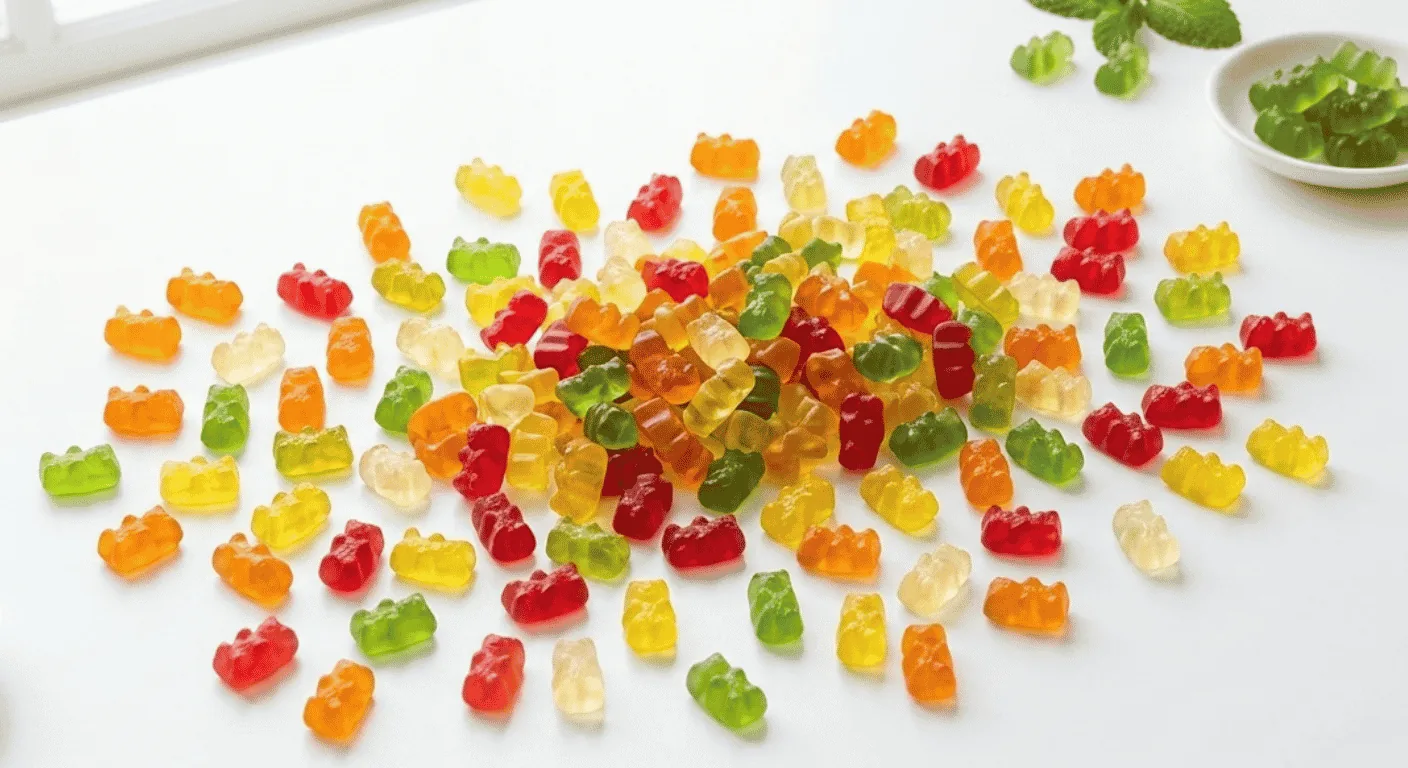
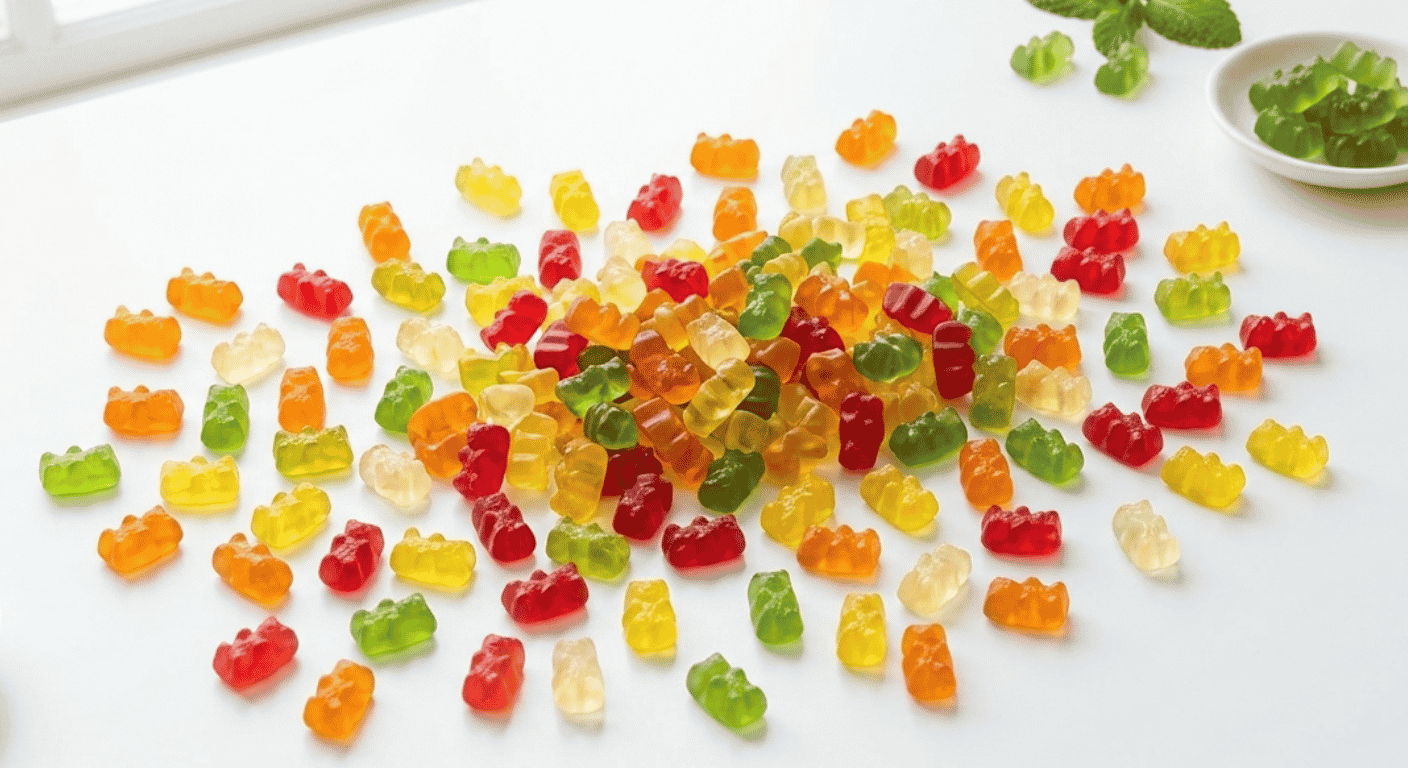
Illustrative image created by Boone, not a photograph of the product.
Haribo Gold Bears Nutrition. The original gummy sweet broken down For Kids.
All sugar in Haribo Gold Bears is free sugar. Here is what the full picture looks like for the world's most recognised gummy sweet.
Haribo Gold Bears are smaller than most gummy sweets at approximately 2g each and 0.9gof sugar per bear. That makes them one of the lower-sugar individual sweets available. The problem is not the per-bear figure - it is that children rarely eat one or two bears.
A standard 200g bag contains approximately 100 bears and 90g of free sugar. Three times the daily limit for a child aged 7 to 10 in a single bag.
Try it: adjust the number of sweets
Use the calculator below to see how any quantity of these sweets compares to NHS daily limits for your child's age and gender.
Sweets calculator
How much sugar is in those sweets?
Choose brand, sweet type and how many — then see the total against NHS daily limits.
5
Your selection—
Free sugar
—
—
0—
—
Calories
—
—
0—
—
Salt
—
—
0—
—
Four portion sizes
The figures below show total sugar, calories and salt for four realistic amounts.
Small portion
5 sweets
5 sweets (10g)
4.5g
sugar
35
kcal
0g
salt
4.5g free sugar — 19% of the daily limit for a 7-year-old; 24% for a 4-year-old
Standard portion
10 sweets
10 sweets (20g)
9g
sugar
70
kcal
0g
salt
9g free sugar — 38% of the daily limit for a 7-year-old; 47% for a 4-year-old
Larger portion
20 sweets
20 sweets (40g)
18g
sugar
140
kcal
0g
salt
18g free sugar — 75% of the daily limit for a 7-year-old; 95% for a 4-year-old
Full bag
~100 sweets
~100 sweets (200g)
90g
sugar
700
kcal
0g
salt
90g free sugar — more than three times the daily limit for children aged 7 to 10 in a single bag.
Sugar
The NHS sets daily limits for free sugars - sugars added to food or drink, plus sugars naturally present in honey, syrups and fruit juice. All sugar in these sweets counts as free sugar.
Small size does not mean low sugar
Gold Bears weigh approximately 2g each. But sugar makes up 45 percent of their total weight. A handful of 20 bears — which disappears quickly from a bag — contains 18g of free sugar. That is 75 percent of the daily limit for a child aged 7 to 10.
NHS recommended daily free sugar limits
Age 4 to 6No more than 19g per day
Age 7 to 10No more than 24g per day
Age 11 and overNo more than 30g per day
Source: NHS. Free sugars include all added sugars and do not include sugars naturally present in whole fruit, vegetables, or milk.
The table below shows 10 sweets as a percentage of the daily free sugar limit for each age group.
Free sugar as % of daily NHS limit — 10 Haribo Gold Bears (9g sugar)
Age
Daily limit
10 sweets
Age 4 to 6
19g
47%
Age 7 to 10
24g
38%
Age 11 and over
30g
30%
Adult
30g
30%
Source: NHS/SACN free sugar guidelines (2015).
Salt
Salt content per sweet is negligible - less than 0.01g. Salt is not a primary nutritional concern with this product. The primary concern is free sugar content.
NHS recommended daily maximum salt intake
Age 4 to 6No more than 3g per day
Age 7 to 10No more than 5g per day
Age 11 and overNo more than 6g per day
Calories
Each sweet contains approximately 7 calories. The calorie count per sweet is modest, but accumulates quickly when eaten from an open bag.
Each Gold Bear weighs approximately 2g and contains 0.9g of free sugar. A standard 200g bag contains around 100 bears and 90g of free sugar — more than three times the daily limit for a child aged 7 to 10.
Per sweet, yes. At 0.9g of sugar per bear they are slightly lower than Starmix (1.1g) and Tangfastics (1.4g). But the smaller size means children tend to eat more of them, so the total consumed in a sitting is often similar.
A child aged 4 to 6 would reach their 19g daily limit at around 21 bears. A child aged 7 to 10 would reach their 24g limit at around 27 bears. These figures assume no other free sugar has been consumed that day.
The NHS recommends no more than 19g of free sugar per day for children aged 4 to 6, 24g for ages 7 to 10, and 30g for age 11 and over.
Protein
Haribo Gold Bears contain approximately 5g of protein per 100g, derived entirely from gelatine. A 10-bear (20g) portion provides around 1g of protein, a negligible contribution to daily needs.
For context, the NHS recommends around 24g of protein per day for a child aged 7 to 10. Ten Gold Bears provide approximately 4% of that. The protein comes from gelatine, an animal-derived ingredient, which also means the product is not suitable for vegetarians or vegans. The smaller size of Gold Bears compared to other gummy sweets does not change this. The protein profile per gram of product is the same as Starmix and Supermix.
The protein in Gold Bears comes from gelatine, not a nutritious source
Unlike protein from meat, eggs, dairy or legumes, gelatine is an incomplete protein. It lacks several essential amino acids the body needs. The protein in ten Gold Bears provides no meaningful nutritional benefit and should not be counted as a protein source in a child's diet.
Protein: Haribo Gold Bears by portion size
5 bears (10g)0.5g protein
10 bears (20g)1.0g protein
20 bears (40g)2.0g protein
Full 200g bag10g protein
Source: UK product label. Protein is derived entirely from gelatine and is an incomplete protein source.
Fibre
Haribo Gold Bears contain 0g of dietary fibre. There is no fibre in any component of the product.
A common perception is that the smaller size of Gold Bears makes them a lighter snack than larger gummy sweets. In terms of fibre this makes no difference. There is no fibre in a Gold Bear regardless of its size. The sugar in each bear is absorbed into the bloodstream at the same rate as sugar in any other gummy sweet. The NHS recommends children aged 2 to 5 consume at least 15g of fibre per day. Gold Bears contribute nothing toward this target regardless of how many are eaten.
Small bears, no fibre: sugar is absorbed just as quickly
The smaller size of Gold Bears compared to other gummy sweets does not affect how quickly the sugar is absorbed. There is no fibre in Gold Bears to slow absorption. Each bear delivers its 0.9g of free sugar directly into the bloodstream at the same rate as any other gummy sweet. The NHS recommends children aged 2 to 5 consume at least 15g of fibre per day. Gold Bears contribute nothing toward this target.
NHS recommended daily fibre intake
Age 2 to 5At least 15g per day
Age 5 to 11At least 20g per day
Age 11 to 16At least 25g per day
Haribo Gold Bears (any portion)0g, no contribution
Source: British Nutrition Foundation. Fibre recommendations are for total dietary fibre intake across the day.
Fat
Haribo Gold Bears contain negligible fat, less than 0.1g per 100g. A full 200g bag contains less than 0.2g of fat. Fat is not a nutritional concern with this product.
Like all Haribo gummy sweets, Gold Bears are made from glucose syrup, sugar and gelatine, none of which contribute meaningful fat. The absence of fat does not make the product healthier overall. The high free sugar content remains the primary nutritional concern. A full 200g bag of Gold Bears contains 90g of free sugar and 700 calories, both of which are significant, even though the fat content is negligible.
Fat: Haribo Gold Bears by portion size
5 bears (10g)Less than 0.1g fat
10 bears (20g)Less than 0.1g fat
20 bears (40g)Less than 0.2g fat
Full 200g bagLess than 0.2g fat
Source: UK product label. Saturated fat content is also negligible at less than 0.1g per 100g.
Vitamins and minerals
Haribo Gold Bears contain no vitamins and no minerals of note. The product is not fortified. There is no vitamin C, no iron, no calcium, no vitamin D and none of the micronutrients a child needs for healthy development.
The bear shape and fruit flavours such as raspberry, strawberry, pineapple, lemon and orange create a strong visual and taste association with fruit. None of the vitamins or other nutrients present in those fruits are present in Gold Bears. The flavours are synthetic. The product delivers calories and free sugar only, regardless of which colour or flavour bear is eaten.
Gold Bears provide calories and sugar and nothing else
Haribo Gold Bears provide only calories and free sugar. The product delivers no vitamins, no minerals, no fibre and no meaningful protein. The bear shape and fruit flavours create a colourful and appealing product, but the nutritional content is the same as any other Haribo gummy line. In nutritional terms, the calories in Gold Bears are empty calories: energy with no accompanying nutritional benefit.
Micronutrient content: Haribo Gold Bears per 100g
Vitamin C0mg, none
Vitamin D0µg, none
Iron0mg, none
Calcium0mg, none
PotassiumNegligible
Fibre0g, none
Source: UK product label and manufacturer nutrition declaration. Haribo Gold Bears are not fortified with any vitamins or minerals.
Full nutrition per 100g
The table below shows the complete nutritional profile of Haribo Gold Bears per 100g for reference.
Haribo Gold Bears: full nutrition per 100g
Energy350 kcal
FatLess than 0.1g
of which saturatesLess than 0.1g
Carbohydrate80g
of which sugars45g (all free sugar)
Fibre0g
Protein5g (from gelatine)
SaltLess than 0.1g
Source: UK product label. All sugar counts as free sugar under NHS guidelines. Figures may vary slightly between product batches.
Frequently asked questions
How much sugar is in Haribo Gold Bears?+
Each Haribo Gold Bear weighs approximately 2g and contains 0.9g of free sugar. Ten bears contain 9g of free sugar, which is 47% of the daily limit for a child aged 4 to 6 and 38% for a child aged 7 to 10. A standard 200g bag contains approximately 100 bears and 90g of free sugar, more than three times the daily limit for a child aged 7 to 10.
Haribo Gold Bears nutrition: what are the key figures?+
Per bear: 0.9g free sugar, 7 kcal, less than 0.01g salt, 2g weight. Per 5 bears: 4.5g free sugar, 35 kcal. Per 10 bears: 9g free sugar, 70 kcal. Per 20 bears: 18g free sugar, 140 kcal. Per full 200g bag: 90g free sugar, 700 kcal. All sugar counts as free sugar under NHS guidelines.
Are Gold Bears lower in sugar than other Haribo sweets?+
Per sweet, yes. At 0.9g of free sugar per bear, Gold Bears are slightly lower than Starmix at 1.1g per sweet and Tangfastics at 1.4g per sweet. However the smaller size means children tend to eat more of them in a sitting, so the total consumed is often similar. A handful of 20 Gold Bears contains 18g of free sugar, which is 75% of the daily limit for a child aged 7 to 10.
What flavours are in Haribo Gold Bears?+
Haribo Gold Bears come in five flavours: raspberry (red), strawberry (green), pineapple (clear/white), lemon (yellow) and orange (orange). All five flavours are made from synthetic flavourings. None of the vitamins, fibre or other nutrients present in real raspberries, strawberries, pineapple, lemon or oranges are present in Gold Bears. Every colour contains the same amount of sugar, calories and salt.
What is the daily sugar limit for children?+
The NHS recommends no more than 19g of free sugar per day for children aged 4 to 6, 24g for children aged 7 to 10, and 30g for anyone aged 11 and over. These limits apply only to free sugars and do not include sugars naturally present in whole fruit, vegetables or milk. Every gram of sugar in Haribo Gold Bears counts as free sugar.
How many Gold Bears can a child eat within the daily sugar limit?+
A child aged 4 to 6 with a daily free sugar limit of 19g would reach their entire daily limit at approximately 21 bears. A child aged 7 to 10 with a limit of 24g would reach their limit at approximately 27 bears. These figures assume no other free sugar has been consumed during the day, which is rarely the case as children typically consume free sugar from cereals, drinks and other snacks throughout the day.
How many calories are in Haribo Gold Bears?+
Each Haribo Gold Bear contains approximately 7 calories. Five bears contain 35 calories, ten bears contain 70 calories, twenty bears contain 140 calories and a full 200g bag contains approximately 700 calories. At 7 calories per bear the individual count appears low, but a full bag delivers 700 calories, which is 50% of the daily energy needs of a child aged 4 to 6.
Does Haribo Gold Bears contain salt?+
Salt content in Haribo Gold Bears is negligible, less than 0.01g per bear. A full 200g bag contains a trivial amount of salt, well within NHS daily limits for all age groups. The NHS recommends a maximum of 3g per day for children aged 4 to 6 and 5g for ages 7 to 10. Salt is not a nutritional concern with this product. Free sugar content is the primary consideration.
What are the ingredients in Haribo Gold Bears?+
The main ingredients in Haribo Gold Bears are glucose syrup, sugar, gelatine, dextrose, citric acid and fruit and plant concentrates for colouring and flavouring. The glucose syrup and sugar are both free sugars under NHS guidelines. Gelatine means the product is not suitable for vegetarians or vegans. There is no real fruit content despite the fruit-inspired flavours and colours.
Is Haribo Gold Bears suitable for vegetarians or vegans?+
No. Haribo Gold Bears contain gelatine, which is derived from animal collagen. The product is not suitable for vegetarians or vegans. Haribo produces some vegetarian-friendly sweets under separate product lines, but standard Gold Bears are not among them. Always check the current packaging for the most up-to-date ingredient information.
Why does all the sugar in Gold Bears count as free sugar?+
Haribo Gold Bears are made from glucose syrup, sugar and gelatine. There is no whole fruit content and no fibre. Under NHS guidelines, free sugars include all added sugars. Glucose syrup and added sugar both count in full. Unlike whole fruit where sugar is contained within plant cell walls, gummy sweets have no fibre to slow sugar absorption into the bloodstream.
How much sugar is in a full 200g bag of Haribo Gold Bears?+
A full 200g bag of Haribo Gold Bears contains approximately 90g of free sugar across around 100 bears. This is more than three times the daily free sugar limit for a child aged 7 to 10 (24g) and more than four times the limit for a child aged 4 to 6 (19g), all in a single bag. The larger bag size compared to other Haribo products (200g versus 160g) means the total sugar per bag is higher even though the per-bear figure is lower.
Does Haribo Gold Bears contain allergens?+
Haribo Gold Bears contain gelatine derived from pork. The product does not contain the 14 major allergens listed under UK food law, including no gluten, nuts, dairy, eggs or soya, but it is produced in facilities that may handle these ingredients. Always check the current packaging for the most up-to-date allergen information as formulations can change.
What does free sugar mean on food labels?+
Free sugars are all sugars added to food or drink during manufacturing, cooking or at the table, plus sugars naturally present in honey, syrups, fruit juice and smoothies. They do not include sugars naturally present in whole fruit, vegetables or milk. UK food labels show total sugar rather than free sugar, making it difficult to apply NHS daily limits directly from the packet. For Haribo Gold Bears, total sugar and free sugar are effectively the same figure as the product contains no whole fruit or milk.
How do Gold Bears compare to Starmix for sugar per bag?+
A full 200g bag of Gold Bears contains 90g of free sugar, compared to 73.7g in a 160g bag of Starmix. Gold Bears appear lower in sugar per individual sweet at 0.9g versus 1.1g for Starmix, but the larger standard bag size means a full bag of Gold Bears delivers more total sugar. The smaller size of each bear also makes it easier to eat larger quantities quickly from an open bag.
Track your family's nutrition in real time
See exactly what your family is eating — in real time.
The Boone app breaks down any meal into its full macro and micro nutrition and lets you add family members so you can see the difference between what you are eating and what your children are eating.
Download the Boone app and start tracking your family's nutrition today.
Nutrition data from UK product labels. Daily limits: NHS/SACN free sugar guidelines(2015); SACN Dietary Reference Values for calories; NHS salt targets by age. For guidance only - not medical advice.
How this page is made
The nutrition figures for Haribo Gold Bears come from the information published by the brand or retailer. Where a company does not publish full nutrition information, we estimate the missing values from comparable products and say so on the page. Daily shares are measured against NHS and SACN guidance for each age group.
The text on this page was written with AI assistance from this data and checked against it. The image is an illustration created for this page, not a photograph of the product.