Every type of sweet broken down per sweet and per bag, with the guidance on choking risk for young children, why frequency matters more than quantity for teeth, and how the sweet types actually differ.
Sweets are the one food category where the label tells you least. Nutrition panels are given per 100g, and almost nobody eats sweets by the 100g. They are eaten by the piece, by the handful, or by the bag, and the gap between those three is where the useful information sits.
For young children, the questions that matter most are not really about the sugar total at all.
Hard boiled sweets, lollipops and large round sweets are a choking hazard for young children in the same way whole nuts and whole grapes are. UK guidance is to avoid them under five. The mechanism is the same in each case: a hard, round, airway-sized object in a mouth without the molars or the chewing control to break it down.
The risk fades gradually with molars and chewing skill rather than on a birthday, and it is worse when a child is walking, running, laughing or in a moving car. Sweets given to keep a child occupied on a journey are given in exactly the circumstances that make them most dangerous.
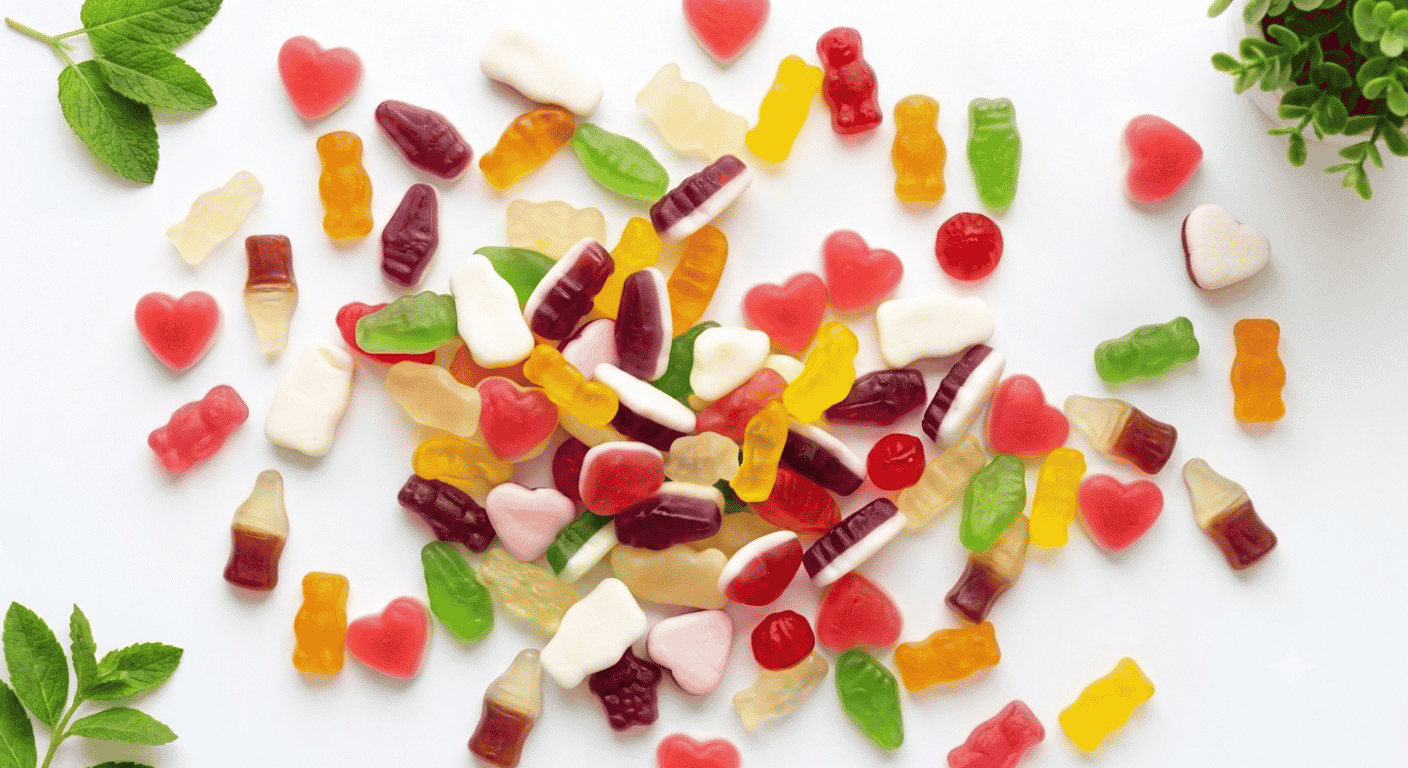
Softer sweets are not risk-free either. Large gummy sweets, marshmallows and chewy cubes can block an airway if swallowed whole, and they are harder to dislodge than a hard sweet because they deform. Cutting them lengthways, or choosing smaller pieces, removes most of the risk.
This is the part most people have backwards. For dental health, how often sugar reaches the teeth matters more than how much arrives in total. Every exposure starts an acid attack lasting roughly twenty minutes to an hour, and it is the number of attacks across a day that drives decay, not the size of any one of them.
A whole bag eaten at the end of a meal is better for teeth than the same bag eaten one sweet at a time across an afternoon. That is why dental guidance points to keeping sweets to mealtimes rather than to reducing the amount alone.
Dissolve time compounds it. A lolly or a boiled sweet keeps sugar against the enamel for many minutes; a chew is gone in under one. Two products with identical sugar figures are not equivalent in this respect.
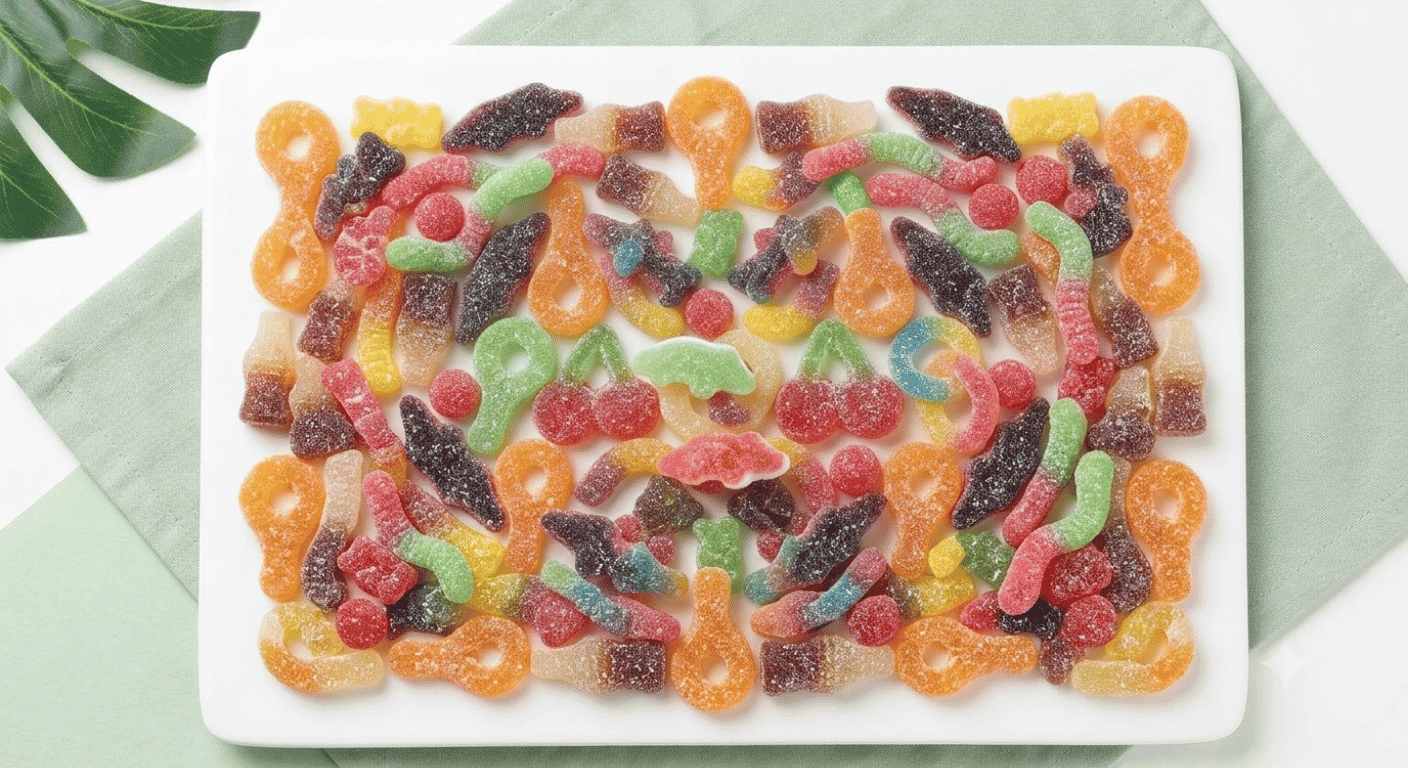
Sour and fizzy coatings add a separate mechanism. The citric or malic acid that produces the sourness erodes enamel directly, without any bacteria involved, and it does so even in sugar-free sour sweets.
Between sweet types the sugar concentration varies less than you would expect. Gums, pastilles, jellies and tablet sweets are all essentially sugar and glucose syrup; the firmness that separates them comes from the gelling agent and moisture content, not from a different amount of sugar.
The real variable is fat. Chews and caramels contain fat in the base, which is what produces the texture, and that pushes their calorie figure per gram well above a gum carrying the same sugar. Boiled sweets, tablet sweets and most gums contain effectively none, so their calorie figure tracks their sugar figure almost exactly.
Piece size does the rest. Sweets designed to be eaten by the handful carry a small figure each and a large one per realistic portion, which is why a per-sweet number is only useful alongside an honest count.
Fruit names on sweet packaging describe flavouring. Where fruit juice from concentrate appears in the ingredient list it still counts as free sugar under NHS guidelines, because concentrating juice releases the sugars from the cell structure that would otherwise slow their absorption. There is no fibre and no meaningful vitamin content in any sweet in this category, whatever the front of the packet says.
Sugar-free versions genuinely do carry no free sugar, but the sugar alcohols used in them, usually sorbitol or maltitol, have a laxative effect in quantity and children reach that threshold at smaller amounts than adults. Xylitol is the exception worth knowing about: it is actively protective against decay rather than merely neutral.
Each page includes a full nutrition breakdown per sweet and per bag, portion comparisons at 5, 10 and 20 sweets and full bag, free sugar and salt checked against daily reference intakes for your child's age, and a complete ingredient and allergen guide.