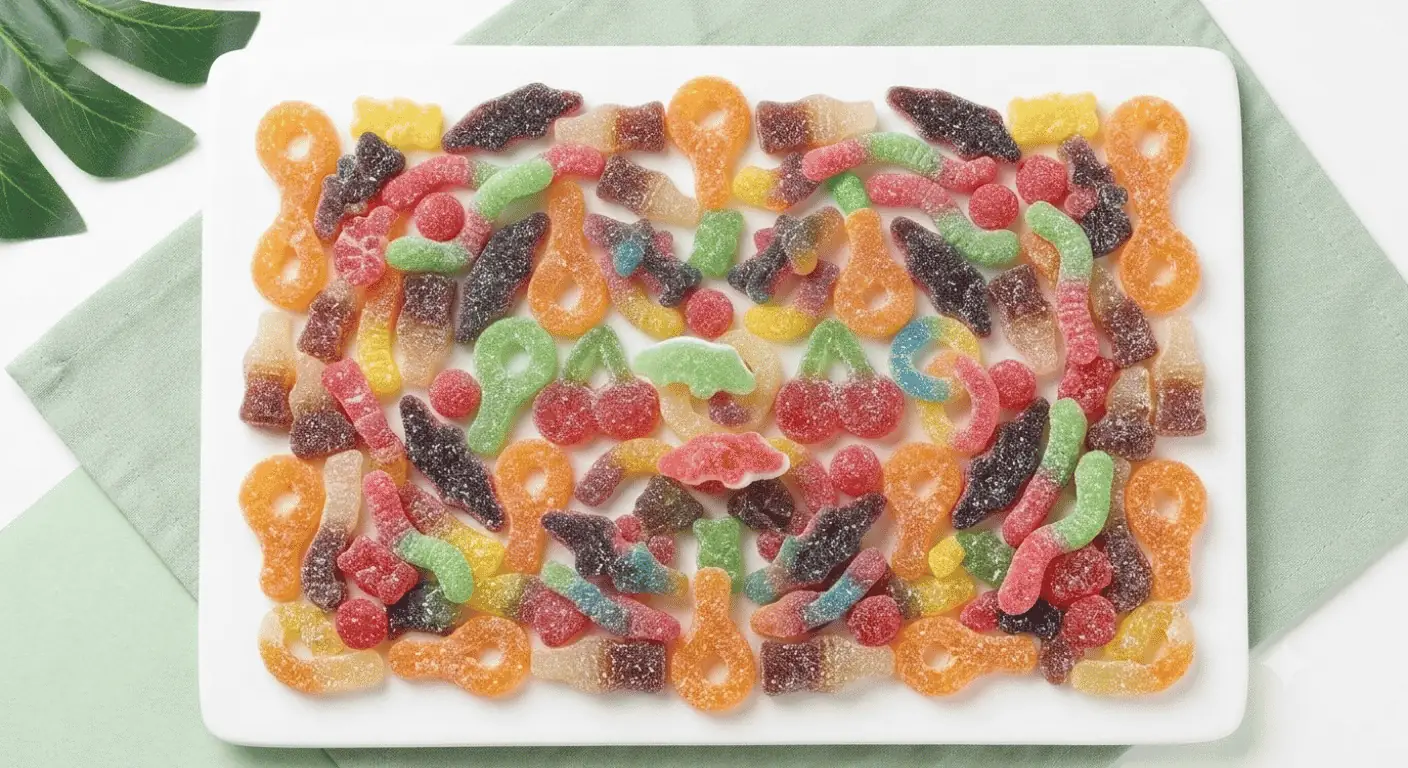
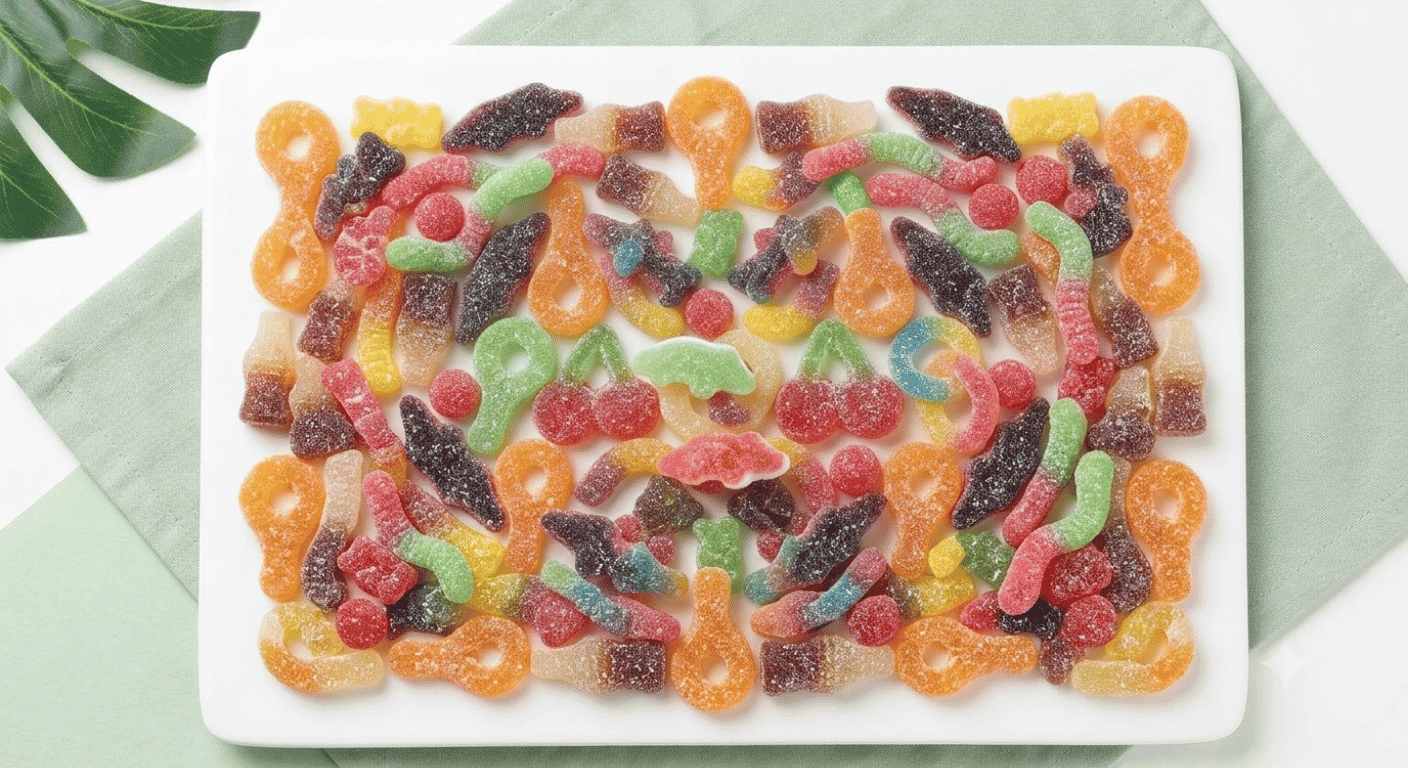
Illustrative image created by Boone, not a photograph of the product.
Haribo Tangfastics. What is actually in five sweets, ten, or the whole bag
All sugar in Haribo Tangfastics is free sugar. Here is what the full picture looks like once you account for both the gummy base and the acid-sugar coating.
Haribo Tangfastics have a slightly higher sugar content per sweet than standard Starmix — 1.4g versus 1.1g — because of the sour coating. The coating is amixture of citric acid and sugar, and all of it counts as free sugar under NHS guidelines.
A standard 160g bag contains approximately 67 sweets and around 93.8g of free sugar. That is more than three times the NHS daily limit for a child aged 7 to 10.
Try it: adjust the number of sweets
Use the calculator below to see how any quantity of these sweets compares to NHS daily limits for your child's age and gender.
Sweets calculator
How much sugar is in those sweets?
Choose brand, sweet type and how many — then see the total against NHS daily limits.
5
Your selection—
Free sugar
—
—
0—
—
Calories
—
—
0—
—
Salt
—
—
0—
—
Four portion sizes
The figures below show total sugar, calories and salt for four realistic amounts.
Small portion
5 sweets
5 sweets (12g)
7g
sugar
40
kcal
0g
salt
7g free sugar — 37% of the daily limit for a 7-year-old; 37% for a 4-year-old
Standard portion
10 sweets
10 sweets (24g)
14g
sugar
80
kcal
0g
salt
14g free sugar — 58% of the daily limit for a 7-year-old; 74% for a 4-year-old
Larger portion
20 sweets
20 sweets (48g)
28g
sugar
160
kcal
0g
salt
28g free sugar — exceeds the daily limit for children aged 4 to 10; 93% of the limit for ages 11 and over
Full bag
~67 sweets
~67 sweets (160g)
93.8g
sugar
536
kcal
0g
salt
93.8g free sugar — exceeds the daily limit for every age group. More than three times the daily limit for children aged 7 to 10.
Sugar
The NHS sets daily limits for free sugars - sugars added to food or drink, plus sugars naturally present in honey, syrups and fruit juice. All sugar in these sweets counts as free sugar.
The sour coating adds to the free sugar total
The citric acid and sugar coating on Tangfastics is what creates the initial sour hit before the sweetness follows. Both the coating and the gummy base are almost entirely sugar. There is no fibre in either component. Every gram counts as free sugar.
NHS recommended daily free sugar limits
Age 4 to 6No more than 19g per day
Age 7 to 10No more than 24g per day
Age 11 and overNo more than 30g per day
Source: NHS. Free sugars include all added sugars and do not include sugars naturally present in whole fruit, vegetables, or milk.
The table below shows 10 sweets as a percentage of the daily free sugar limit for each age group.
Free sugar as % of daily NHS limit — 10 Haribo Tangfastics (14g sugar)
Age
Daily limit
10 sweets
Age 4 to 6
19g
74%
Age 7 to 10
24g
58%
Age 11 and over
30g
47%
Adult
30g
47%
Source: NHS/SACN free sugar guidelines (2015).
Salt
Salt content per sweet is negligible - less than 0.01g. Salt is not a primary nutritional concern with this product. The primary concern is free sugar content.
NHS recommended daily maximum salt intake
Age 4 to 6No more than 3g per day
Age 7 to 10No more than 5g per day
Age 11 and overNo more than 6g per day
Calories
Each sweet contains approximately 8 calories. The calorie count per sweet is modest, but accumulates quickly when eaten from an open bag.
Protein
Haribo Tangfastics contain approximately 5g of protein per 100g, derived entirely from gelatine. A 10-sweet (24g) portion provides around 1.2g of protein, a negligible contribution to daily needs.
For context, the NHS recommends around 24g of protein per day for a child aged 7 to 10. A portion of ten Tangfastics provides approximately 5% of that. The protein in Tangfastics comes from gelatine, an animal-derived ingredient, which also means the product is not suitable for vegetarians or vegans.
The protein in Tangfastics comes from gelatine, not a nutritious source
Unlike protein from meat, eggs, dairy or legumes, gelatine is an incomplete protein — it lacks several essential amino acids the body needs. The 1.2g of protein in ten Tangfastics provides no meaningful nutritional benefit and should not be counted as a protein source in a child's diet.
Protein: Haribo Tangfastics by portion size
5 sweets (12g)0.6g protein
10 sweets (24g)1.2g protein
20 sweets (48g)2.4g protein
Full 160g bag8g protein
Source: UK product label. Protein is derived entirely from gelatine and is an incomplete protein source.
Fibre
Haribo Tangfastics contain 0g of dietary fibre. There is no fibre in any component of the product, neither the gummy base nor the sour coating.
This is nutritionally significant. Fibre slows the absorption of sugar into the bloodstream. In whole fruit, natural sugars are surrounded by fibre within the cell walls, which moderates the rate at which sugar enters the blood. In Haribo Tangfastics, there is no fibre whatsoever — sugar enters the bloodstream rapidly with nothing to slow it down.
No fibre means sugar is absorbed immediately
The NHS recommends children aged 2 to 5 consume at least 15g of fibre per day, rising to 20g for ages 5 to 11 and 25g for ages 11 to 16. Haribo Tangfastics contribute nothing toward this target. The complete absence of fibre is one reason why gummy sweets have a different effect on blood sugar compared to whole fruit, even when the total sugar content appears similar.
NHS recommended daily fibre intake
Age 2 to 5At least 15g per day
Age 5 to 11At least 20g per day
Age 11 to 16At least 25g per day
Haribo Tangfastics (any portion)0g — no contribution
Source: British Nutrition Foundation. Fibre recommendations are for total dietary fibre intake across the day.
Fat
Haribo Tangfastics contain negligible fat, less than 0.1g per 100g. A full 160g bag contains less than 0.2g of fat. Fat is not a nutritional concern with this product.
Unlike chocolate or crisps, gummy sweets contain almost no fat. The product is made from glucose syrup, sugar and gelatine, none of which contribute meaningful fat content. This also means Tangfastics are lower in calories per gram than chocolate, but the near-total absence of fat alongside high sugar content means they have a different nutritional profile rather than a better one.
Fat: Haribo Tangfastics by portion size
5 sweets (12g)Less than 0.1g fat
10 sweets (24g)Less than 0.1g fat
20 sweets (48g)Less than 0.1g fat
Full 160g bagLess than 0.2g fat
Source: UK product label. Saturated fat content is also negligible at less than 0.1g per 100g.
Vitamins and minerals
Haribo Tangfastics contain no vitamins and no minerals of note. The product is not fortified. There is no vitamin C, no iron, no calcium, no vitamin D, none of the micronutrients a child needs for healthy development.
This contrasts with fortified breakfast cereals, which are required by UK law to add back vitamins and minerals lost during processing. Gummy sweets have no equivalent requirement and no mechanism through which micronutrients would naturally be present.
Tangfastics provide calories and sugar — nothing else
Unlike fruit, which provides vitamin C, potassium and fibre alongside its natural sugar, Haribo Tangfastics provide only calories and free sugar. The product delivers no vitamins, no minerals, no fibre and no meaningful protein. In nutritional terms, the calories in Tangfastics are often described as empty calories — energy with no accompanying nutritional benefit.
Micronutrient content: Haribo Tangfastics per 100g
Vitamin C0mg — none
Vitamin D0µg — none
Iron0mg — none
Calcium0mg — none
PotassiumNegligible
Fibre0g — none
Source: UK product label and manufacturer nutrition declaration. Haribo Tangfastics are not fortified with any vitamins or minerals.
Full nutrition per 100g
The table below shows the complete nutritional profile of Haribo Tangfastics per 100g for reference.
Haribo Tangfastics — full nutrition per 100g
Energy335 kcal
FatLess than 0.1g
of which saturatesLess than 0.1g
Carbohydrate77g
of which sugars58g (all free sugar)
Fibre0g
Protein5g (from gelatine)
SaltLess than 0.1g
Source: UK product label. All sugar counts as free sugar under NHS guidelines. Figures may vary slightly between product batches.
Haribo Tangfastics - Fequently Asked Questions
How much sugar is in Haribo Tangfastics?+
Each Haribo Tangfastic sweet weighs approximately 2.4g and contains 1.4g of free sugar. Ten sweets contain 14g of free sugar — 74% of the daily limit for a child aged 4 to 6 and 58% for a child aged 7 to 10. A full 160g bag contains approximately 67 sweets and 93.8g of free sugar, more than three times the daily limit for a child aged 7 to 10.
Haribo Tangfastics nutrition: what are the key figures?+
Per sweet: 1.4g free sugar, 8 kcal, less than 0.01g salt, 2.4g weight. Per 5 sweets: 7g free sugar, 40 kcal. Per 10 sweets: 14g free sugar, 80 kcal. Per 20 sweets: 28g free sugar, 160 kcal. Per full 160g bag: 93.8g free sugar, 536 kcal. All sugar counts as free sugar under NHS guidelines.
Why do Tangfastics have more sugar than Starmix?+
The sour coating on Haribo Tangfastics is a mixture of citric acid and sugar. Both the coating and the gummy base contain sugar that counts as free sugar under NHS guidelines. Tangfastics contain 1.4g of free sugar per sweet compared to 1.1g in Starmix — a difference of 0.3g per sweet that comes entirely from the sour coating. Across a full 160g bag, Tangfastics deliver 93.8g of free sugar versus 73.7g in Starmix.
Are Tangfastics worse than Starmix for children?+
Marginally. Tangfastics contain 1.4g of free sugar per sweet versus 1.1g in Starmix. Ten Tangfastics deliver 14g of free sugar compared to 11g from ten Starmix. Both products are high in free sugar and all of it counts toward NHS daily limits. The primary issue with both is portion size rather than the difference between the two products — a child eating 20 of either will exceed the daily limit for children aged 4 to 10.
What makes Tangfastics sour?+
The sour sensation in Haribo Tangfastics comes from a coating of citric acid and sugar on the outside of each sweet. When the coating hits the tongue, the citric acid creates a sharp acidic reaction before the sweetness of the gummy underneath follows. The coating adds approximately 0.3g of extra free sugar per sweet compared to standard non-sour Haribo products like Starmix.
What is the daily sugar limit for children?+
The NHS recommends no more than 19g of free sugar per day for children aged 4 to 6, 24g for children aged 7 to 10, and 30g for anyone aged 11 and over. These limits apply only to free sugars and do not include sugars naturally present in whole fruit, vegetables or milk. Every gram of sugar in Haribo Tangfastics counts as free sugar.
How many Tangfastics can a child eat within the daily sugar limit?+
A child aged 4 to 6 with a daily free sugar limit of 19g would reach their entire daily limit at approximately 14 sweets. A child aged 7 to 10 with a limit of 24g would reach their limit at approximately 17 sweets. These figures assume no other free sugar has been consumed during the day, which is rarely the case as children typically consume free sugar from cereals, drinks and other snacks throughout the day.
How many calories are in Haribo Tangfastics?+
Each Haribo Tangfastic sweet contains approximately 8 calories. Five sweets contain 40 calories, ten sweets contain 80 calories, twenty sweets contain 160 calories and a full 160g bag contains approximately 536 calories. For a child aged 4 to 6 with a daily energy need of around 1,400 calories, a full bag represents 38% of their daily requirement.
Does Haribo Tangfastics contain salt?+
Salt content in Haribo Tangfastics is negligible — less than 0.01g per sweet. A full 160g bag contains a trivial amount of salt, well within NHS daily limits for all age groups. The NHS recommends a maximum of 3g per day for children aged 4 to 6 and 5g for ages 7 to 10. Salt is not a nutritional concern with this product. Free sugar is the primary consideration.
What are the ingredients in Haribo Tangfastics?+
The main ingredients in Haribo Tangfastics are glucose syrup, sugar, gelatine, dextrose, citric acid and fruit and plant concentrates for colouring and flavouring. The glucose syrup and sugar form the gummy base, while the citric acid and sugar create the sour coating. Both components contribute free sugar. Gelatine means the product is not suitable for vegetarians or vegans.
Is Haribo Tangfastics suitable for vegetarians or vegans?+
No. Haribo Tangfastics contain gelatine, which is derived from animal collagen. The product is not suitable for vegetarians or vegans. Haribo produces some vegetarian-friendly sweets under separate product lines, but standard Tangfastics are not among them. Always check the current packaging for the most up-to-date ingredient information.
How much sugar is in a full 160g bag of Haribo Tangfastics?+
A full 160g bag of Haribo Tangfastics contains approximately 93.8g of free sugar across around 67 sweets. This is more than three times the daily free sugar limit for a child aged 7 to 10 (24g), more than four times the limit for a child aged 4 to 6 (19g), and more than three times the adult daily limit of 30g, all in a single bag.
How does Haribo Tangfastics compare to Haribo Fizzy Cola Bottles for sugar?+
Haribo Tangfastics and Haribo Fizzy Cola Bottles have identical sugar content — both contain 1.4g of free sugar per sweet and 93.8g per full 160g bag. Both products have a citric acid and sugar sour coating that raises their sugar content above standard non-sour Haribo lines like Starmix. The nutritional difference between the two is negligible.
Does Haribo Tangfastics contain allergens?+
Haribo Tangfastics contain gelatine derived from pork. The product does not contain the 14 major allergens listed under UK food law — no gluten, nuts, dairy, eggs or soya — but it is produced in facilities that may handle these ingredients. Always check the current packaging for the most up-to-date allergen information as formulations can change.
What does free sugar mean on food labels?+
Free sugars are all sugars added to food or drink during manufacturing, cooking or at the table, plus sugars naturally present in honey, syrups, fruit juice and smoothies. They do not include sugars naturally present in whole fruit, vegetables or milk. UK food labels show total sugar rather than free sugar, making it difficult to apply NHS daily limits directly from the packet. For Haribo Tangfastics, total sugar and free sugar are effectively the same figure as the product contains no whole fruit or milk.
Track your family's nutrition in real time
See exactly what your family is eating — in real time.
The Boone app breaks down any meal into its full macro and micro nutrition and lets you add family members so you can see the difference between what you are eating and what your children are eating.
Download the Boone app and start tracking your family's nutrition today.
Nutrition data from UK product labels. Daily limits: NHS/SACN free sugar guidelines (2015); SACN Dietary Reference Values for calories; NHS salt targets by age. For guidance only - not medical advice.
How this page is made
The nutrition figures for Haribo Tangfastics come from the information published by the brand or retailer. Where a company does not publish full nutrition information, we estimate the missing values from comparable products and say so on the page. Daily shares are measured against NHS and SACN guidance for each age group.
The text on this page was written with AI assistance from this data and checked against it. The image is an illustration created for this page, not a photograph of the product.