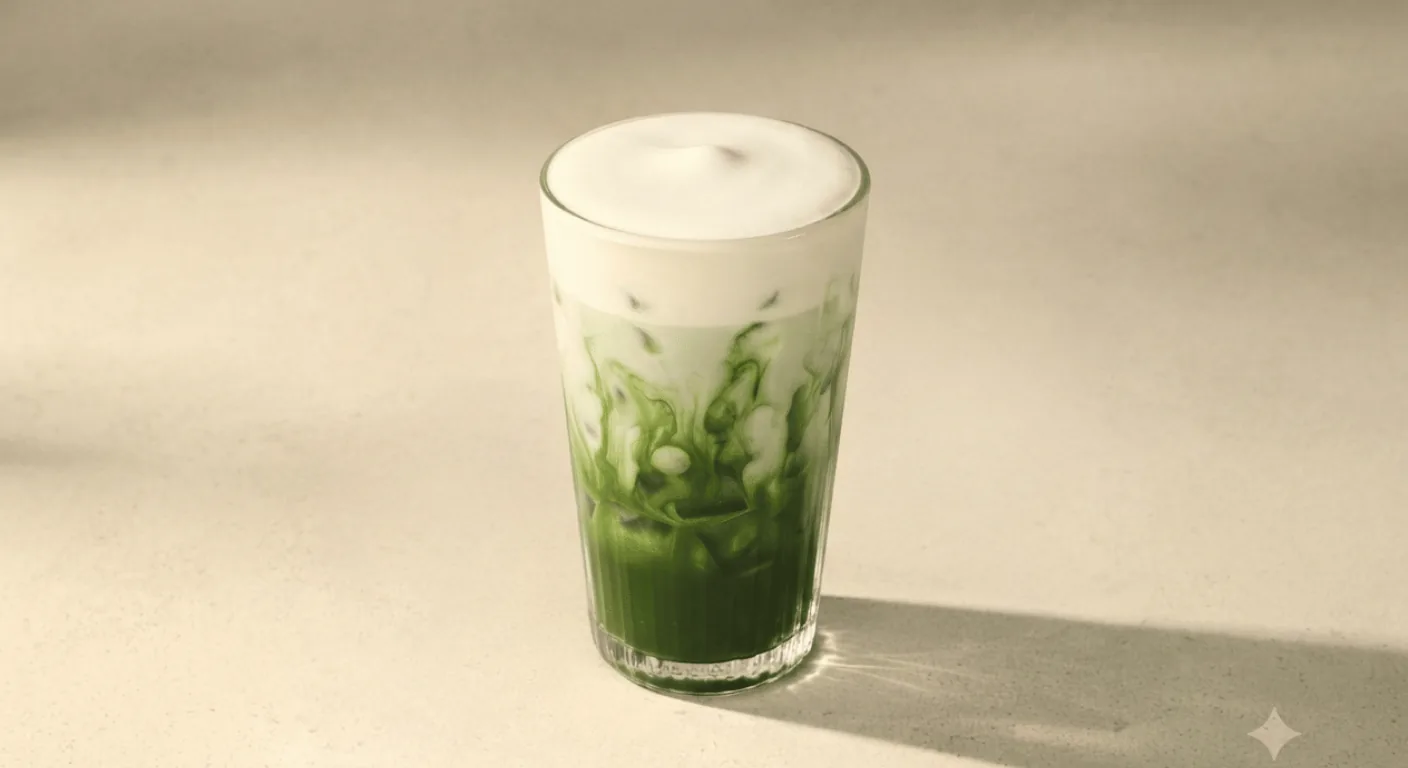
A Grande Iced Vanilla Protein Matcha Latte made with semi-skimmed milk contains 160 kcal, 9g of sugar (0.0 teaspoons) and 70.7mg of caffeine. It is classified as NOVA 4 under the NOVA food processing classification system.
Size: Grande | Milk: Semi-Skimmed Milk | Allergens: Milk
Nutrition by serving: calories, sugar and caffeine
Starbucks Iced Vanilla Protein Matcha Latte (Grande) contains 160 kcal, 2.9g of fat (1.6g saturated), 11.9g of carbohydrate (9g sugar), 21.1g of protein, 0.5g of salt and 70.7mg of caffeine.
Nutrition by serving: Starbucks Iced Vanilla Protein Matcha Latte (Grande)
| Serving | Calories | Salt | Sugar | = teaspoons | Carbs | Protein | Caffeine |
|---|
| Per serving | 160 kcal | 0.5g | 9g | 0.0 tsp | 11.9g | 21.1g | 70.7mg |
Sugar in Starbucks Iced Vanilla Protein Matcha Latte (Grande)
Starbucks Iced Vanilla Protein Matcha Latte (Grande) contains 0g of free sugar per serving. Low free sugar
The NHS free sugar limit is 30g a day for adults, 24g for children aged 7 to 10 and 19g for children aged 4 to 6. Sugars naturally present in milk are excluded.
Free sugar by serving: Starbucks Iced Vanilla Protein Matcha Latte (Grande)
| Serving | Adult (female) 30g | Adult (male) 30g | Age 11 to 17 30g | Age 7 to 10 24g | Age 4 to 6 19g |
|---|
| Per serving | 0g 0% | 0g 0% | 0g 0% | 0g 0% | 0g 0% |
Boone calculates these percentages from Starbucks UK published nutrition data against UK Dietary Reference Values and NHS free sugar and salt limits. Free sugar, salt, calories and saturated fat are limits to stay under; fibre is a target to reach. For guidance only.
Calories in Starbucks Iced Vanilla Protein Matcha Latte (Grande)
Starbucks Iced Vanilla Protein Matcha Latte (Grande) contains 160 kcal of calories per serving. Low calories
Daily calorie needs vary by age and sex.
Calories by serving: Starbucks Iced Vanilla Protein Matcha Latte (Grande)
| Serving | Adult (female) 2000 kcal | Adult (male) 2500 kcal | Age 11 to 17 1936 kcal | Age 7 to 10 1553 kcal | Age 4 to 6 1291 kcal |
|---|
| Per serving | 160 kcal 8% | 160 kcal 6% | 160 kcal 8% | 160 kcal 10% | 160 kcal 12% |
Boone calculates these percentages from Starbucks UK published nutrition data against UK Dietary Reference Values and NHS free sugar and salt limits. Free sugar, salt, calories and saturated fat are limits to stay under; fibre is a target to reach. For guidance only.
Saturated fat in Starbucks Iced Vanilla Protein Matcha Latte (Grande)
Starbucks Iced Vanilla Protein Matcha Latte (Grande) contains 1.6g of saturated fat per serving. Low saturated fat
The saturated fat guideline is 20g a day for women and 30g for men, and lower again for children.
Saturated fat by serving: Starbucks Iced Vanilla Protein Matcha Latte (Grande)
| Serving | Adult (female) 20g | Adult (male) 30g | Age 11 to 17 20g | Age 7 to 10 18g | Age 4 to 6 16g |
|---|
| Per serving | 1.6g 8% | 1.6g 5% | 1.6g 8% | 1.6g 9% | 1.6g 10% |
Boone calculates these percentages from Starbucks UK published nutrition data against UK Dietary Reference Values and NHS free sugar and salt limits. Free sugar, salt, calories and saturated fat are limits to stay under; fibre is a target to reach. For guidance only.
Salt in Starbucks Iced Vanilla Protein Matcha Latte (Grande)
Starbucks Iced Vanilla Protein Matcha Latte (Grande) contains 0.5g of salt per serving. Low salt
Children have lower salt limits: 3g a day for ages 4 to 6 and 5g for ages 7 to 10.
Salt by serving: Starbucks Iced Vanilla Protein Matcha Latte (Grande)
| Serving | Adult (female) 6g | Adult (male) 6g | Age 11 to 17 6g | Age 7 to 10 5g | Age 4 to 6 3g |
|---|
| Per serving | 0.5g 8% | 0.5g 8% | 0.5g 8% | 0.5g 10% | 0.5g 17% |
Boone calculates these percentages from Starbucks UK published nutrition data against UK Dietary Reference Values and NHS free sugar and salt limits. Free sugar, salt, calories and saturated fat are limits to stay under; fibre is a target to reach. For guidance only.
Fibre in Starbucks Iced Vanilla Protein Matcha Latte (Grande)
Starbucks Iced Vanilla Protein Matcha Latte (Grande) contains 0g of fibre per serving. Low fibre
Fibre is a target to reach rather than a limit to stay under.
Fibre by serving: Starbucks Iced Vanilla Protein Matcha Latte (Grande)
| Serving | Adult (female) 30g | Adult (male) 30g | Age 11 to 17 25g | Age 7 to 10 20g | Age 4 to 6 15g |
|---|
| Per serving | 0g 0% | 0g 0% | 0g 0% | 0g 0% | 0g 0% |
Boone calculates these percentages from Starbucks UK published nutrition data against UK Dietary Reference Values and NHS free sugar and salt limits. Free sugar, salt, calories and saturated fat are limits to stay under; fibre is a target to reach. For guidance only.
Free sugar vs total sugar
Where the sugar comes from: Starbucks Iced Vanilla Protein Matcha Latte (Grande)
| Serving | Total sugar | Free (added) sugar | Naturally occurring | Free sugar in teaspoons |
|---|
| Per serving | 9g | 0g | 9g | 0.0 tsp |
Made with semi-skimmed milk, about 9g of the sugar in this drink is lactose, which occurs naturally in milk and does not count towards NHS free sugar limits. Effectively none of the sugar in this drink is free sugar.
Boone derives the lactose figure from the milk protein in each build, at 1.3g of lactose per gram of milk protein, a ratio taken from Starbucks' own unsweetened milk drinks where all of the sugar is lactose.
NHS daily free sugar limits: 30g for adults and children 11+, 24g age 7 to 10, 19g age 4 to 6.
Ultra-processed food: what is really in it
Processing and additives: Starbucks Iced Vanilla Protein Matcha Latte (Grande)
Starbucks Iced Vanilla Protein Matcha Latte (Grande) is assembled from 5 separately manufactured components. Reading the ingredient list closely, it contains stabilisers, acidity regulators, preservatives and sweeteners. These are not there to add nutritional value. They make industrial production and distribution possible.
Stabilisers
Stop the mixture separating or settling over its shelf life.
Acidity regulators
Hold the ph steady so flavour and shelf life stay consistent.
Preservatives
Slow the growth of moulds and yeasts so the product keeps longer.
Sweeteners
Provide sweetness in place of sugar, with little or no energy.
Boone classifies Starbucks Iced Vanilla Protein Matcha Latte (Grande) as NOVA group 4, ultra-processed, based on the ingredients named above. NOVA groups foods by how far they are from their whole-food form, not by how nutritious they are. A group 4 food is not automatically unhealthy, and a group 1 food is not automatically healthy. Read from the published ingredient list, Retrieved 28 August 2026.
A Starbucks Iced Vanilla Protein Matcha Latte (Grande) contains at least 13 distinct ingredients: 5 raw and 8 manufactured.
Ingredient count by order: Starbucks Iced Vanilla Protein Matcha Latte (Grande)
| What you order | Raw | Manufactured | Total | % manufactured |
|---|
| Starbucks Iced Vanilla Protein Matcha Latte (Grande) on its own | 5 | 8 | 13 | 62% |
The 8 manufactured ingredients
acesulfame k, citric acid, natural flavourings, potassium sorbate, skimmed milk powder, sucralose, whey protein concentrate, xanthan gum.
The 5 raw ingredients
ice, powdered green tea, semi-skimmed milk [semi-skimmed milk, skimmed milk, water.
What those ingredients are, by type
Milk solids and proteins2
Sweeteners2
Emulsifiers and stabilisers1
Flavourings1
Acids and acidity regulators1
Preservatives and antioxidants1
Boone counts every distinct named ingredient on the Starbucks published component lists, including sub-ingredients, and removes duplicates, so milk appearing in three components counts once. Additive class names are dropped and the named substance kept, so "stabiliser: guar gum" counts guar gum once. Raw covers whole foods and basic kitchen staples such as water, coffee, milk, sugar and salt. Manufactured covers substances that only exist as an output of industrial processing. Figures are for the standard build; syrups, cold foams, whipped cream and drizzles added to order are not included. Retrieved 28 August 2026.
Allergens at a glance
Starbucks Iced Vanilla Protein Matcha Latte (Grande) contains milk as a declared ingredient.
Allergen information: Starbucks Iced Vanilla Protein Matcha Latte (Grande)
| Allergen | Status |
|---|
| Wheat | Not present |
| Rye | Not present |
| Barley | Not present |
| Oats | Not present |
| Spelt | Not present |
| Tree nuts | Not present |
| Peanuts | Not present |
| Sesame | Not present |
| Soya | Not present |
| Milk | Contains |
| Eggs | Not present |
| Fish | Not present |
| Crustaceans | Not present |
| Molluscs | Not present |
| Celery | Not present |
| Mustard | Not present |
| Lupin | Not present |
| Sulphur dioxide and sulphites | Not present |
Contains = declared as an ingredient in the Starbucks UK Nutrition and Allergen Guide. Starbucks prepares drinks and food in stores where all 14 major allergens are present and equipment, jugs and steam wands are shared, so no item can be guaranteed allergen free, even when ingredients are left out on request. Ask a barista before ordering if you have an allergy. Retrieved 28 August 2026.