McDonald's Mayo Chicken Happy Meal. What it actually contains for a child
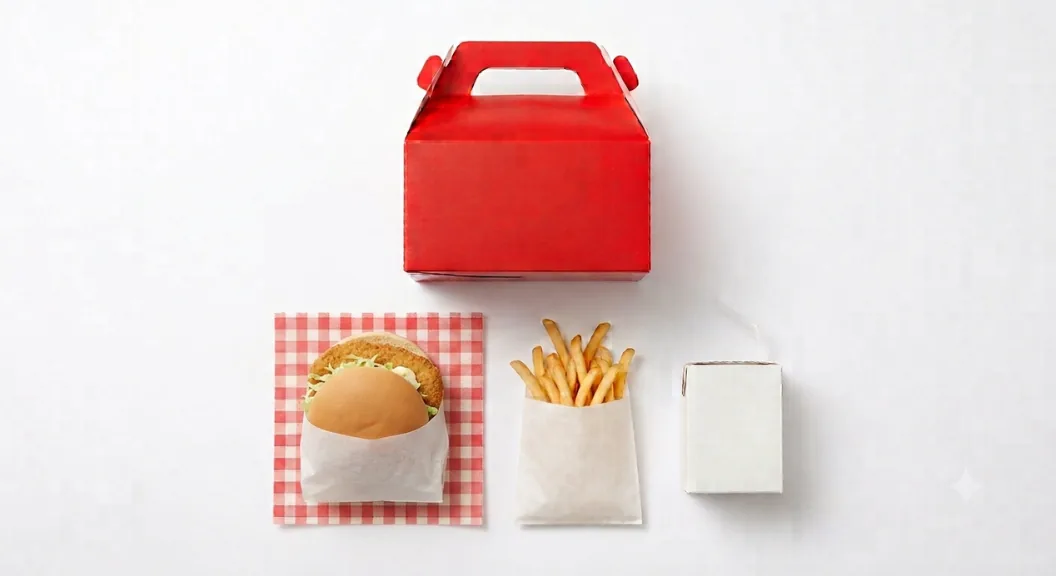
Boone’s analysis puts McDonald's Mayo Chicken Happy Meal at 21% of an adult’s daily calories, 40% of the daily salt limit for a child aged 4 to 6 and 4.3 teaspoons of sugar.
McDonald's publishes nutrition data for the best-case build. Here is what the meal most children actually eat looks like.
Most parents ordering a Happy Meal are making three nutrition decisions without knowing it. The drink. The side. Whether ketchup comes with it. Each one shifts the nutritional outcome significantly. Together, they determine whether your child is eating a reasonable meal or one that blows past their daily sugar limit before they leave the restaurant.
The worst-case Mayo Chicken Happy Meal delivers 322% of a one-year-old's entire daily sugar limit in a single sitting. That number does not come from the burger. It comes from the drink.
Sugar is only part of the story. The typical build with fries and ketchup pushes salt above the daily maximum for children under four. The worst-case build approaches a full day's calories for a one-year-old. In each case, the difference between the best and worst build comes down to choices most parents make without the numbers in front of them.
McDonald's publishes nutrition figures for the default build: mayo chicken burger, cucumber sticks, water, and an organic milk bottle. That combination is carefully optimised to show the best possible numbers. Most children do not eat the default.
This article breaks down every component individually, shows what each combination adds up to, and converts the figures against NHS recommended daily limits for each age group, including adults.
All nutritional data is taken directly from the McDonald's UK nutrition calculator.
The choices that matter most
Before the data. Two choices determine the nutritional outcome of this meal more than anything else.
Drink
Choose water or Fruit Shoot
The difference between water and Tropicana is 22g of free sugar. This is the single biggest lever in the entire meal.
Side
Cucumber sticks or apple slices
The side swap is a calorie and salt issue rather than a sugar one. Fries add 225 calories and 0.44g of salt. Ketchup adds a further 4.7g of free sugar and 0.48g of salt.
The three meal builds
The Mayo Chicken Happy Meal is not one meal. It is a set of choices that produces very different nutritional outcomes. Here are three realistic builds.
The default meal is what McDonald's uses for its published nutrition figures: burger, cucumber sticks, milk. The typical meal is what many children actually eat: burger, fries with ketchup, Fruit Shoot. The worst case is the highest sugar combination available: burger, fries with ketchup, Tropicana.
✅
Default
The optimised meal
Mayo Chicken burger + cucumber sticks + milk
Calories419kcal
Free sugar~5.1g
Salt1.21g
⚠️
Typical
Fries and Fruit Shoot
Mayo Chicken burger + fries + ketchup + Fruit Shoot
Calories554kcal
Free sugar~11.8g
Salt1.90g
🔴
Worst case
Fries and Tropicana
Mayo Chicken burger + fries + ketchup + Tropicana
Calories646kcal
Free sugar~32.2g
Salt1.84g
Nutrition information
Nutrition information: McDonald's Mayo Chicken Happy Meal
| Energy | 419 kcal |
| Fat | 14.4g |
| of which saturates | 3.8g |
| Carbohydrate | 49g |
| of which sugars | 18.1g |
| Fibre | 2.7g |
| Salt | 1.21g |
| Protein | 21.8g |
Nutrition figures are McDonald’s UK published data, per item as sold and before any optional sauces or extras. Boone converts them to the portion and age comparisons on this page.
A McDonald's Mayo Chicken Happy Meal contains 419 kcal, which is 21% of the 2,000 kcal adult daily reference intake. It provides 14.4g of total fat, of which 3.8g is saturated, 18.1g of sugar, 1.21g of salt, 21.8g of protein and 2.7g of fibre.
The saturated fat content of 3.8g represents 19% of the adult daily guideline of 20g.
The 18.1g of sugar shown above is the total McDonald’s publishes. Around 5.1g of that counts as free sugar; the rest is naturally present and does not count towards daily limits.
McDonald's Mayo Chicken Happy Meal is assembled from 6 separately manufactured components, combined at the point of sale. The chicken patty alone carries 4 different classes of additive. Across the whole item the ingredient list names dextrose, emulsifiers, flavourings, glucose or glucose-fructose syrup, maltodextrin, modified starches, preservatives, raising agents, stabilisers and thickeners. None of these add nutritional value. They exist to make the item survive industrial production, freezing and transport.
McDonald's Mayo Chicken Happy Meal carries a large share of a child’s daily salt
A McDonald's Mayo Chicken Happy Meal contains 1.21g of salt, which is 40% of the daily limit for a child aged 4 to 6.
Adult daily reference intakes (Reference Intake, RI)
Calories2,000 kcal
Total fat70g
Saturated fat20g
Carbohydrate260g
Sugars90g
Fibre30g
Salt6g
Protein50g
Sugar
The NHS sets daily limits for free sugars — sugars added to food or drink, plus sugars naturally present in honey, syrups, and fruit juice. Sugars naturally present in whole fruit, vegetables, and milk do not count.
The total sugar figure McDonald's publishes for the default meal looks alarming. It is not the whole story. The milk bottle accounts for 12g — all lactose, none of which counts as free sugar. The default meal contains approximately 5.1g of free sugar. The same meal with Tropicana contains around 27.1g.
NHS recommended daily free sugar limits
Under 1No added sugar at all
Age 1No more than 10g per day
Age 2 to 3No more than 14g per day
Age 4 to 6No more than 19g per day
Age 7 to 10No more than 24g per day
Age 11 and overNo more than 30g per day
Source: NHS. Free sugars include added sugars and sugars in honey, syrups, and fruit juice. They do not include sugars naturally present in whole fruit, vegetables, or milk.
Total sugar vs free sugar — why it matters
The NHS daily sugar limits for children apply to free sugars — not total sugar. Sugars naturally present in milk, whole fruit, and vegetables do not count. Sugars in fruit juice count in full, even though they are natural. This means the default Happy Meal with water contains around 5.1g of free sugar. The same meal with Tropicana instead of water contains around 27.1g of free sugar. One choice. One number that changes everything.
The single most consequential choice in a Happy Meal order is the drink. The difference between choosing water and choosing Tropicana orange juice is 22g of free sugar.
Better choice
Fruit Shoot (no added sugar)
1.6g
total sugar per bottle
Worth knowing
Tropicana orange juice 250ml
22g
free sugar per bottle — all counts toward daily limit
Itis worth being clear about why fruit juice counts as free sugar when whole fruit does not. When fruit is juiced, the cellular structure is broken down and the sugars are released. The NHS classifies all fruit juice sugars as free sugars on this basis. A glass of orange juice and a can of fizzy drink are treated as equivalent from a free sugar perspective.
Free sugar as a percentage of daily NHS limit — by age
| Age | Daily limit | Default | Typical | Worst case |
|---|
| Age 1 | 10g | 51% | 118% | 322% |
| Age 2 to 3 | 14g | 32% | 84% | 230% |
| Age 4 to 6 | 19g | 27% | 62% | 169% |
| Age 7 to 10 | 24g | 21% | 49% | 134% |
| Age 11 and over | 30g | 17% | 31% | 107% |
| Adult | 30g | 17% | 32% | 107% |
Figures above 100% mean the meal exceeds the child's entire recommended daily free sugar allowance in a single sitting. Source: NHS, McDonald's UK nutrition calculator.
Salt
Unlike sugar, the salt story in this meal is driven by the side choice rather than the drink choice. Tropicana contains no salt. The drinks make almost no difference to the salt total. What matters is whether a child has fries and ketchup.
NHS recommended daily maximum salt intake
Under 1Less than 1g per day
Age 1 to 3No more than 2g per day
Age 4 to 6No more than 3g per day
Age 7 to 10No more than 5g per day
Age 11 and overNo more than 6g per day
Source: NHS. Children's kidneys are not fully developed to process large amounts of salt.
Salt as a percentage of daily NHS maximum — by age
| Age | Daily max | Default | Typical | Worst case |
|---|
| Under 1 | 1g | 121% | 190% | 184% |
| Age 1 to 3 | 2g | 61% | 95% | 92% |
| Age 4 to 6 | 3g | 40% | 63% | 61% |
| Age 7 to 10 | 5g | 24% | 38% | 37% |
| Age 11 and over | 6g | 20% | 32% | 31% |
| Adult | 6g | 20% | 32% | 31% |
Figures above 100% mean the meal exceeds the child's entire recommended daily salt allowance in a single sitting. Source: NHS, McDonald's UK nutrition calculator.
Salt in context
The default Happy Meal contains 1.21g of salt. The typical meal with fries and ketchup contains 1.90g, which exceeds the daily limit for children aged 1 to 3 in a single meal. The ketchup dip alone adds 0.48g. The fries add another 0.44g. Together that is almost a full day's salt for a toddler before the burger is counted.
Calories
The calorie figures on the McDonald's label are shown as a percentage of a 2,000kcal adult reference intake. A child's daily energy needs are substantially lower. The table below converts each build against estimated average daily energy requirements for children at each age group.
Calories as a percentage of daily energy needs — by age
| Age | Daily need | Default | Typical | Worst case |
|---|
| Age 1 | ~741kcal | 57% | 75% | 87% |
| Age 2 to 3 | ~1046kcal | 40% | 53% | 62% |
| Age 4 to 6 | ~1430kcal | 29% | 39% | 45% |
| Age 7 to 10 | ~1760kcal | 24% | 31% | 37% |
| Age 11 and over | ~2000kcal | 21% | 28% | 32% |
| Adult | ~2000kcal | 21% | 28% | 32% |
Daily energy figures are averages across boys and girls. Individual needs vary by activity level and body size. Source: SACN Dietary Reference Values for Energy (2011), McDonald's UK nutrition calculator.
The calorie picture
The default meal at 419kcal is a reasonable proportion of a young child's daily energy needs for a single meal. The issue is the swaps. The typical build adds 135kcal over the default. The worst-case build adds 227kcal. For a one-year-old whose entire daily need is around 741kcal, the worst-case meal provides essentially a full day's calories in one sitting.
Free sugar vs total sugar
Where the sugar comes from: McDonald's Mayo Chicken Happy Meal
Roughly 5.1g of the 18.1g counts as free sugar, or about 1.3 teaspoons. The rest is naturally present (organic milk 12g + cucumber 1g). McDonald’s does not publish the split, so the free figure is Boone’s estimate and is deliberately rounded so it is not understated.
Free (added) sugars come from
- dextrose, maltodextrin, sugar in the regular bun
- dextrose, glucose syrup in the chicken patty
- sugar in the Cool Mayo
Naturally occurring sugars come from
- lactose in the organic semi-skimmed milk
- sugars naturally present in the cucumber sticks
- sugars naturally present in the lettuce
NHS daily free sugar limits: 30g for adults and children 11+, 24g age 7 to 10, 19g age 4 to 6. Sources are read from the published ingredient list for each component.
Ultra-processed food: what is really in it
Processing and additives: McDonald's Mayo Chicken Happy Meal
McDonald's Mayo Chicken Happy Meal is assembled from 6 separately manufactured components, combined and cooked at the point of sale. Reading the ingredient list closely, it contains dextrose, emulsifiers, flavourings, glucose or glucose-fructose syrup, maltodextrin, modified starches, preservatives, raising agents, stabilisers and thickeners. These are not there to add nutritional value. They make industrial production and distribution possible.
Dextrose
A simple sugar used for browning, bulk and mild sweetness. Found in the regular bun, chicken patty.
Emulsifiers
Help oil-based and water-based ingredients blend and stay blended. Found in the regular bun.
Flavourings
Add or restore taste lost during processing. Found in the chicken patty.
Glucose or glucose-fructose syrup
Sweeten and control texture more cheaply than sugar alone. Found in the chicken patty.
Maltodextrin
Bulk out a product and carry flavour, with little taste of its own. Found in the regular bun.
Modified starches
Thicken and hold water in a way unmodified flour cannot. Found in the Cool Mayo.
Preservatives
Slow the growth of bacteria, yeasts and moulds in centrally prepared components. Found in the Cool Mayo.
Raising agents
Make doughs and batters rise without a long ferment. Found in the chicken patty.
Stabilisers
Stop mixtures separating and hold texture during storage and transport. Found in the Cool Mayo.
Thickeners
Give sauces and syrups the body they would otherwise lack. Found in the Cool Mayo.
Boone classifies McDonald's Mayo Chicken Happy Meal as NOVA group 4, ultra-processed, based on the additives named above. NOVA groups foods by how far they are from their whole-food form, not by how nutritious they are. A group 4 food is not automatically unhealthy, and a group 1 food is not automatically healthy. Read from the published ingredient list, 17-18 August 2026.
A McDonald's Mayo Chicken Happy Meal contains at least 34 distinct ingredients: 17 raw and 17 manufactured.
Ingredient count by order: McDonald's Mayo Chicken Happy Meal
| What you order | Raw | Manufactured | Total | % manufactured |
|---|
| McDonald's Mayo Chicken Happy Meal on its own | 17 | 17 | 34 | 50% |
The 17 manufactured ingredients
43-, celery, contain celery and wheat, dextrose, dried glucose syrup, maize maltodextrin, maize starch, modified maize starch, mustard flour, pea protein, potassium chloride, wheat breadcrumb, wheat fibre, wheat gluten, wheat maltodextrin, wheat starch, xanthan gum.
The 17 raw ingredients
chicken breast meat, cream yeast, cucumber, free range egg yolk, iceberg lettuce, lemon juice concentrate, maize flour, organic semi-skimmed milk, pepper, rapeseed oil, salt, spirit vinegar, sugar, sunflower oil, water, wheat flour, wheat semolina.
What those ingredients are, by type
Grains and flours13
Starches5
Fruit and vegetables4
Sugars and syrups3
Oils and fats3
Meat, fish, dairy and eggs3
Salt and minerals2
Stabilisers and thickeners1
Acids and acidity regulators1
Boone counts every distinct named ingredient on McDonald’s published component lists, including sub-ingredients, and removes duplicates, so salt appearing in four components counts once. Additive class names are dropped and the named substance kept, so “stabiliser (guar gum)” counts guar gum once. Raw covers whole foods and basic kitchen staples such as flour, sugar, salt and oil. Manufactured covers substances that only exist as an output of industrial processing. Where McDonald’s lists more than one approved supplier recipe only the primary one is counted, so every figure here is a minimum. The build uses a Sweet and Sour dip.
Ingredients
McDonald's Mayo Chicken Happy Meal is assembled from 6 separately manufactured components.
Ingredients by component: McDonald's Mayo Chicken Happy Meal
Regular bun
WHEAT flour, water, sugar, cream yeast, rapeseed oil, salt, WHEAT fibre, emulsifier, pea protein, WHEAT starch, WHEAT maltodextrin, dextrose, maize maltodextrin, maize starch.
Chicken patty
chicken breast meat (43-44%), water, vegetable oils (sunflower, rapeseed), maize flour, WHEAT flour, starches, WHEAT breadcrumb, WHEAT semolina, WHEAT gluten, natural flavourings (contain CELERY and WHEAT), dried glucose syrup, potassium chloride, salt, pepper, raising agents, dextrose, CELERY.
Lettuce
100% iceberg lettuce.
Cool Mayo
water, rapeseed oil (23.5%), spirit vinegar, modified maize starch, free range EGG yolk (3%), sugar, salt, MUSTARD flour, acid, thickener (xanthan gum), preservative, lemon juice concentrate.
Cucumber sticks
100% cucumber.
Organic semi-skimmed milk
100% organic semi-skimmed MILK.
McDonald’s lists more than one approved supplier formulation for the regular bun and chicken patty; the version shown is the primary one and the allergen information covers all variants. Ingredients taken from the McDonald’s UK product pages, retrieved 17-18 August 2026. Recipes change - always check in restaurant before ordering if you have an allergy.
Allergens at a glance
McDonald's Mayo Chicken Happy Meal contains wheat, milk, eggs, celery and mustard.
Allergen information: McDonald's Mayo Chicken Happy Meal
| Allergen | Status |
|---|
| Wheat | Contains |
| Rye | May contain traces |
| Barley | May contain traces |
| Oats | Not present |
| Sesame | May contain traces |
| Soya | Not present |
| Milk | Contains |
| Eggs | Contains |
| Fish | Not present |
| Crustaceans | Not present |
| Celery | Contains |
| Mustard | Contains |
| Molluscs | Not present |
| Lupin | Not present |
Contains = declared as an ingredient. May contain traces = McDonald's states the allergen cannot be excluded. McDonald's prepares food in kitchens where all 14 major allergens are present and equipment is shared, so no item can be guaranteed allergen free, even when ingredients are removed on request. Buns, rolls and tortilla wraps are toasted in the same toaster as sesame-topped buns. Retrieved 17-18 August 2026.
Frequently asked questions
How many calories are in a McDonald's Mayo Chicken Happy Meal?+
Boone calculates that a McDonald's Mayo Chicken Happy Meal contains 419 kcal, which is 21% of an adult’s 2,000 kcal daily reference intake and 32% of the daily intake for a child aged 4 to 6.
How much sugar is in a McDonald's Mayo Chicken Happy Meal?+
McDonald’s publishes a total sugar figure of 18.1g. Boone calculates that around 5.1g of that is free sugar, or about 1.3 teaspoons. The rest occurs naturally in milk or whole fruit, which NHS daily sugar limits do not count.
How much of a child’s daily sugar limit is a McDonald's Mayo Chicken Happy Meal?+
Boone measures the 5.1g of free sugar in a McDonald's Mayo Chicken Happy Meal against NHS limits: 27% of the daily allowance for a child aged 4 to 6, 21% for ages 7 to 10, and 17% for an adult.
How much saturated fat is in a McDonald's Mayo Chicken Happy Meal?+
A McDonald's Mayo Chicken Happy Meal contains 3.8g of saturated fat. Boone calculates this as 19% of the daily guideline for an adult woman and 13% for an adult man, because the guideline differs by sex: 20g and 30g respectively.
How much salt is in a McDonald's Mayo Chicken Happy Meal?+
A McDonald's Mayo Chicken Happy Meal contains 1.21g of salt. Boone calculates that as 40% of the daily limit for a child aged 4 to 6 and 20% of an adult’s 6g limit.
Is a McDonald's Mayo Chicken Happy Meal ultra-processed?+
Boone classifies a McDonald's Mayo Chicken Happy Meal as NOVA group 4. Reading the published ingredient list, it is assembled from 6 separately manufactured components and contains dextrose, emulsifiers, flavourings, glucose or glucose-fructose syrup, maltodextrin, modified starches, preservatives, raising agents, stabilisers and thickeners. NOVA group 4 describes how far a food is from its whole-food form, not how nutritious it is.
How much fibre is in a McDonald's Mayo Chicken Happy Meal?+
A McDonald's Mayo Chicken Happy Meal contains 2.7g of fibre. Boone calculates that as 9% of an adult’s 30g daily target and 18% of the 15g target for a child aged 4 to 6. Fibre is a target to reach rather than a limit to stay under.
Is a McDonald's Mayo Chicken Happy Meal suitable for children?+
Boone’s analysis puts a McDonald's Mayo Chicken Happy Meal within every daily guideline it checks for a child aged 4 to 6, on free sugar, salt and saturated fat. On this menu that is uncommon.
How much protein is in a McDonald's Mayo Chicken Happy Meal?+
A McDonald's Mayo Chicken Happy Meal contains 21.8g of protein, which Boone calculates as 44% of a 50g adult daily target.