Free UK delivery on all orders · At-home saliva test · Secure checkout
Free UK delivery on all orders

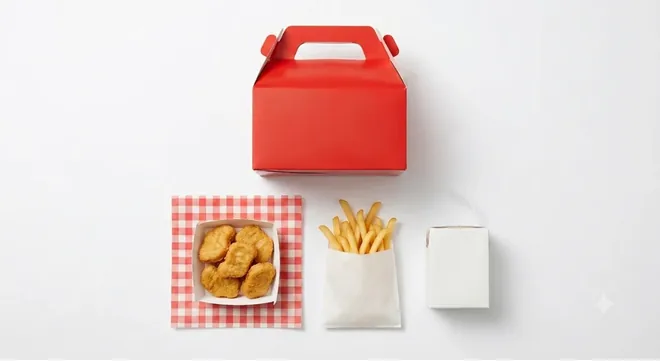
McDonald's Chicken McNuggets (4 piece) Happy Meal. What it actually contains for a child

McDonald's publishes nutrition data for the best-case build. Here is what the meal most children actually eat looks like.

Most parents ordering a Happy Meal are making three nutrition decisions without knowing it. The drink. The side. Whether ketchup comes with it. Each one shifts the nutritional outcome significantly. Together, they determine whether your child is eating a reasonable meal or one that blows past their daily sugar limit before they leave the restaurant.

The worst-case Chicken McNuggets Happy Meal delivers 276 percent of a one-year-old's entire daily sugar limit in a single sitting. That number does not come from the nuggets. It comes from the drink.

Sugar is only part of the story. The typical build with fries and ketchup pushes salt above the daily maximum for children under four. The worst-case build approaches a full day's calories for a one-year-old. In each case, the difference between the best and worst build comes down to choices most parents make without the numbers in front of them.

McDonald's publishes nutrition figures for the default build: Chicken McNuggets (4 piece), cucumber sticks, water, and an organic milk bottle. That combination is carefully optimised to show the best possible numbers. Most children do not eat the default.

This article breaks down every component individually, shows what each combination adds up to, and converts the figures against NHS recommended daily limits for each age group, including adults.

All nutritional data is taken directly from the McDonald's UK nutrition calculator.

The choices that matter most

Before the data. Two choices determine the nutritional outcome of this meal more than anything else.

Drink

Choose water or Fruit Shoot

The difference between water and Tropicana is 22g of free sugar. This is the single biggest lever in the entire meal.

Side

Cucumber sticks or apple slices

The side swap is a calorie and salt issue rather than a sugar one. Fries add 225 calories and 0.44g of salt. Ketchup adds a further 4.7g of free sugar and 0.48g of salt.

The three meal builds

The Chicken McNuggets (4 piece) Happy Meal is not one meal. It is a set of choices that produces very different nutritional outcomes. Here are three realistic builds.

The default meal is what McDonald's uses for its published nutrition figures: burger, cucumber sticks, water, organic milk. The typical meal is what many children actually eat: burger, fries with ketchup, Fruit Shoot, milk. The worst case is the highest sugar combination available: burger, fries with ketchup,Tropicana, milk.

Default

The optimised meal

Chicken McNuggets (4 piece) + cucumber sticks + milk

Calories327kcal
Free sugar~0.5g
Salt1.02g
⚠️

Typical

Fries and Fruit Shoot

Chicken McNuggets (4 piece) + fries + ketchup + Fruit Shoot

Calories462kcal
Free sugar~7.2g
Salt1.71g
🔴

Worst case

Fries and Tropicana

Chicken McNuggets (4 piece) + fries + ketchup + Tropicana

Calories554kcal
Free sugar~27.6g
Salt1.65g

Every component, individually

The Chicken McNuggets (4 piece) Happy Meal is not a single item. It is a combination of components, each contributing differently to the overall nutritional picture. Here is what each one contains.

Nutritional values per component — McDonald's UK

ComponentCaloriesTotal sugarFree sugarSalt
Chicken McNuggets (4 piece)190kcal0.5g~0.5g0.73g
Sides
Cucumber sticks12kcal1g~0g0.01g
Apple slices46kcal9.9g~0g0g
Small fries237kcal0.4g~0.4g0.44g
Drinks
Water0kcal0g~0g0g
Organic milk bottle125kcal12g~0g0.28g
Fruit Shoot (no added sugar)8kcal1.6g~1.6g0.06g
Tropicana orange juice 250ml100kcal22g~22g0g
Extras
Ketchup dip27kcal4.7g~4.7g0.48g

Free sugar estimates based on NHS guidelines. Milk sugar (lactose) and sugars in whole fruit do not count as free sugars. Juice sugars count in full. Source: McDonald's UK nutrition calculator.

All percentage figures on the packaging are for adults

The percentage reference intake figures shown by McDonald's are based on a 2,000kcal adult diet. A child aged 4 to 6 needs roughly 1,200 to 1,400kcal per day. The product is designed for children. The nutritional labelling is not.

Sugar

The NHS sets daily limits for free sugars — sugars added to food or drink, plussugars naturally present in honey, syrups, and fruit juice. Sugars naturally present in whole fruit, vegetables, and milk do not count.

The total sugar figure McDonald's publishes for the default meal looks alarming. It is not the whole story. The milk bottle accounts for 12g — all lactose, none of which counts as free sugar. The default meal contains approximately 0.5g offree sugar. The same meal with Tropicana contains around 22.5g.

NHS recommended daily free sugar limits

Under 1No added sugar at all
Age 1No more than 10g per day
Age 2 to 3No more than 14g per day
Age 4 to 6No more than 19g per day
Age 7 to 10No more than 24g per day
Age 11 and overNo more than 30g per day

Source: NHS. Free sugars include added sugars and sugars in honey, syrups, and fruit juice. They do not include sugars naturally present in whole fruit, vegetables, or milk.

Total sugar vs free sugar — why it matters

The NHS daily sugar limits for children apply to free sugars — not total sugar. Sugars naturally present in milk, whole fruit, and vegetables do not count. Sugars in fruit juice count in full, even though they are natural. This means the default Happy Meal with water contains around 0.5g of free sugar. The same meal with Tropicana instead of water contains around 22.5g of free sugar. One choice. One number that changes everything.

The single most consequential choice in a Happy Meal order is the drink. The difference between choosing water and choosing Tropicana orange juice is 22g of free sugar.

Better choice

Fruit Shoot (no added sugar)

1.6g

total sugar per bottle

Worth knowing

Tropicana orange juice 250ml

22g

free sugar per bottle — all counts toward daily limit

It is worth being clear about why fruit juice counts as free sugar when whole fruit does not. When fruit is juiced, the cellular structure is broken down and the sugars are released. The NHS classifies all fruit juice sugars as free sugars on this basis. A glass of orange juice and a can of fizzy drink are treated as equivalent from a free sugar perspective.

See sugar as a percentage of daily NHS limit

Age Adult daily NHS limit Chocolate milk Default Semi-skimmed
Child 4 to 6 3g 134% 72% 72%
Age 7 to 10 5g 80% 43% 43%
Age 11 and over/adult 6g 67% 36% 36%

Adult daily NHS limit reference: 3g for 4–6 years, 5g for 7–10 years, 6g for 11+ years and adults. Younger children and babies should have less. Source: NHS, McDonald’s UK nutrition calculator.

Salt

Unlike sugar, the salt story in this meal is driven by the side choice rather than thedrink choice. Tropicana contains no salt. The drinks make almost no difference to the salt total. What matters is whether a child has fries and ketchup.

See salt as a percentage of daily NHS limit

Age
NHS limit
Default
Low salt
Age 1 to 3
2g
70%
29%
Age 4 to 6
3g
47%
19%
Age 7 to 10
5g
28%
12%
Age 11+ / Adult
6g
23%
10%

Source: NHS. Children's kidneys are not fully developed to process large amounts of salt.

See salt as a percentage of daily NHS maximum

Age Daily max. Default Low salt
Age 1 to 3 2g 70% 29%
Age 4 to 6 3g 47% 19%
Age 7 to 10 5g 28% 12%
Age 11 and over/adult 6g 23% 10%

Adult daily NHS limit reference: 2g for 1–3 years, 3g for 4–6 years, 5g for 7–10 years, 6g for 11+ years and adults. Children should eat less because their kidneys are still developing. Source: NHS, McDonald's UK nutrition calculator.

Salt in context

The default Happy Meal contains 1.02g of salt. The typical meal with fries and ketchup contains 1.99g, which exceeds the daily limit for children aged 1 to 3 in a single meal. The ketchup dip alone adds 0.48g. The fries add another 0.44g. Together that is almost a full day's salt for a toddler before the burger is counted.

Calories

The calorie figures on the McDonald's label are shown as a percentage of a 2,000kcal adult reference intake. A child's daily energy needs are substantially lower. The table below converts each build against estimated average daily energy requirements for children at each age group.

See calories as a percentage of daily energy allowance

Age Daily needs Default No cheese
Age 2 to 3 1000 kcal 104% 79%
Age 4 to 6 1300 kcal 80% 61%
Age 7 to 10 1700 kcal 61% 47%
Age 11 and over/adult 2000 kcal 52% 39%

Daily energy figures are averages across boys and girls. Individual needs vary by activity level and body size. Source: SACN Dietary Reference Values for Energy (2011), McDonald's UK nutrition calculator.

The calorie picture

The default Happy Meal contains approximately 104% of a daily energy allowance for a 2 to 3 year old. The meal can still fit within a balanced diet, but younger children have significantly lower calorie requirements than adults. The worst-case build adds around 260 kcal over the default. The worst-case build with cheese and additional ingredients provides approximately a full day's calories for a 2 to 3 year old child in a single sitting.

What this means for parents

The purpose of this article is not to suggest that Happy Meals should never be eaten. Occasional fast food is not the issue. The issue is that the nutritional difference between the choices within the meal is very large, most parents donot have the numbers in front of them, and the menu presents all options as broadly equivalent.

The choices that make the most difference are straight forward once you know them.

What drives the calories?

The default Happy Meal contains approximately 414 kcal. Removing the cheese reduces calories to approximately 392 kcal, a reduction of around 22 kcal. This is the single biggest calorie-saving adjustment available within the meal.

The sauce effect

Cucumber sticks or apple slices provide a very low-calorie side option. Colourful ingredients such as tomatoes and lettuce contribute minimal calories. The largest additional calorie sources come from higher-energy extras and condiments. Ketchup adds approximately 17 kcal per sachet, while mayonnaise adds approximately 118 kcal.

Personalised nutrition changes the picture

The figures above use average daily calorie requirements based on age and sex. In reality, nutritional needs vary significantly between individuals. A physically active 10-year-old may require considerably more energy than a sedentary child of the same age, while adults can differ substantially depending on body size, activity levels, and health goals. Boone accounts for these differences by using personal characteristics rather than population averages, helping to provide a more individualised assessment of how a meal fits within a person's overall diet.

Frequently asked questions

The default Happy Meal build with cucumber sticks, water, and milk contains very little free sugar at around 0.5g. However, the nutritional profile changes significantly depending on the drink and side selected. Choosing orange juice instead of water increases free sugar by approximately 22g and can exceed the recommended daily limit for younger children in a single meal.

Not every Happy Meal affects every child in the same way

The figures in this article are based on population averages. In reality, children's nutritional needs vary considerably depending on age, sex, body size, activity levels, and overall dietary patterns. A meal that represents a large proportion of one child's daily requirements may have a much smaller impact on another's. Boone helps put these numbers into context by analysing meals against individual requirements rather than population averages.

Get started with Boone