

Snap your meals, get your nutrition breakdown. Download free.
Use Boone to snap a meal: get a full nutrition breakdown.

Wetherspoon Toast and Marmalade: calories and sugar by portion, age and sex

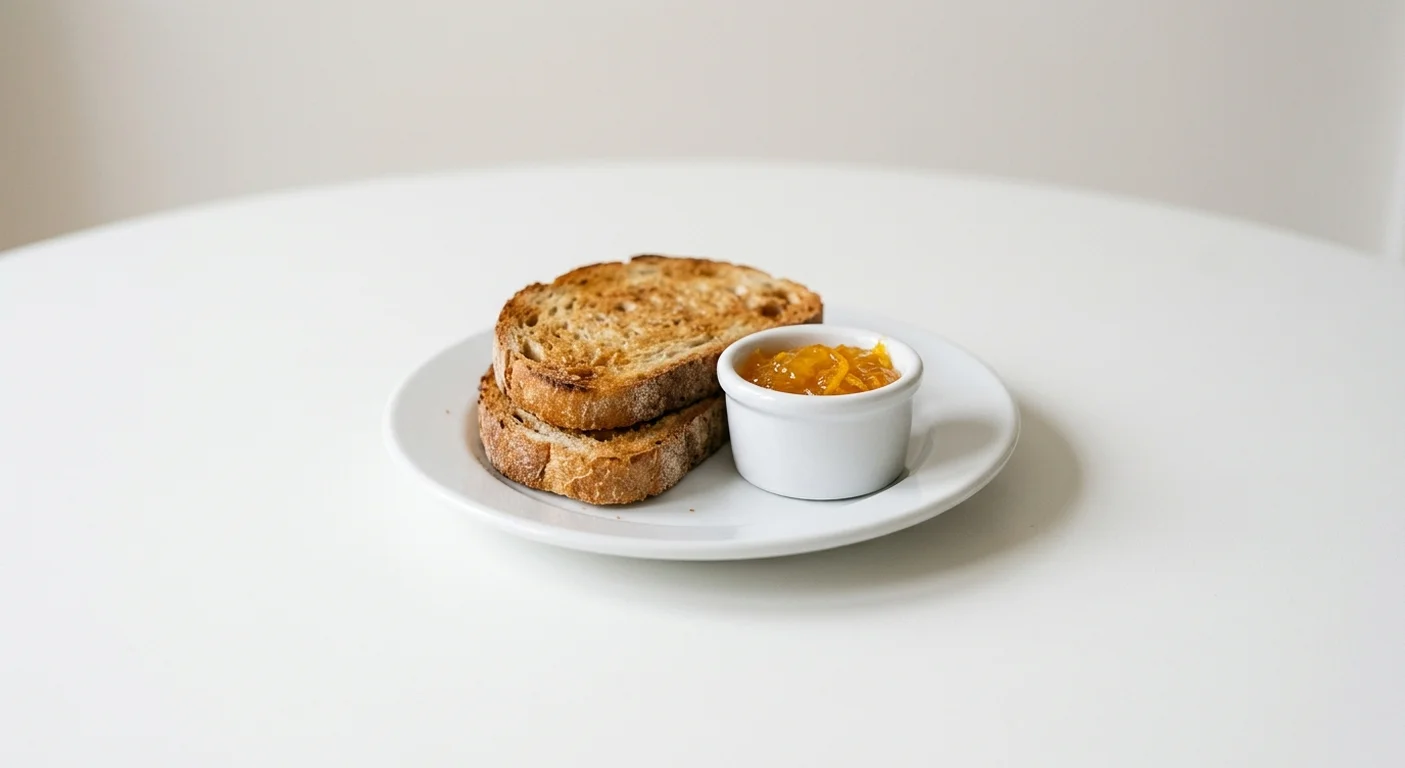
Wetherspoon Toast and Marmalade, two slices of toast with a pot of orange marmalade on a white plate, nutrition and calories

Boone’s analysis puts Wetherspoon Toast and Marmalade at 23% of an adult’s daily calories, 33% of the daily salt limit for a child aged 4 to 6 and 5 teaspoons of free sugar.

How many calories are in a Wetherspoon Toast and Marmalade? It contains 451 kcal, 15g of fat (6g saturated), 20g of sugar and 1g of salt, one of the lighter items on the menu.

Build a full meal with our nutrition calculator

Use the Boone meal calculator to build a full meal rather than view this item on its own. Add chips, sides, dips and a dessert, then choose your age and sex for a more accurate view of how it fits into a day.

‍

Nutrition information

Nutrition information: Wetherspoon Toast and Marmalade

Energy451 kcal
Fat15g
of which saturates6g
Carbohydrate68g
of which sugars20g
Fibre3g
Salt1g
Protein10g

Nutrition figures are Wetherspoon’s UK published data, per dish as served. Wetherspoon rounds grams to whole numbers, so Boone works fat, saturates, carbohydrate, sugars, protein and salt back from the published reference intake percentages to one decimal place. Fibre is shown as published.

A Wetherspoon Toast and Marmalade contains 451 kcal, which is 23% of the 2,000 kcal adult daily reference intake. It provides 15g of total fat, of which 6g is saturated, 20g of sugar, 1g of salt, 10g of protein and 3g of fibre.

The saturated fat content of 6g represents 30% of the adult daily guideline of 20g.

Wetherspoon Toast and Marmalade is made from 3 separately listed components, finished in the pub kitchen. Across the whole dish the ingredient list names dextrose and hydrolysed or isolated proteins. None of these add nutritional value. They exist to make the components survive industrial production, freezing and transport.

Wetherspoon Toast and Marmalade is high in free sugar for a young child

Wetherspoon Toast and Marmalade contains 20g of free sugar, which is 105% of the daily limit for a child aged 4 to 6.

Adult daily reference intakes (Reference Intake, RI)

Calories2,000 kcal
Total fat70g
Saturated fat20g
Carbohydrate260g
Sugars90g
Fibre30g
Salt6g
Protein50g

Sugar in Wetherspoon Toast and Marmalade

Wetherspoon Toast and Marmalade contains 20g of free sugar per standard serving (5.0 teaspoons). High sugar

The NHS free sugar limit is 30g per day for adults, 24g for children aged 7 to 10, and 19g for children aged 4 to 6. Free sugar excludes the sugars naturally present in milk and whole fruit. The table below shows how this compares across all age groups.

Free sugar by portion: Wetherspoon Toast and Marmalade

PortionAdult (female)
30g
Adult (male)
30g
Age 11 to 17
30g
Age 7 to 10
24g
Age 4 to 6
19g
Per portion20g
67%
20g
67%
20g
67%
20g
83%
20g
105%
Teaspoons5.0 tsp

Boone calculates these percentages from Wetherspoon’s UK published nutrition data against UK Dietary Reference Values and NHS free sugar and salt limits. Free sugar, salt, calories and saturated fat are limits to stay under; fibre is a target to reach, so a high percentage there is a good thing. For guidance only.

Salt in Wetherspoon Toast and Marmalade

Wetherspoon Toast and Marmalade contains 1g of salt per standard serving. Low salt

Children have lower salt limits: 3g per day for ages 4 to 6, 5g for ages 7 to 10. The table below shows how this serving compares to daily limits for adults and children.

Salt by portion: Wetherspoon Toast and Marmalade

PortionAdult (female)
6g
Adult (male)
6g
Age 11 to 17
6g
Age 7 to 10
5g
Age 4 to 6
3g
Per portion1g
17%
1g
17%
1g
17%
1g
20%
1g
33%

Boone calculates these percentages from Wetherspoon’s UK published nutrition data against UK Dietary Reference Values and NHS free sugar and salt limits. Free sugar, salt, calories and saturated fat are limits to stay under; fibre is a target to reach, so a high percentage there is a good thing. For guidance only.

Calories in Wetherspoon Toast and Marmalade

Wetherspoon Toast and Marmalade contains 451 kcal per standard serving. Moderate calorie share

Daily calorie needs vary by age and sex. The table below shows how this serving compares to typical daily reference intakes.

Calories by portion: Wetherspoon Toast and Marmalade

PortionAdult (female)
2,000 kcal
Adult (male)
2,500 kcal
Age 11 to 17
1,936 kcal
Age 7 to 10
1,553 kcal
Age 4 to 6
1,291 kcal
Per portion451 kcal
23%
451 kcal
18%
451 kcal
23%
451 kcal
29%
451 kcal
35%

Boone calculates these percentages from Wetherspoon’s UK published nutrition data against UK Dietary Reference Values and NHS free sugar and salt limits. Free sugar, salt, calories and saturated fat are limits to stay under; fibre is a target to reach, so a high percentage there is a good thing. For guidance only.

Saturated fat in Wetherspoon Toast and Marmalade

Wetherspoon Toast and Marmalade contains 6g of saturated fat per standard serving. Moderate saturated fat

The saturated fat guideline is 20g a day for women and 30g for men, and lower again for children. The table below shows how this serving compares.

Saturated fat by portion: Wetherspoon Toast and Marmalade

PortionAdult (female)
20g
Adult (male)
30g
Age 11 to 17
20g
Age 7 to 10
18g
Age 4 to 6
16g
Per portion6g
30%
6g
20%
6g
30%
6g
33%
6g
38%

Boone calculates these percentages from Wetherspoon’s UK published nutrition data against UK Dietary Reference Values and NHS free sugar and salt limits. Free sugar, salt, calories and saturated fat are limits to stay under; fibre is a target to reach, so a high percentage there is a good thing. For guidance only.

Fibre in Wetherspoon Toast and Marmalade

Wetherspoon Toast and Marmalade contains 3g of fibre per standard serving. Some fibre

Fibre is the one figure here that is a target to reach rather than a limit to stay under. UK guidance is 30g a day for adults, 25g for ages 11 to 17, 20g for ages 7 to 10 and 15g for ages 4 to 6. Most people in the UK fall well short. The table below shows how much of a day’s fibre this serving provides.

Fibre by portion: Wetherspoon Toast and Marmalade

PortionAdult (female)
30g
Adult (male)
30g
Age 11 to 17
25g
Age 7 to 10
20g
Age 4 to 6
15g
Per portion3g
10%
3g
10%
3g
12%
3g
15%
3g
20%

Boone calculates these percentages from Wetherspoon’s UK published nutrition data against UK Dietary Reference Values and NHS free sugar and salt limits. Free sugar, salt, calories and saturated fat are limits to stay under; fibre is a target to reach, so a high percentage there is a good thing. For guidance only.

Free sugar vs total sugar

Where the sugar comes from: Wetherspoon Toast and Marmalade

Effectively all 20g counts as free sugar, or about 5.0 teaspoons against the daily limit. Any naturally occurring sugar is too small to change the figure.

Free (added) sugars come from

  • sugar in the orange marmalade
  • dextrose, sugar in the white bloomer bread

Naturally occurring sugars come from

  • lactose in the Lurpak butter portions

NHS daily free sugar limits: 30g for adults and children 11+, 24g age 7 to 10, 19g age 4 to 6. Sources are read from the published ingredient list for each component. Whole fruit and lactose deductions are Boone estimates; Wetherspoon publishes total sugar only.

Ultra-processed food: what is really in it

Processing and additives: Wetherspoon Toast and Marmalade

Wetherspoon Toast and Marmalade is assembled from 3 separately listed components, combined and cooked in the pub kitchen. Reading the ingredient list closely, it contains dextrose and hydrolysed or isolated proteins. These are not there to add nutritional value. They make industrial production and distribution possible.

Dextrose

A simple sugar used for browning, bulk and mild sweetness. Found in the white bloomer bread.

Hydrolysed or isolated proteins

Proteins broken down or extracted industrially to add savoury flavour or texture. Found in the white bloomer bread.

Boone classifies Wetherspoon Toast and Marmalade as NOVA group 4, ultra-processed, based on the industrial ingredients named above. NOVA groups foods by how far they are from their whole-food form, not by how nutritious they are. A group 4 food is not automatically unhealthy, and a group 1 food is not automatically healthy. Read from the published ingredient list, retrieved 3 October 2026.

Wetherspoon Toast and Marmalade contains at least 46 distinct ingredients: 31 raw and 15 manufactured. Raw means something you could buy and cook with at home; manufactured means a substance that only exists as an output of industrial processing.

Ingredient count by order: Wetherspoon Toast and Marmalade

What you orderRawManufacturedTotal% manufactured
Wetherspoon Toast and Marmalade on its own31154633%

The 15 manufactured ingredients

ascorbic acid, calcium sulphate, cellulose, citric acid, dextrin, dextrose, enzymes, mono- and diglycerides of fatty acids, pectin, potassium sorbate, potato dextrin, potato starch, sodium hydroxide, sorbitol, wheat protein.

The 31 raw ingredients

amylase, aqua lipase xf, aqua ng enhancer xf, aqua oxidant xf, bleach clay, butter, fluid shortening sg, hull aqua conditioner, lactic culture, lemon juice from concentrate, lipase, liquid vegetable fat, liquid yeast, orange juice from concentrate, orange oil, palm fat palm fat, palm oil, phosphoric acid, rapeseed oil, salt, seville oranges, sodium chloride, sodium ferrocyanide, spirit vinegar, sugar, sulphur dioxide, sunflower oil, water, wheat flour, xylanase, yeast.

What those ingredients are, by type

Other14
Oils and fats8
Acids and acidity regulators5
Salt and minerals3
Fruit and vegetables3
Starches3
Sugars and syrups2
Stabilisers and thickeners2
Preservatives and antioxidants2
Grains and flours2
Meat, fish, dairy and eggs1
Water1

Boone counts every distinct named ingredient on Wetherspoon’s published component lists, including sub-ingredients, and removes duplicates, so salt appearing in four components counts once. Additive class names are dropped and the named substance kept, so “stabiliser (guar gum)” counts guar gum once, and the vitamins and minerals added to fortified flour are not counted separately. Raw covers whole foods and basic kitchen staples such as flour, sugar, salt and oil. Manufactured covers substances that only exist as an output of industrial processing. Where Wetherspoon lists more than one approved supplier recipe only the first is counted, so every figure here is a minimum.

Ingredients

Wetherspoon Toast and Marmalade is made from 3 separately listed components.

Ingredients by component: Wetherspoon Toast and Marmalade

Lurpak Butter Portions

Butter (From Cows MILK), Rapeseed Oil, Water, Lactic Culture, Salt.

Orange Marmalade

Sugar, Seville Oranges, Orange Juice From Concentrate, Lemon Juice From Concentrate, Pectin, Citric Acid, Orange Oil.

White Bloomer Bread

Liquid Yeast (Yeast, Water), PF Sedna Blend (Rapeseed Oil (Citric Acid, Rapeseed Oil (Rapeseed Oil, Bleach Clay, Cellulose, Phosphoric Acid, Sodium Hydroxide)), Emulsifier (Mono- And Diacetyl Tartaric Acid Esters Of Mono- And Diglycerides Of Fatty Acids)), Aqua Oxidant XF (Salt (Salt, Sodium Ferrocyanide), Ascorbic Acid, Water, Sugar (Sugar, SULPHUR DIOXIDE)), Aqua Lipase XF (Salt (Salt, Sodium Ferrocyanide), Water, Sugar (Sugar, SULPHUR DIOXIDE), Enzymes (Sodium Chloride, Potato Dextrin, Lipase, Water)), Hull Aqua Conditioner (Salt (Salt, Sodium Ferrocyanide), Sugar (Sugar, SULPHUR DIOXIDE), Water, Enzymes (Potassium Sorbate, Sodium Chloride, Sorbitol, Water, Xylanase, Amylase)), Aqua NG Enhancer XF (Salt (Salt, Sodium Ferrocyanide), Water, Sugar (Sugar, SULPHUR DIOXIDE), Enzymes (WHEAT Flour, Sunflower Oil, Potato Starch, Dextrin (WHEAT), Sodium Chloride, Amylase)), Fluid Shortening SG (Liquid Vegetable Fat) (Palm Oil (Palm Oil, Citric Acid), Rapeseed Oil (Rapeseed Oil (Sodium Hydroxide, Phosphoric Acid, Cellulose, Bleach Clay), Citric Acid), Palm Fat (Palm Fat, Citric Acid)), Fortified Wheat Flour (Calcium Sulphate, Folic Acid, Calcium Carbonate, Thiamin, Niacin, Iron, WHEAT Flour), Water, Salt (Sodium Ferrocyanide, Salt), Dextrose (SULPHUR DIOXIDE, Dextrose), WHEAT Protein, Spirit Vinegar, Mono- And Diglycerides Of Fatty Acids (Mono- And Diglycerides Of Fatty Acids, Ascorbic Acid, Citric Acid).

Wetherspoon lists more than one approved supplier recipe for the Lurpak butter portions; the first one listed is shown and the allergen information covers all of them. Ingredients taken from Wetherspoon’s UK allergen and nutrition service, retrieved 3 October 2026. Recipes change; always check with the pub before ordering if you have an allergy.

Allergens at a glance

Wetherspoon Toast and Marmalade contains wheat and milk. Wetherspoon lists it as suitable for vegetarians.

Allergen information: Wetherspoon Toast and Marmalade

AllergenStatus
WheatContains
RyeNot present
BarleyNot present
OatsNot present
CrustaceansNot present
EggsNot present
FishNot present
PeanutsNot present
SoyaNot present
MilkContains
Tree nutsNot present
CeleryNot present
MustardNot present
SesameNot present
SulphitesNot present
LupinNot present
MolluscsNot present

Contains = declared by Wetherspoon for this dish. May contain traces = a precautionary warning on one of the published component ingredient lists. Cereals containing gluten are split by grain where the ingredient list names it. Wetherspoon kitchens handle all 14 major allergens and share equipment and fryers, so no dish can be guaranteed allergen free. Taken from Wetherspoon’s UK allergen and nutrition service, retrieved 3 October 2026. Recipes change; always check with the pub before ordering if you have an allergy.

Frequently asked questions

How many calories are in a Wetherspoon Toast and Marmalade?+

Boone calculates that a Wetherspoon Toast and Marmalade contains 451 kcal, which is 23% of an adult’s 2,000 kcal daily reference intake and 35% of the daily intake for a child aged 4 to 6.

How much sugar is in a Wetherspoon Toast and Marmalade?+

Boone calculates that all 20g of the sugar in a Wetherspoon Toast and Marmalade counts as free sugar, or about 5 teaspoons.

How much of a child’s daily sugar limit is a Wetherspoon Toast and Marmalade?+

Boone measures the 20g of free sugar in a Wetherspoon Toast and Marmalade against NHS limits: 105% of the daily allowance for a child aged 4 to 6, 83% for ages 7 to 10, and 67% for an adult.

How much saturated fat is in a Wetherspoon Toast and Marmalade?+

A Wetherspoon Toast and Marmalade contains 6g of saturated fat. Boone calculates this as 30% of the daily guideline for an adult woman and 20% for an adult man, because the guideline differs by sex: 20g and 30g respectively.

How much salt is in a Wetherspoon Toast and Marmalade?+

A Wetherspoon Toast and Marmalade contains 1g of salt. Boone calculates that as 33% of the daily limit for a child aged 4 to 6 and 17% of an adult’s 6g limit.

Is a Wetherspoon Toast and Marmalade ultra-processed?+

Boone classifies a Wetherspoon Toast and Marmalade as NOVA group 4. Reading the published ingredient list, it is made from 3 separately listed components and contains dextrose and hydrolysed or isolated proteins. NOVA group 4 describes how far a food is from its whole-food form, not how nutritious it is.

How much fibre is in a Wetherspoon Toast and Marmalade?+

A Wetherspoon Toast and Marmalade contains 3g of fibre. Boone calculates that as 10% of an adult’s 30g daily target and 20% of the 15g target for a child aged 4 to 6. Fibre is a target to reach rather than a limit to stay under.

Is a Wetherspoon Toast and Marmalade suitable for children?+

For a child aged 4 to 6, Boone’s analysis flags that its 20g of free sugar is 105% of their daily limit. That does not make it off limits, but it does mean it uses up a large share of a young child’s day in one item.

How much protein is in a Wetherspoon Toast and Marmalade?+

A Wetherspoon Toast and Marmalade contains 10g of protein, which Boone calculates as 20% of a 50g adult daily target.

Track this and everything else you eat
with the Boone App