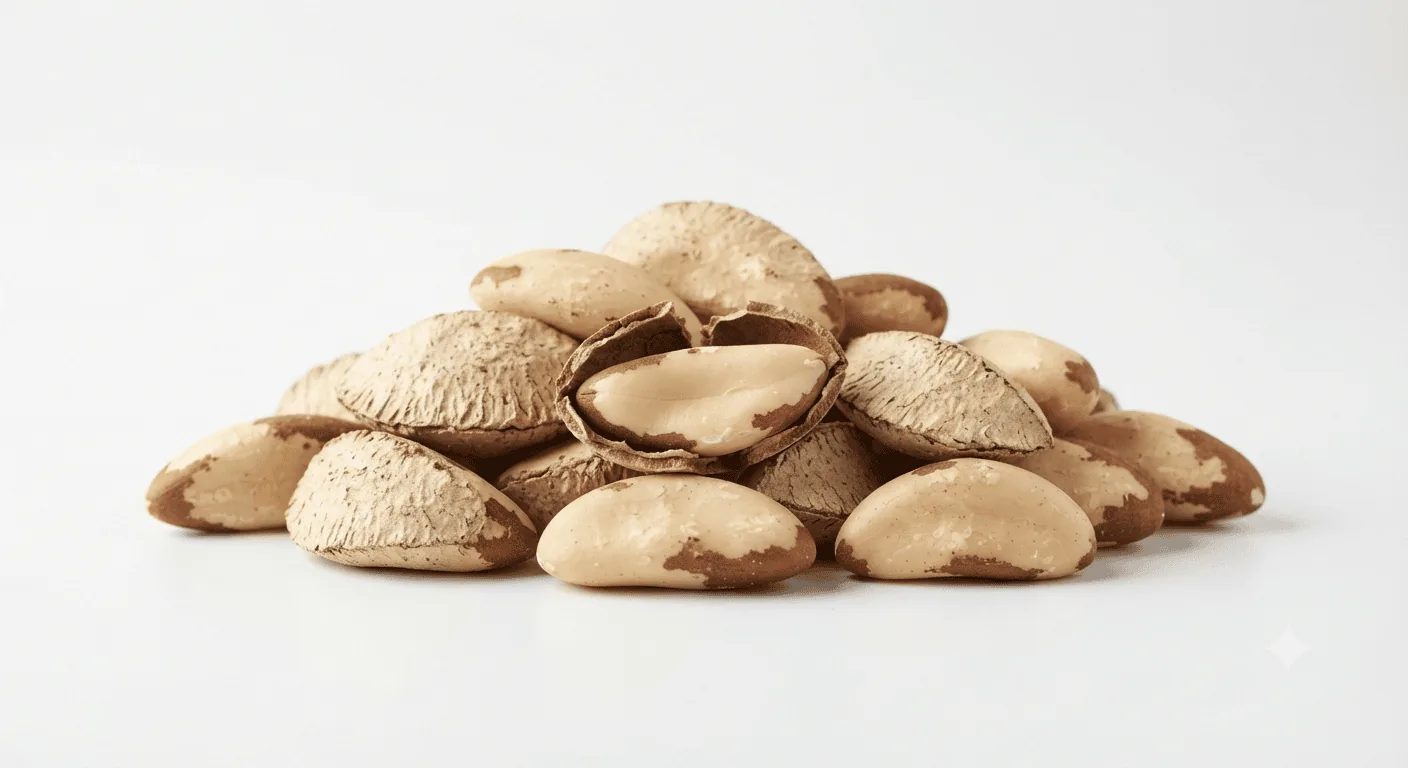
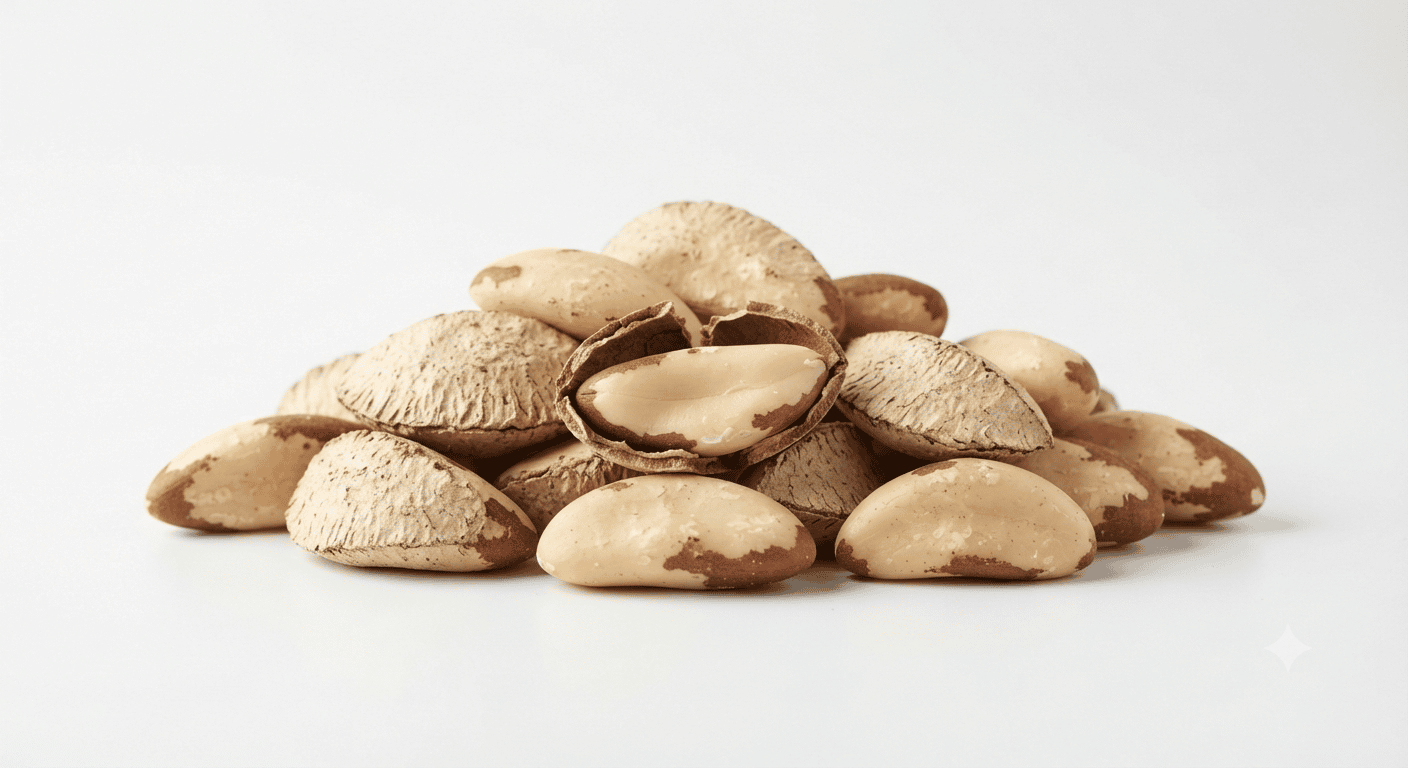
Brazil Nuts nutrition: calories, protein and healthy fats
Brazil Nuts are a whole food and, as a NOVA group 1 food, deliver naturally occurring energy and nutrients with no added sugar, salt or additives. They are a source of selenium, copper and phosphorus. Work out the numbers for any portion and age below, then see the full macro and micronutrient breakdown.
Brazil Nuts nutrition calculator
Calories, sugar and key nutrients by portion, adjusted for age and gender.
Key nutrients in this portion
Brazil Nuts nutrition per 100g and per portion
Typical values
Per 100g
Per portion (30g)
Energy
659
198
Fat
67g
20.1g
of which saturates
15.1g
4.5g
Carbohydrate
12g
3.6g
of which total sugars
2.3g
0.7g
of which added sugars
0g
0g
of which starch
0g
0g
Fibre
7.5g
2.2g
Protein
14g
4.2g
Salt
0g
0g
Sugar, fat, fibre and carbohydrate, by age
The tables below put each macronutrient against age-appropriate guidance, because what matters for a 4 year old is very different from an adult.
Sugar in Brazil Nuts: natural, not added
A small handful (about 30g) contains about 0.7g of sugar, and it is all natural (intrinsic) sugar that comes packaged with fibre and water. It has 0g of added or free sugar, so it does not count toward the daily free sugar limit the NHS sets. The table shows those limits by age; Brazil Nuts contribute nothing to them.
Age group
Daily free sugar limit
In a small handful (about 30g)
% of that
Adult
30g
0g
0%
Age 11 to 17
30g
0g
0%
Age 7 to 10
24g
0g
0%
Age 4 to 6
19g
0g
0%
Fat in Brazil Nuts: high, mostly saturated
Brazil Nuts are naturally high in fat, with about 20.1g per portion, and most of it is saturated (4.53g). There is 0g of added fat, but the table shows how the saturated fat compares with the daily maximum, so it is best enjoyed in smaller amounts.
Age group
Max saturated fat
In a small handful (about 30g)
% of that
Adult
24g
4.53g
19%
Age 11 to 17
27g
4.53g
17%
Age 7 to 10
22g
4.53g
21%
Age 4 to 6
18g
4.53g
25%
Fibre in Brazil Nuts by age
Fibre supports healthy digestion, and most people in the UK do not get enough. A portion provides about 2.25g. Because children need less fibre than adults, that same portion covers a bigger share of a younger child's target.
Age group
Recommended fibre
In a small handful (about 30g)
% of that
Adult
30g
2.25g
8%
Age 11 to 17
25g
2.25g
9%
Age 7 to 10
20g
2.25g
11%
Age 4 to 6
15g
2.25g
15%
Carbohydrate in Brazil Nuts by age
There is about 3.6g of carbohydrate per portion. There is no single daily target, but roughly half of daily energy should come from carbohydrate; the reference values below are based on that.
Age group
Reference carbohydrate
In a small handful (about 30g)
% of that
Adult
250g
3.6g
1%
Age 11 to 17
275g
3.6g
1%
Age 7 to 10
225g
3.6g
2%
Age 4 to 6
188g
3.6g
2%
Vitamins and minerals in Brazil Nuts
Percentages are share of the daily Nutrient Reference Value (NRV). Under UK and EU rules a food is a source of a nutrient at 15% NRV per 100g and high in it at 30%.
Nutrient
Per 100g
%NRV /100g
%NRV /portion
Selenium
1917ug
3485%
1046%
high in Selenium
Copper
1.7mg
170%
51%
high in Copper
Phosphorus
725mg
104%
31%
high in Phosphorus
Magnesium
376mg
100%
30%
high in Magnesium
Manganese
1.2mg
60%
18%
high in Manganese
Zinc
4.1mg
41%
12%
high in Zinc
Vitamins and minerals in Brazil Nuts, by age
These tables show how the nutrients compare to daily needs across different ages, using UK Reference Nutrient Intakes (RNIs). This differs from the source of and high in labels above, which use the single adult figure (NRV) set for food packaging. Children's needs are lower, so a portion goes further.
Selenium in Brazil Nuts by age
Selenium helps protect cells from damage and supports the immune system. A small handful (about 30g) contains 575ug. Because children need less than adults, that same portion covers a bigger share of a younger child's daily target.
Age group
Daily need (RNI)
In a small handful (about 30g)
% of daily need
Adult
75ug
575ug
767%
Age 11 to 17
70ug
575ug
822%
Age 7 to 10
30ug
575ug
1917%
Age 4 to 6
20ug
575ug
2876%
Copper in Brazil Nuts by age
Copper helps the body make red blood cells and supports the immune system. A small handful (about 30g) contains 0.51mg. Because children need less than adults, that same portion covers a bigger share of a younger child's daily target. These figures use safe intake levels, as no formal UK RNI is set.
Age group
Daily need (RNI)
In a small handful (about 30g)
% of daily need
Adult
1.2mg
0.51mg
43%
Age 11 to 17
0.8mg
0.51mg
64%
Age 7 to 10
0.6mg
0.51mg
85%
Age 4 to 6
0.4mg
0.51mg
127%
Phosphorus in Brazil Nuts by age
Phosphorus works with calcium to build strong bones and teeth. A small handful (about 30g) contains 218mg. Because children need less than adults, that same portion covers a bigger share of a younger child's daily target.
Age group
Daily need (RNI)
In a small handful (about 30g)
% of daily need
Adult
550mg
218mg
40%
Age 11 to 17
775mg
218mg
28%
Age 7 to 10
550mg
218mg
40%
Age 4 to 6
450mg
218mg
48%
Magnesium in Brazil Nuts by age
Magnesium supports muscle and nerve function and helps release energy from food. A small handful (about 30g) contains 113mg. Because children need less than adults, that same portion covers a bigger share of a younger child's daily target.
Age group
Daily need (RNI)
In a small handful (about 30g)
% of daily need
Adult
300mg
113mg
38%
Age 11 to 17
300mg
113mg
38%
Age 7 to 10
200mg
113mg
56%
Age 4 to 6
120mg
113mg
94%
Manganese in Brazil Nuts by age
Manganese contributes to normal bone formation and helps protect cells from oxidative stress. A small handful (about 30g) contains 0.36mg. Because children need less than adults, that same portion covers a bigger share of a younger child's daily target. These figures use safe intake levels, as no formal UK RNI is set.
Age group
Daily need (RNI)
In a small handful (about 30g)
% of daily need
Adult
2mg
0.36mg
18%
Age 11 to 17
1.9mg
0.36mg
19%
Age 7 to 10
1.6mg
0.36mg
22%
Age 4 to 6
1.5mg
0.36mg
24%
Zinc in Brazil Nuts by age
Zinc supports the immune system, wound healing and normal growth. A small handful (about 30g) contains 1.23mg. Because children need less than adults, that same portion covers a bigger share of a younger child's daily target.
Age group
Daily need (RNI)
In a small handful (about 30g)
% of daily need
Adult
9.5mg
1.23mg
13%
Age 11 to 17
9mg
1.23mg
14%
Age 7 to 10
7mg
1.23mg
18%
Age 4 to 6
6.5mg
1.23mg
19%
Are Brazil Nuts processed?
No. Brazil Nuts are a NOVA group 1 whole food, the least processed category, eaten in their natural state with nothing added, which is why whole foods behave very differently in the body from ultra-processed foods.
Brazil Nuts nutrition FAQ
How many calories are in brazil nuts?+
Brazil nuts contain 659 kcal per 100g — the highest calorie count of any common tree nut. A small handful of about 30g (roughly 6 nuts) contains approximately 198 kcal — 10% of the adult 2,000 kcal daily reference intake. A single brazil nut weighs approximately 5g and contains around 33 kcal. The high calorie density comes from the very high fat content at 67g per 100g. Portion control is particularly important with brazil nuts — both for calorie management and, more critically, for selenium intake.
How much selenium is in brazil nuts?+
Brazil nuts contain approximately 1917ug of selenium per 100g — by a very large margin the richest dietary source of selenium available. A 30g handful provides approximately 575ug of selenium — 767% of the adult daily requirement of 75ug. A single brazil nut provides approximately 96ug — already 128% of the adult daily requirement. The NHS upper safe limit for selenium is 350ug per day for adults. Eating just 4 brazil nuts in a day (approximately 20g) provides roughly 383ug — above the safe upper limit. Brazil nuts are the only common food where a single small serving can exceed safe micronutrient limits. They should not be eaten in large quantities or daily.
How many brazil nuts is it safe to eat per day?+
The NHS advises eating no more than a small handful (about 30g, roughly 6 nuts) of brazil nuts occasionally — not every day. The NHS upper safe limit for selenium is 350ug per day for adults. Given that a single brazil nut provides approximately 96ug of selenium, the safe daily maximum is approximately 3 to 4 nuts per day when accounting for selenium from other dietary sources such as meat, fish, eggs and dairy. Eating a 30g handful (575ug selenium) regularly over time poses a risk of selenium toxicity. One to two brazil nuts per day, a few times a week, is widely considered a safe and nutritionally useful intake for maintaining selenium levels.
What is selenium and why does the body need it?+
Selenium is an essential trace mineral that the body needs in very small amounts. It forms part of selenoproteins — enzymes that protect cells from oxidative damage, regulate thyroid hormone metabolism and support immune function. Selenium deficiency is rare in the UK but more common in parts of Europe where soils are selenium-poor. The adult RNI for selenium is 75ug per day for men and 60ug per day for women. Just one or two brazil nuts per day is sufficient to meet or exceed this requirement, making brazil nuts one of the most practical ways to ensure selenium adequacy without supplements.
What are the symptoms of too much selenium from brazil nuts?+
Selenium toxicity (selenosis) can occur from regularly eating large quantities of brazil nuts. Early symptoms include a garlic-like odour on the breath, a metallic taste in the mouth, nausea and diarrhoea. Chronic excessive intake can cause hair loss, brittle nails, skin rashes, fatigue and in severe cases neurological damage. Selenosis is unlikely from occasional consumption of a small handful, but can develop from eating brazil nuts daily in quantities of 5 or more. Children are at higher risk due to lower body weight and lower upper safe limits — a single brazil nut can provide several times a child's daily selenium requirement. If you eat brazil nuts regularly, limiting intake to 1-2 nuts per day is a sensible precaution.
How much fat is in brazil nuts?+
Brazil nuts contain 67g of fat per 100g — the highest fat content of any common tree nut. A 30g handful provides approximately 20.1g of fat. Unlike almonds and peanuts, a significant proportion is saturated fat — 15.1g per 100g (4.5g per 30g handful), representing 19% of the adult daily saturated fat guideline of 24g in a single handful. The remaining fat is predominantly oleic acid (monounsaturated) and linoleic acid (polyunsaturated). The high saturated fat content makes brazil nuts nutritionally distinct from most other nuts, where unsaturated fat is dominant.
How much sugar is in brazil nuts?+
Brazil nuts contain 2.3g of sugar per 100g — approximately 0.7g per 30g handful, or less than a quarter of a teaspoon. This is among the lowest natural sugar content of any tree nut. All of it is intrinsic sugar, naturally occurring within the nut, with 0g of added or free sugar. Brazil nuts contribute 0g to the NHS daily free sugar limits of 30g for adults, 24g for children aged 7 to 10, and 19g for children aged 4 to 6. For those specifically managing sugar intake, brazil nuts are one of the lowest sugar nut options available.
What other vitamins and minerals are in brazil nuts?+
Beyond selenium, brazil nuts are high in copper (170% NRV per 100g), phosphorus (104%), magnesium (100%), manganese (60%) and zinc (41%). A 30g handful provides 113mg of magnesium — 38% of the adult daily requirement — and 218mg of phosphorus — 40% of the adult daily requirement. Magnesium supports muscle and nerve function; phosphorus works with calcium for bone health. The combination of magnesium, phosphorus and zinc makes brazil nuts a genuinely broad micronutrient source, even before the extraordinary selenium content is considered.
Are brazil nuts good for you?+
Yes, in small amounts. Brazil nuts are a NOVA group 1 whole food with 0g of added sugar, 0g of salt and no additives. They are the single most efficient dietary source of selenium available — 1 to 2 nuts provides the entire adult daily selenium requirement. They also provide meaningful amounts of magnesium, phosphorus, copper and zinc. The caveats are significant: very high in calories at 659 kcal/100g, highest saturated fat of any common nut at 15.1g/100g, and a very real selenium toxicity risk if eaten in large quantities regularly. Brazil nuts are best thought of as a micronutrient supplement food rather than a snacking nut — 1 to 2 per day, a few times a week, is the nutritionally optimal approach.
Are brazil nuts safe for children?+
Whole brazil nuts are a choking hazard for children under 5 and must not be given to this age group. From age 5 upwards they can be introduced carefully. The selenium content requires particular attention with children: the upper safe limit for selenium in children aged 4 to 6 is 60ug per day. A single brazil nut provides approximately 96ug — already above the safe upper limit for this age group. Children aged 4 to 6 should not be given whole brazil nuts. Older children (7 to 10) have an upper limit of approximately 150ug — meaning at most 1 to 2 small nuts occasionally. Brazil nuts are a tree nut and one of the 14 major allergens — introduce with care and watch for any allergic reaction.
Do brazil nuts contain allergens?+
Yes. Brazil nuts are a tree nut and one of the 14 major allergens regulated under UK food law. Tree nut allergy can cause reactions ranging from mild hives and itching to severe anaphylaxis. Brazil nut allergy is one of the more common tree nut allergies. Cross-reactivity with other tree nuts is possible — someone allergic to one tree nut may also react to others, though this is not always the case. Anyone with a known or suspected tree nut allergy should seek medical advice before consuming brazil nuts. They should not be given to children with a family history of tree nut allergy without GP or allergy specialist guidance.
Are brazil nuts suitable for vegans?+
Yes. Brazil nuts are suitable for vegans and vegetarians. They contain no animal-derived ingredients. For vegans, brazil nuts are particularly valuable as a selenium source — selenium is found mainly in meat, fish and eggs in most diets, making it a nutrient that plant-based eaters can struggle to obtain. One to two brazil nuts per day is sufficient to meet the adult daily selenium requirement without animal products. They are naturally gluten-free, though those with coeliac disease should check for cross-contamination on packaged products.
How do brazil nuts compare to other nuts nutritionally?+
Brazil nuts are the most calorie-dense common nut at 659 kcal/100g, ahead of almonds at 579 kcal and peanuts at 567 kcal. They have the highest fat content at 67g/100g and the highest saturated fat at 15.1g/100g — significantly more than almonds at 3.8g/100g. Protein at 14g/100g is moderate — less than almonds (21.2g) and peanuts (26g) but more than tiger nuts (4g). Fibre at 7.5g/100g is reasonable but lower than almonds (12.5g) and tiger nuts (33g). The selenium content at 1917ug/100g is without comparison in the food world — no other commonly eaten food comes close. Brazil nuts are best consumed for selenium rather than as a general-purpose snack nut.
How do brazil nuts fit into a balanced diet?+
Brazil nuts fit best into a balanced diet as an occasional selenium source rather than a regular snacking nut. One to two nuts per day, a few times a week, is the approach that captures the selenium benefit without risking toxicity. At this quantity the calorie and saturated fat contribution is minimal — 1 nut provides approximately 33 kcal and 0.75g of saturated fat. A 30g handful eaten regularly would provide excessive selenium, significant saturated fat and nearly 200 kcal — not appropriate as a daily snack in that quantity. The NHS recommends eating a variety of nuts rather than large amounts of any single type, and this advice applies with particular force to brazil nuts given the selenium upper limit.
Track this in Boone
Log your food and see your macros and micronutrients in real time, personalised to your genetics.
Nutrition data from McCance and Widdowson and UK FoodData Central, per 100g raw edible portion; values are reference figures and can vary by variety and ripeness. Reference intakes: EU NRVs for labelling and UK RNIs (SACN) for age-based needs. For guidance only.