
M&S cereals, ranked by calories
All 69 M&S cereals, highest calories first. Figures are for a 30g bowl without milk, as a share of the daily energy reference for the person eating.
Calories per bowl of M&S cereal
69 cereals, highest first. Per 30g bowl, without milk. % of day is against an adult woman’s 2,000 kcal reference. No Added Sugar Grain Free GranolaGranola623 kcal per 100g, 5.5g protein a bowl187 kcal9% of day2
 Honey & Mixed Nut CrunchClusters and crunch476 kcal per 100g, 3.2g protein a bowl143 kcal7% of day3
 Brain Food Granola Super SeededGranola474 kcal per 100g, 3.7g protein a bowl142 kcal7% of day4
 Peanut & Honey GranolaGranola472 kcal per 100g, 4.1g protein a bowl142 kcal7% of day5
 No Added Sugar Seed & Nut GranolaGranola467 kcal per 100g, 4g protein a bowl140 kcal7% of day
 Made Without Triple Chocolate CrunchClusters and crunchJoint460 kcal per 100g, 2.5g protein a bowl138 kcal7% of day7
 Triple Chocolate CrunchClusters and crunchJoint460 kcal per 100g, 2.9g protein a bowl138 kcal7% of day8
 Made Without 4 Nut & Flame Raisin GranolaGranola454 kcal per 100g, 3g protein a bowl136 kcal7% of day9
 Good Gut Mango & Apple GranolaGranola448 kcal per 100g, 3g protein a bowl134 kcal7% of day10
 Strawberry & Almond CrunchClusters and crunch445 kcal per 100g, 2.9g protein a bowl134 kcal7% of day
Cereal images are illustrations created by Boone, not photographs.
The whole M&S cereal range at a glance
Each dot is one cereal, coloured by type. Granola sit highest for calories on average; Wheat biscuits and bran sit lowest.
Lightest of each M&S cereal type
The same kind of cereal, compared.
 FlakesStrawberry & Cherry Special Flakes111 kcal a bowl, against Nutty Maple Special Flakes at 119 kcalSaves 8 kcal
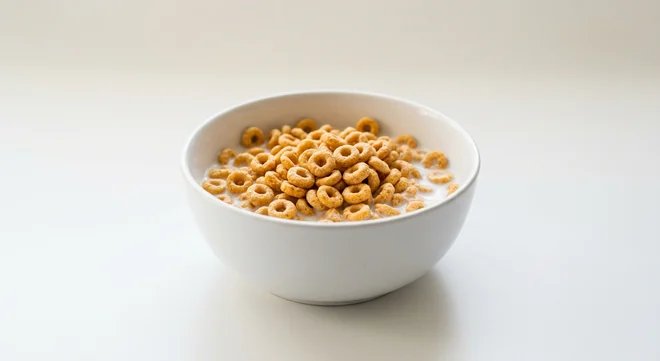 Puffs, hoops and popsMultigrain Hoops110 kcal a bowl, against Choco Hazelnut Pillows at 130 kcalSaves 20 kcal
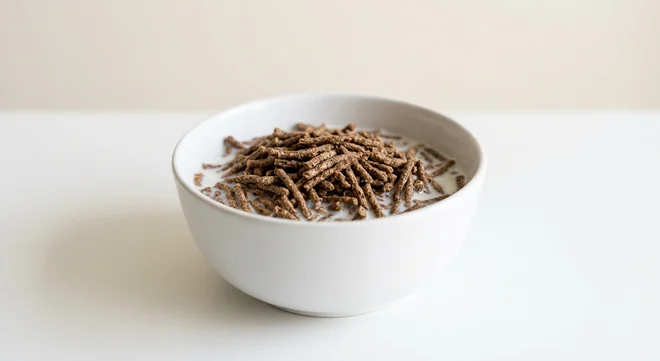 Wheat biscuits and branBran Sticks101 kcal a bowl, against Malted Wheats at 110 kcalSaves 9 kcal
 GranolaRaisin Almond & Honey Granola122 kcal a bowl, against No Added Sugar Grain Free Granola at 187 kcalSaves 65 kcal
 MuesliMixed Berry Muesli105 kcal a bowl, against Good Gut Fruit & Multigrain Muesli at 126 kcalSaves 21 kcal
 Clusters and crunchHigh Protein Vegan Chocolate Crunch125 kcal a bowl, against Honey & Mixed Nut Crunch at 143 kcalSaves 18 kcal
 Porridge and overnight oatsMade Without Wheat Gluten Free Apple & Chia Overnight Oats105 kcal a bowl, against Made Without Traditional Porridge Oats at 119 kcalSaves 14 kcal
Quick answers
Which M&S cereal has the most calories?+
M&S No Added Sugar Grain Free Granola, with 623 kcal per 100g, or 187 kcal in a 30g serving before milk.
Which M&S cereal has the fewest calories?+
M&S Sultana Bran Flakes, with 337 kcal per 100g, or 101 kcal in a 30g serving before milk.
Why are granolas so high in calories?+
Granola is baked with oil, nuts and seeds, so it packs more energy into each gram than flakes or puffs. The M&S granolas average 459 kcal per 100g, against 384 kcal for M&S Corn Flakes.
Does this include milk?+
No. These figures are the cereal alone. Each product page lets you add semi-skimmed, skimmed, whole, oat, almond or soya milk and change the portion.
Where does this data come from?+
The nutrition panels and ingredients lists on Ocado’s M&S own-label cereal listings, collected in October 2026. Boone works out free sugar, manufactured ingredients and nutrient profiling scores from them.
Calories are per 100g as sold, taken from the nutrition panels on Ocado’s M&S listings. Ranking per 100g compares what each cereal is made of; serving sizes on the boxes vary, so a fair comparison needs a fixed weight.
The percentages under each cereal are for a 30g serving and change with the age and sex you pick, using the estimated daily energy requirements from the Scientific Advisory Committee on Nutrition. Milk is not included; each product page adds it.
Read the full methodology →