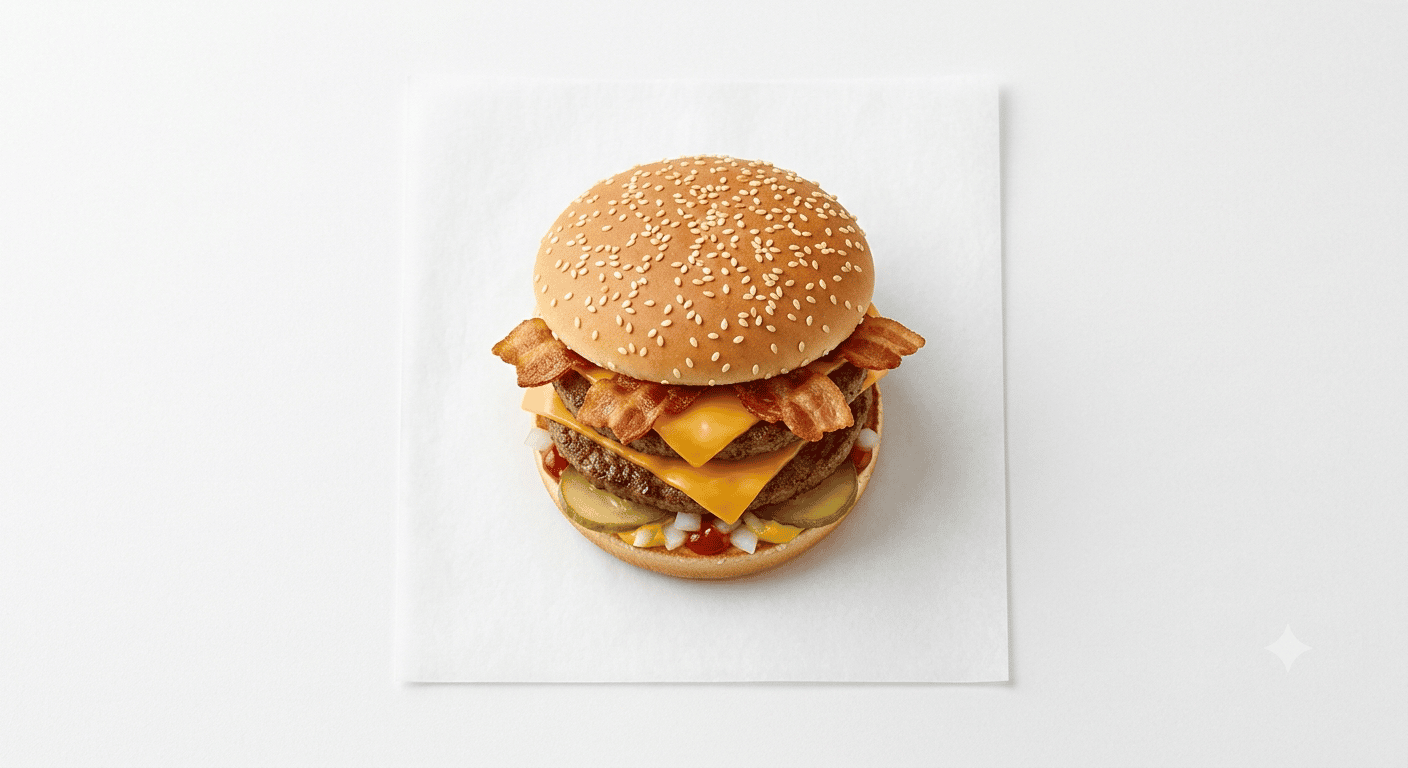
Boone’s analysis puts McDonald's Bacon Double Cheeseburger at 24% of an adult’s daily calories, 87% of the daily salt limit for a child aged 4 to 6 and 1.8 teaspoons of free sugar.
How many calories are in a McDonald's Bacon Double Cheeseburger? It contains 483 kcal, 25g of fat (11.5g saturated), 7g of sugar and 2.6g of salt, one of the higher-calorie items on the menu.
Build a full meal with our nutrition calculator
Use the Boone meal calculator to build a full meal rather than view this item on its own. Add fries, a drink, dips and a dessert, then choose your age and sex for a more accurate view of how a Bacon Double Cheeseburger fits into a day.
Nutrition information
Nutrition information: McDonald's Bacon Double Cheeseburger
| Energy | 483 kcal |
| Fat | 25g |
| of which saturates | 11.5g |
| Carbohydrate | 33g |
| of which sugars | 7g |
| Salt | 2.6g |
| Protein | 30g |
Nutrition figures are McDonald’s UK published data, per item as sold and before any optional sauces or extras. Boone converts them to the portion and age comparisons on this page.
A McDonald's Bacon Double Cheeseburger contains 483 kcal, which is 24% of the 2,000 kcal adult daily reference intake. It provides 25g of total fat, of which 11.5g is saturated, 7g of sugar, 2.6g of salt and 30g of protein.
The saturated fat content of 11.5g represents 57% of the adult daily guideline of 20g.
McDonald's Bacon Double Cheeseburger carries a large share of a child’s daily salt
A McDonald's Bacon Double Cheeseburger contains 2.6g of salt, which is 87% of the daily limit for a child aged 4 to 6. It is also high in saturated fat.
Adult daily reference intakes (Reference Intake, RI)
Calories2,000 kcal
Total fat70g
Saturated fat20g
Carbohydrate260g
Sugars90g
Fibre30g
Salt6g
Protein50g
Sugar in McDonald's Bacon Double Cheeseburger
McDonald's Bacon Double Cheeseburger contains 7g of free sugar per standard serving (1.8 teaspoons). Moderate sugar
The NHS free sugar limit is 30g per day for adults, 24g for children aged 7 to 10, and 19g for children aged 4 to 6. Free sugar excludes the sugars naturally present in milk and whole fruit. The table below shows how this compares across all age groups.
Free sugar by portion: McDonald's Bacon Double Cheeseburger
| Portion | Adult (female)
30g | Adult (male)
30g | Age 11 to 17
30g | Age 7 to 10
24g | Age 4 to 6
19g |
|---|
| Per portion | 7g
23% | 7g
23% | 7g
23% | 7g
29% | 7g
37% |
| Teaspoons | 1.8 tsp |
Boone calculates these percentages from McDonald's UK published nutrition data against UK Dietary Reference Values and NHS free sugar and salt limits. Free sugar, salt, calories and saturated fat are limits to stay under; fibre is a target to reach, so a high percentage there is a good thing. For guidance only.
Salt in McDonald's Bacon Double Cheeseburger
McDonald's Bacon Double Cheeseburger contains 2.6g of salt per standard serving. Moderate salt
Children have lower salt limits: 3g per day for ages 4 to 6, 5g for ages 7 to 10. The table below shows how this serving compares to daily limits for adults and children.
Salt by portion: McDonald's Bacon Double Cheeseburger
| Portion | Adult (female)
6g | Adult (male)
6g | Age 11 to 17
6g | Age 7 to 10
5g | Age 4 to 6
3g |
|---|
| Per portion | 2.6g
43% | 2.6g
43% | 2.6g
43% | 2.6g
52% | 2.6g
87% |
Boone calculates these percentages from McDonald's UK published nutrition data against UK Dietary Reference Values and NHS free sugar and salt limits. Free sugar, salt, calories and saturated fat are limits to stay under; fibre is a target to reach, so a high percentage there is a good thing. For guidance only.
Calories in McDonald's Bacon Double Cheeseburger
McDonald's Bacon Double Cheeseburger contains 483 kcal per standard serving. Moderate calorie share
Daily calorie needs vary by age and sex. The table below shows how this serving compares to typical daily reference intakes.
Calories by portion: McDonald's Bacon Double Cheeseburger
| Portion | Adult (female)
2000 kcal | Adult (male)
2500 kcal | Age 11 to 17
1936 kcal | Age 7 to 10
1553 kcal | Age 4 to 6
1291 kcal |
|---|
| Per portion | 483 kcal
24% | 483 kcal
19% | 483 kcal
25% | 483 kcal
31% | 483 kcal
37% |
Boone calculates these percentages from McDonald's UK published nutrition data against UK Dietary Reference Values and NHS free sugar and salt limits. Free sugar, salt, calories and saturated fat are limits to stay under; fibre is a target to reach, so a high percentage there is a good thing. For guidance only.
Saturated fat in McDonald's Bacon Double Cheeseburger
McDonald's Bacon Double Cheeseburger contains 11.5g of saturated fat per standard serving. Moderate saturated fat
The saturated fat guideline is 20g a day for women and 30g for men, and lower again for children. The table below shows how this serving compares.
Saturated fat by portion: McDonald's Bacon Double Cheeseburger
| Portion | Adult (female)
20g | Adult (male)
30g | Age 11 to 17
20g | Age 7 to 10
18g | Age 4 to 6
16g |
|---|
| Per portion | 11.5g
57% | 11.5g
38% | 11.5g
57% | 11.5g
64% | 11.5g
72% |
Boone calculates these percentages from McDonald's UK published nutrition data against UK Dietary Reference Values and NHS free sugar and salt limits. Free sugar, salt, calories and saturated fat are limits to stay under; fibre is a target to reach, so a high percentage there is a good thing. For guidance only.
Ultra-processed food: what is really in it
A McDonald's Bacon Double Cheeseburger is assembled from 5 separate components, each manufactured and prepared separately, often at different factories, before being combined and cooked at the point of sale. The most heavily formulated of these is the bacon.
Reading the ingredient list closely, a McDonald's Bacon Double Cheeseburger contains preservatives. These are not used to add nutritional value. Preservatives extend shelf life by slowing the growth of bacteria, yeasts and moulds in components that are prepared centrally and distributed to restaurants.
None of this means the ingredients are unsafe; all additives used are approved for use in UK food. What it indicates is the degree of industrial formulation involved. A home-cooked equivalent, made from a small number of fresh or minimally processed ingredients prepared in one kitchen, would typically involve far fewer steps and far fewer additives. The version sold at McDonald's reaches a comparable end result using a longer list of industrially processed components, several manufacturing sites, and a number of functional additives designed to keep the product consistent across thousands of restaurants.
What's in it: Bacon Double Cheeseburger
Bun
Same wheat flour bun as the Double Cheeseburger
Beef patties (x2)
Two 100% beef patties
Cheese slices (x2)
Two processed cheddar cheese slices
Bacon
Smoked bacon, cured with salt and preservatives (nitrites)
Onions, pickle, ketchup, mustard
Same as Double Cheeseburger
Looking at the ingredient list rather than just the nutrition panel tells a different story. Even where individual macros (sugar, salt, calories) look moderate, the number of separately manufactured components, and the additives used to bind, emulsify, preserve, colour and flavour them, place almost every hot item on the McDonald's menu in the most processed food category under the NOVA classification system.
Processing (NOVA classification)
A McDonald's Bacon Double Cheeseburger falls into NOVA group 4, ultra-processed food. The NOVA classification system groups foods by the extent and purpose of the processing involved, rather than by their individual nutrients. Group 4 covers products that are formulated mostly or entirely from substances derived from foods, plus additives, using a series of industrial processes with little or no whole food remaining recognisable in the final product. In this item, that includes preservatives, on top of the breaded or formed proteins, processed cheese and multi-stage assembly typical of the menu. This classification applies to almost all hot menu items at McDonald's, and indeed to most fast food and packaged convenience food generally; it is not a finding specific to this item.