Free UK delivery on all orders · At-home saliva test · Secure checkout
Free UK delivery on all orders

McDonald's Triple Cheeseburger: calories, nutrition, ingredients and allergens

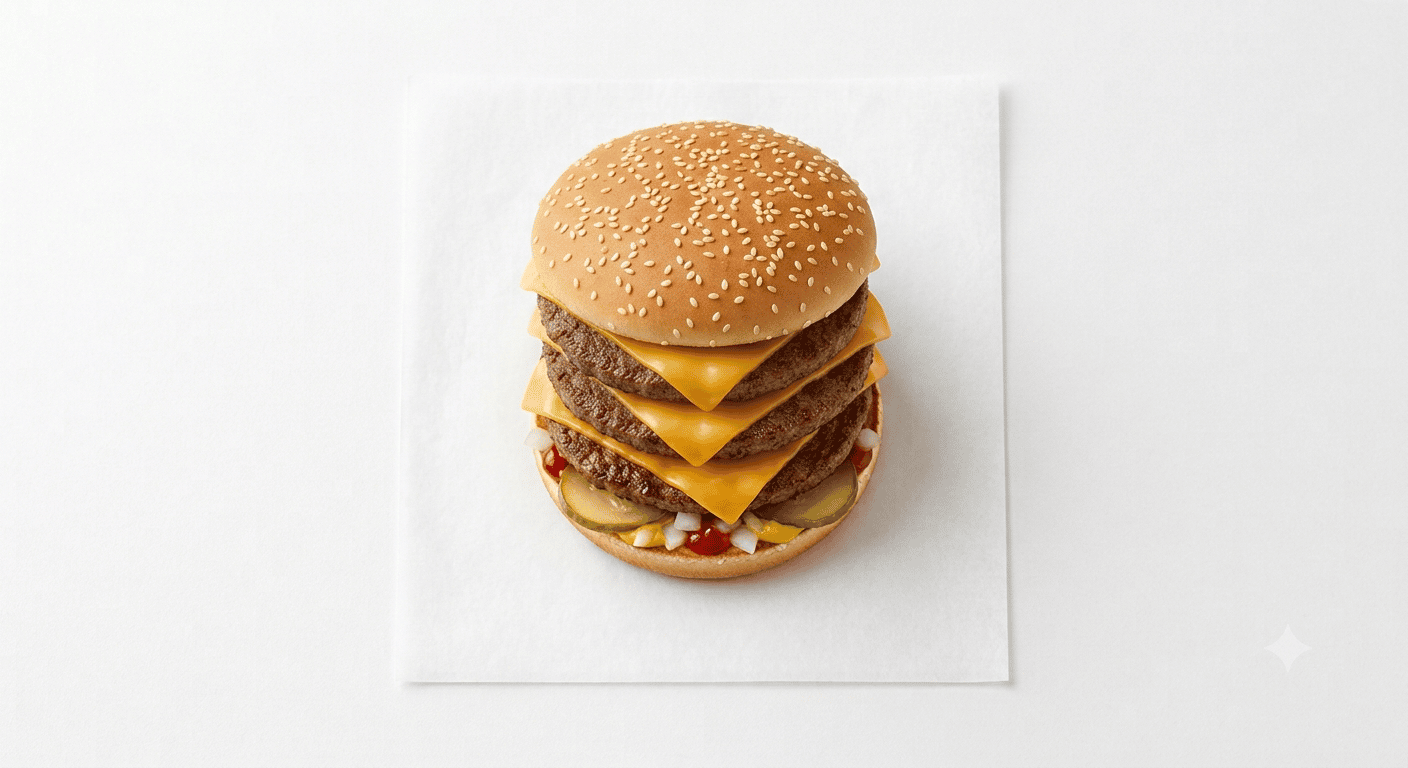
McDonald's Triple Cheeseburger — calories, saturated fat and salt nutrition breakdown

How many calories are in a McDonald's Triple Cheeseburger? It contains 577 kcal, 33g of fat (16g saturated), 7g of sugar and 2.9g of salt. At 577 kcal, it is one of the higher-calorie items on the core menu.

Build a full meal with our nutrition calculator

A Triple Cheeseburger is rarely ordered on its own. Use the calculator below to add fries, a drink, dips and a dessert, and see what the combined order adds up to against daily guidelines for calories, saturated fat, sugar and salt.

McDonald's meal builder
Build your meal and see the totals
Choose your main, then add fries, a drink, dips and a dessert. See combined calories, fat, saturated fat, sugar and salt against daily guidelines.

Your meal
Calories
--
--
0--
--
Saturated fat
--
--
0--
--
Sugar
--
--
0--
--
Salt
--
--
0--
--

Nutrition information

Nutrition information: Triple Cheeseburger

Energy577 kcal
Fat33g
of which saturates16g
Carbohydrate33g
of which sugars7g
Salt2.9g
Protein35g

Source: McDonald’s UK nutrition information. Figures are per item as sold, before any optional sauces or extras.

A McDonald's Triple Cheeseburger contains 577 kcal, which is 29% of the 2,000 kcal adult daily reference intake. It provides 33g of total fat, of which 16g is saturated, 7g of sugar, 2.9g of salt and 35g of protein.

At 16g, the saturated fat content is high, representing 80% of the adult daily guideline of 20g from this single item alone.

At 16g of saturated fat, the Triple Cheeseburger alone delivers 80% of the adult daily saturated fat guideline of 20g, and 123% of the guideline for a child aged 11 to 17 (17g).

Triple Cheeseburger is one of the higher-calorie items on the core menu

A McDonald's Triple Cheeseburger contains 577 kcal and 16g of saturated fat, 80% of the adult daily saturated fat guideline of 20g. At 16g of saturated fat, the Triple Cheeseburger alone delivers 80% of the adult daily saturated fat guideline of 20g, and 123% of the guideline for a child aged 11 to 17 (17g).

Adult daily reference intakes (Reference Intake, RI)

Calories2,000 kcal
Total fat70g
Saturated fat20g
Total sugars90g (free sugar limit: 30g)
Salt6g

Reference Intakes are EU-wide guideline daily amounts for an average adult (2,000 kcal). The free sugar limit of 30g is the NHS/SACN guideline, which is stricter than the 90g total sugars RI as it excludes naturally occurring sugars in whole foods and dairy.

Sugar, salt and protein by age group

The table below shows how the sugar, salt and protein in a McDonald's Triple Cheeseburger compares to daily guidelines for different age groups and life stages.

Sugar, salt and protein by age group: McDonald's Triple Cheeseburger

Age groupSugar (g / % limit)Salt (g / % limit)Protein (g / % target)
Age 4 to 6 7g / 37% 2.9g / 97% 35g / 175%
Age 7 to 10 7g / 29% 2.9g / 58% 35g / 125%
Age 11 to 17 7g / 23% 2.9g / 48% 35g / 83%
Adult 7g / 23% 2.9g / 48% 35g / 70%

Sugar and salt % shown against NHS/SACN daily limits. Protein % shown against estimated daily targets. Red = 75%+ of limit, amber = 20-74%, green = under 20%. Protein is beneficial and has no upper limit, shown for reference only.

Protein

Triple Cheeseburger provides 35g of protein. For comparison, a general guide for adult daily protein intake is around 50g, so this item alone provides 70% of that target.

Salt

Triple Cheeseburger contains 2.9g of salt, 48% of the adult daily limit of 6g. This is a substantial share of the daily limit from one item, before any fries or sides are added.

Ultra-processed food: what is really in it

A McDonald's Triple Cheeseburger is assembled from 4 separate components, each manufactured and prepared separately, often at different factories, before being combined and cooked at the point of sale. The component is close to a single ingredient, with comparatively little additional formulation.

None of this means the ingredients are unsafe; all additives used are approved for use in UK food. What it indicates is the degree of industrial formulation involved. A home-cooked equivalent, made from a small number of fresh or minimally processed ingredients prepared in one kitchen, would typically involve far fewer steps and far fewer additives. The version sold at McDonald's reaches a comparable end result using a longer list of industrially processed components, several manufacturing sites, and a number of functional additives designed to keep the product consistent across thousands of restaurants.

What's in it: Triple Cheeseburger

Bun

Same wheat flour bun as the other cheeseburgers

Beef patties (x3)

Three 100% beef patties

Cheese slices (x3)

Three processed cheddar cheese slices

Onions, pickle, ketchup, mustard

Same as Double Cheeseburger

Looking at the ingredient list rather than just the nutrition panel tells a different story. Even where individual macros (sugar, salt, calories) look moderate, the number of separately manufactured components, and the additives used to bind, emulsify, preserve, colour and flavour them, place almost every hot item on the McDonald's menu in the most processed food category under the NOVA classification system.

Processing (NOVA classification)

A McDonald's Triple Cheeseburger falls into NOVA group 4, ultra-processed food. The NOVA classification system groups foods by the extent and purpose of the processing involved, rather than by their individual nutrients. Group 4 covers products that are formulated mostly or entirely from substances derived from foods, plus additives, using a series of industrial processes with little or no whole food remaining recognisable in the final product. In this item, that is reflected in the breaded or formed components, processed cheese, and multi-stage assembly typical of fast food production. This classification applies to almost all hot menu items at McDonald's, and indeed to most fast food and packaged convenience food generally; it is not a finding specific to this item.

Allergens at a glance

Allergen information: Triple Cheeseburger

WheatContains
RyeMay contain traces
BarleyMay contain traces
OatsNot present
SesameMay contain traces
SoyaContains
MilkContains
EggsNot present
FishNot present
CrustaceansNot present
CeleryNot present
MustardNot present
MolluscsNot present
LupinNot present

McDonald's UK prepares food in kitchens where allergens are present and equipment is shared. "May contain traces" reflects cross-contact risk from shared fryers, toasters and preparation areas. McDonald's cannot guarantee any item is completely allergen-free, even when ingredients are removed on request.

Frequently asked questions

How many calories are in a McDonald's Triple Cheeseburger?+

A McDonald's Triple Cheeseburger contains 577 kcal. With small fries the total reaches 827 kcal. With medium fries the total reaches 907 kcal. With large fries the total reaches 1,007 kcal. Adding a medium Coca-Cola to a medium meal brings the total to 1,087 kcal. The Triple Cheeseburger represents 29% of the 2,000 kcal adult daily reference intake and is one of the higher-calorie items on the core McDonald's menu.

McDonald's Triple Cheeseburger nutrition: what are the full figures?+

Per item: 577 kcal, 33g fat (16g saturated), 33g carbohydrate (7g sugar), 2.9g salt, 35g protein. The saturated fat content of 16g is 80% of the adult daily guideline of 20g from a single item. The salt content of 2.9g is 48% of the adult daily limit of 6g and 97% of the daily limit for a child aged 4 to 6. The protein content of 35g is 70% of the adult daily guide and 175% of the daily target for a child aged 4 to 6.

How much saturated fat is in a McDonald's Triple Cheeseburger?+

A McDonald's Triple Cheeseburger contains 16g of saturated fat, which is 80% of the adult daily guideline of 20g from a single item. For a child aged 11 to 17 with an estimated daily saturated fat guideline of approximately 13g, it represents 123% of their daily allowance — exceeding the entire daily guideline from a single burger. For a child aged 7 to 10 it represents approximately 100% of their estimated daily allowance. The three beef patties and three processed cheese slices together account for the high saturated fat content, with the cheese slices contributing approximately 4.8g collectively.

How much salt is in a McDonald's Triple Cheeseburger?+

A McDonald's Triple Cheeseburger contains 2.9g of salt, which is 48% of the adult daily limit of 6g. For a child aged 4 to 6 with a daily salt limit of 3g, the Triple Cheeseburger alone uses 97% of their entire daily allowance — almost the complete daily limit from a single burger. Adding medium fries brings the total to approximately 3.5g, significantly exceeding the full daily salt limit for a child aged 4 to 6. Each additional cheese slice contributes approximately 0.4g of salt compared to the Double Cheeseburger.

How does the Triple Cheeseburger compare to the Double Cheeseburger?+

A McDonald's Triple Cheeseburger contains 577 kcal compared to 436 kcal in a Double Cheeseburger — 141 extra calories from the additional patty and cheese slice. Saturated fat rises from 10.5g to 16g — an increase of 5.5g. Salt rises from 2g to 2.9g. Protein rises from 25g to 35g. The third beef patty and third cheese slice account for the entire difference. The saturated fat jump is the most significant change — from 53% to 80% of the adult daily guideline. The Triple Cheeseburger has no nutritional advantage over the Double Cheeseburger beyond additional protein.

How does the saturated fat escalate across the cheeseburger range?+

Each step up the McDonald's cheeseburger range roughly adds 5g of saturated fat. Hamburger: 3.2g. Cheeseburger: 5.5g. Double Cheeseburger: 10.5g. Triple Cheeseburger: 16g. As a percentage of the adult daily saturated fat guideline of 20g, the progression is 16%, 28%, 53% and 80% respectively. For children aged 7 to 10 with a lower daily guideline, the Triple Cheeseburger exceeds their entire estimated daily allowance from a single item. The pattern makes clear that each additional patty and cheese slice is not a minor nutritional step.

How many calories in a Triple Cheeseburger and fries?+

A McDonald's Triple Cheeseburger with small fries contains approximately 827 kcal. With medium fries the total is approximately 907 kcal. With large fries the total is approximately 1,007 kcal — exceeding 1,000 calories from the burger and fries alone. For an adult with a daily energy need of 2,000 kcal, a Triple Cheeseburger with large fries represents approximately 50% of their daily requirement from one meal. The salt total with medium fries reaches approximately 3.5g, exceeding the full daily limit for a child aged 4 to 6.

How much protein is in a McDonald's Triple Cheeseburger?+

A McDonald's Triple Cheeseburger provides 35g of protein, which is 70% of the adult daily protein guide of around 50g. For a child aged 7 to 10 with a daily protein guide of around 28g, one Triple Cheeseburger provides 125% of their daily target from a single item. The protein comes from the three beef patties and three processed cheese slices. At 35g it is one of the highest protein contributions of any item on the core McDonald's burger menu, though this comes alongside 16g of saturated fat and 2.9g of salt.

How much sugar is in a McDonald's Triple Cheeseburger?+

A McDonald's Triple Cheeseburger contains 7g of sugar, all of which counts as free sugar under NHS guidelines. This is 23% of the adult daily free sugar limit of 30g and 29% of the limit for a child aged 7 to 10. The sugar content is identical to the Cheeseburger and Double Cheeseburger — additional beef patties and cheese slices add no meaningful sugar. As with all McDonald's orders, the drink is the most significant sugar variable. Adding a medium Coca-Cola adds approximately 35g of free sugar, exceeding the adult daily free sugar limit on its own.

Is a McDonald's Triple Cheeseburger ultra-processed?+

Yes. A McDonald's Triple Cheeseburger falls into NOVA group 4, ultra-processed foods. The bun contains emulsifiers, antioxidants, maltodextrin and dextrose. Each of the three processed cheese slices contains emulsifying salts, whey powder and colours. The pickle slices contain a firming agent and preservative. All additives are approved for use in UK food. The NOVA classification reflects the degree of industrial formulation rather than whether the food is unsafe to eat.

What allergens are in a McDonald's Triple Cheeseburger?+

A McDonald's Triple Cheeseburger contains wheat, soya and milk. It may also contain traces of barley, rye and sesame from shared kitchen equipment. It does not contain eggs, fish, crustaceans, celery, mustard, molluscs or lupin as ingredients. The milk allergen comes from the three processed cheese slices. The allergen profile is identical to the Double Cheeseburger — the additional patty and cheese slice do not introduce new allergens. McDonald's UK cannot guarantee any item is completely allergen-free due to shared kitchen equipment.

How does a Triple Cheeseburger compare to a Big Mac?+

A McDonald's Big Mac contains approximately 509 kcal compared to 577 kcal in a Triple Cheeseburger — 68 fewer calories. The Big Mac contains approximately 9.6g of saturated fat versus 16g in the Triple Cheeseburger, making the Triple Cheeseburger significantly higher in saturated fat. The Big Mac contains approximately 2g of salt versus 2.9g in the Triple Cheeseburger. Despite being more widely known and more expensive, the Big Mac is the more moderate choice on every nutritional measure compared to the Triple Cheeseburger.

Is a McDonald's Triple Cheeseburger suitable for children?+

The Triple Cheeseburger is not on the McDonald's Happy Meal menu and is not marketed at children. For a child aged 7 to 10, the saturated fat content of 16g exceeds their estimated entire daily guideline and the salt content of 2.9g uses 58% of their daily limit from the burger alone. For a child aged 4 to 6 the salt figure is 97% of their daily limit. The Triple Cheeseburger is not an appropriate choice for children at any age. The Hamburger remains the most moderate option for children ordering from the core McDonald's burger menu.

What is the lowest calorie drink to order with a Triple Cheeseburger?+

Water is the lowest calorie option at zero calories and zero sugar. A medium water with a Triple Cheeseburger and medium fries keeps the meal at approximately 907 kcal with no drink sugar. A medium Diet Coke or sugar-free Sprite adds zero calories and zero sugar. A medium Coca-Cola adds approximately 180 kcal and 35g of free sugar. Given that the Triple Cheeseburger already delivers 80% of the adult daily saturated fat guideline and 48% of the daily salt limit, keeping drink sugar low is the most practical remaining lever within the meal.

How many calories in a Triple Cheeseburger meal?+

A McDonald's Triple Cheeseburger medium meal — burger with medium fries and medium Coca-Cola — contains approximately 1,087 kcal, 35g of free sugar from the drink, 3.5g of salt from the burger and fries combined, and 17-18g of saturated fat. That is 54% of the adult daily calorie reference intake, more than the adult daily free sugar limit, and approaching or exceeding the entire adult daily saturated fat guideline from a single meal. Substituting water for the Coca-Cola reduces the meal to approximately 907 kcal and removes all drink sugar.

Track how this fits your day

See exactly how this meal fits your day.

The Boone app tracks calories, fat, saturated fat, sugar, salt and 30 plus micronutrients in real time. Log meals by scanning food or searching restaurant items, and see instantly how a meal out fits into your day, adjusted for your exact age and goals.

Download the Boone app and start tracking your nutrition today.

Get started with Boone

Nutrition and allergen information from McDonald's UK official sources (allergen booklet and product pages). Figures are per item as sold, before optional sauces, dips or extras, and may vary slightly by recipe updates. Reference intakes: EU Reference Intakes for an average adult (2,000 kcal); NHS/SACN free sugar and saturated fat guidelines. For guidance only, not medical advice. Always check the McDonald's UK app or in-restaurant information for the most current data.