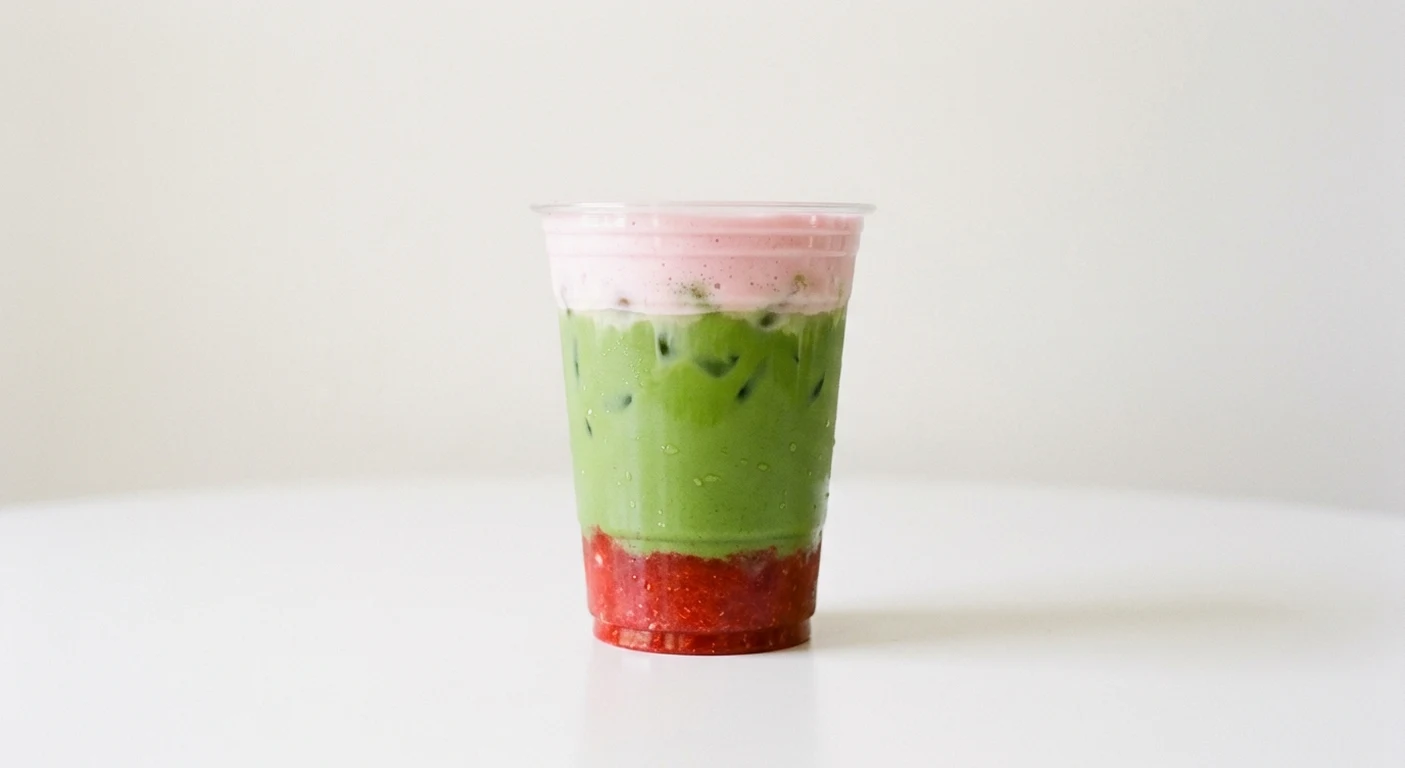
Nutrition information
Nutrition information: Starbucks US Iced Double Berry Matcha (Venti)
| Serving size | 24 fl oz |
| Calories | 410 |
| Total fat | 16g |
| of which saturated | 10g |
| Trans fat | 0.5g |
| Carbohydrate | 53g |
| Total sugars | 51g |
| Includes added sugars (Boone estimate) | 36g |
| Fibre | 1g |
| Protein | 12g |
| Sodium | 170mg |
| Caffeine | 75mg |
Nutrition figures are Starbucks US published data for the standard recipe in this size, including the default milk and toppings. Starbucks publishes total sugar only, so added sugar is a Boone estimate. Boone converts the figures to the portion and age comparisons on this page.
Starbucks US Iced Double Berry Matcha (Venti) contains 410 calories, which is 20% of the 2,000-calorie Daily Value used on US food labels. It provides 16g of total fat, of which 10g is saturated, 51g of total sugars (an estimated 36g added), 170mg of sodium, 12g of protein and 1g of fibre.
The saturated fat content of 10g represents 50% of the 20g Daily Value.
Starbucks US Iced Double Berry Matcha (Venti) is assembled from 4 separately manufactured components, combined at the point of sale. The raspberry cold foam alone carries 6 different classes of additive. Across the whole drink the ingredient list names emulsifiers, thickeners and gums, flavourings, colours, preservatives and acidity regulators. None of these add nutritional value. They exist to make components survive industrial production, storage and transport.
Starbucks US Iced Double Berry Matcha (Venti) is over the US per-meal added sugar limit
Starbucks US Iced Double Berry Matcha (Venti) contains an estimated 36g of added sugar, 3.6 times the 10g per-meal limit in the Dietary Guidelines for Americans. The same guidelines recommend no added sugar at all for children aged 10 and under.
FDA Daily Values (2,000-calorie diet)
Calories2,000
Total fat78g
Saturated fat20g
Carbohydrate275g
Added sugars50g
Fibre28g
Sodium2,300mg
Protein50g
Ultra-processed food: what is really in it
Processing and additives: Starbucks US Iced Double Berry Matcha (Venti)
Starbucks US Iced Double Berry Matcha (Venti) is assembled from 4 separately manufactured components, combined and served at the point of sale. Reading the ingredient list closely, it contains emulsifiers, thickeners and gums, flavourings, colours, preservatives and acidity regulators. These are not there to add nutritional value. They make industrial production and distribution possible.
Emulsifiers
Keep fat and water mixed so sauces, creams and foams stay smooth. Found in the raspberry cold foam.
Thickeners and gums
Thicken and stabilise texture so sauces and foams hold up in storage. Found in the raspberry cold foam and strawberry puree sauce.
Flavourings
Add or restore taste lost during processing. Found in the raspberry cold foam, strawberry puree sauce and classic syrup.
Colours
Keep the colour bright and consistent from batch to batch. Found in the raspberry cold foam and strawberry puree sauce.
Preservatives
Slow the growth of bacteria, yeasts and moulds, or stop fats going stale, in centrally prepared components. Found in the raspberry cold foam and classic syrup.
Acidity regulators
Control sourness and keep syrups and bases stable on the shelf. Found in the raspberry cold foam, strawberry puree sauce and classic syrup.
Boone classifies Starbucks US Iced Double Berry Matcha (Venti) as NOVA group 4, ultra-processed, based on the additives named above. NOVA groups foods by how far they are from their whole-food form, not by how nutritious they are. A group 4 food is not automatically unhealthy, and a group 1 food is not automatically healthy. Read from the published ingredient list, October 2026.
Starbucks US Iced Double Berry Matcha (Venti) contains at least 14 distinct ingredients: 7 raw and 7 manufactured. Raw means something you could buy and cook with at home; manufactured means a substance that only exists as an output of industrial processing.
Ingredient count: Starbucks US Iced Double Berry Matcha (Venti)
| What you order | Raw | Manufactured | Total | % manufactured |
|---|
| Starbucks US Iced Double Berry Matcha (Venti) on its own | 7 | 7 | 14 | 50% |
The 7 manufactured ingredients
carrageenan, citric acid, fruit and vegetable juice for color, mono and diglycerides, natural flavors, potassium sorbate, xanthan gum.
The 7 raw ingredients
cream, ground green tea, milk, strawberry puree, sugar, water, white grape juice concentrate.
What those ingredients are, by type
Emulsifiers and thickeners3
Meat, fish, dairy and eggs2
Sugars and syrups2
Preservatives and acidity regulators2
Water1
Flavourings and extracts1
Colours1
Fruit, vegetables and nuts1
Coffee, tea and cocoa1
Boone counts every distinct named ingredient on Starbucks’ published component lists, including sub-ingredients, and removes duplicates, so sugar appearing in three syrups counts once. Ice and water added at the counter are not counted. Raw covers whole foods and basic kitchen staples such as milk, sugar, salt and oil. Manufactured covers substances that only exist as an output of industrial processing. Every figure here is a minimum.
Ingredients
Starbucks US Iced Double Berry Matcha (Venti) is made from 6 components, 4 of them separately manufactured.
Ingredients by component: Starbucks US Iced Double Berry Matcha (Venti)
Raspberry cold foam
Vanilla Sweet Cream (Cream (Cream, Mono and Diglycerides, Carrageenan), Milk, Vanilla Syrup (Sugar, Water, Natural Flavors, Potassium Sorbate, Citric Acid)), Raspberry Syrup (Water, Sugar, Fruit and Vegetable Juice for Color, Natural Flavors, Citric Acid, Potassium Sorbate).
Strawberry puree sauce
Strawberry Puree, White Grape Juice Concentrate, Water, Fruit and Vegetable Juice for Color, Natural Flavors, Xanthan Gum, Citric Acid.
Classic syrup
Sugar, Water, Natural Flavors, Potassium Sorbate, Citric Acid.
Ingredients taken from the Starbucks US menu at starbucks.com, retrieved October 2026, for the standard recipe. Recipes change and customisations alter them, so always check in store before ordering if you have an allergy.
Allergens at a glance
Starbucks US Iced Double Berry Matcha (Venti) contains milk.
Allergen information: Starbucks US Iced Double Berry Matcha (Venti)
| Allergen | Status |
|---|
| Milk | Contains |
| Eggs | Not declared |
| Fish | Not declared |
| Crustacean shellfish | Not declared |
| Tree nuts | Not declared |
| Peanuts | Not declared |
| Wheat | Not declared |
| Soybeans | Not declared |
| Sesame | Not declared |
Contains 75mg of caffeine. Contains = named in the Starbucks US ingredient list for the standard recipe; Starbucks does not publish a separate allergen statement for most drinks. Starbucks prepares drinks with shared equipment, so no drink can be guaranteed allergen free, and changing the milk or adding toppings changes the allergens. UK rules also require barley, oats, mustard, celery and sulphites to be declared; these are shown where the ingredient list names them. Retrieved October 2026.