Free UK delivery on all orders · At-home saliva test · Secure checkout
Free UK delivery on all orders

McDonald's US Egg & Cheese Biscuit: calories and sugar by portion, age and sex

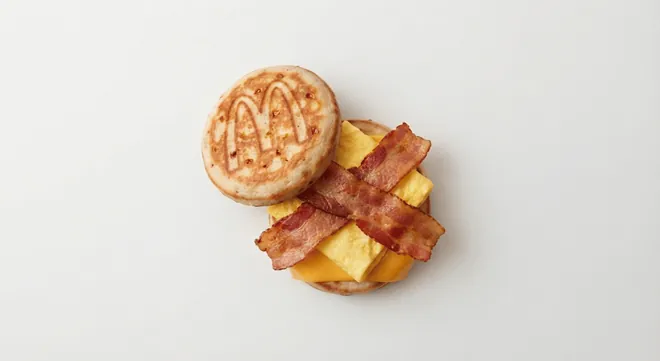
McDonald's US Egg & Cheese Biscuit with a folded egg and melted American cheese in a split buttermilk biscuit

Boone’s analysis puts McDonald's US Egg & Cheese Biscuit at 20% of an adult’s daily calories, 74% of the daily sodium limit for a child aged 4 to 8 and 0.2 teaspoons of added sugar.

How many calories are in an McDonald's US Egg & Cheese Biscuit? It contains 390 calories, 21g of fat (11g saturated), 1g of added sugar and 1,110mg of sodium.

Build a full meal with our nutrition calculator

Use the Boone meal calculator to build a full meal rather than view this item on its own. Add fries, a drink, dips and a dessert, then choose your age and sex, and switch between US and UK guidance, for a more accurate view of how an Egg & Cheese Biscuit fits into a day.

Nutrition information

Nutrition information: McDonald's US Egg & Cheese Biscuit

Calories390
Total fat21g
of which saturated11g
Trans fat0g
Carbohydrate39g
Total sugars3g
Includes added sugars1g
Fibre1g
Protein13g
Sodium1,110mg

Nutrition figures are McDonald’s USA published data, per item as sold and before any optional sauces or extras. Boone converts them to the portion and age comparisons on this page.

McDonald's US Egg & Cheese Biscuit contains 390 calories, which is 20% of the 2,000-calorie Daily Value used on US food labels. It provides 21g of total fat, of which 11g is saturated, 3g of total sugars (1g added), 1,110mg of sodium, 13g of protein and 1g of fibre.

The saturated fat content of 11g represents 55% of the 20g Daily Value.

McDonald's US Egg & Cheese Biscuit is assembled from 5 separately manufactured components, combined at the point of sale. The biscuit alone carries 7 different classes of additive. Across the whole item the ingredient list names modified starches, emulsifiers, thickeners and gums, processed cellulose, flavourings, colours, phosphates and raising agents, emulsifying and buffering salts and protein and dairy fractions. None of these add nutritional value. They exist to make the item survive industrial production, storage and transport.

McDonald's US Egg & Cheese Biscuit carries a large share of a child’s daily sodium

McDonald's US Egg & Cheese Biscuit contains 1,110mg of sodium, which is 74% of the daily limit for a child aged 4 to 8. It is also high in saturated fat.

FDA Daily Values (2,000-calorie diet)

Calories2,000
Total fat78g
Saturated fat20g
Carbohydrate275g
Added sugars50g
Fibre28g
Sodium2,300mg
Protein50g

Added sugar vs total sugar

Where the sugar comes from: McDonald's US Egg & Cheese Biscuit

1g of the 3g counts as added sugar, or about 0.2 teaspoons. The other 2g is naturally occurring.

Added sugars come from

  • sugar in the biscuit

Naturally occurring sugars come from

  • lactose in the biscuit
  • lactose in the folded egg
  • lactose in the pasteurized process American cheese
  • lactose in the salted butter
  • lactose in the clarified butter

Dietary Guidelines for Americans, 2025–2030: no more than 10g of added sugar per meal from age 11 and none for children aged 10 and under. FDA Daily Value: 50g a day. Sources are read from the published ingredient list for each component.

Ultra-processed food: what is really in it

Processing and additives: McDonald's US Egg & Cheese Biscuit

McDonald's US Egg & Cheese Biscuit is assembled from 5 separately manufactured components, combined and served at the point of sale. Reading the ingredient list closely, it contains modified starches, emulsifiers, thickeners and gums, processed cellulose, flavourings, colours, phosphates and raising agents, emulsifying and buffering salts and protein and dairy fractions. These are not there to add nutritional value. They make industrial production and distribution possible.

Modified starches

Starches altered industrially to thicken, bind or hold texture through freezing and reheating. Found in the biscuit and folded egg.

Emulsifiers

Help oil-based and water-based ingredients blend and stay blended. Found in the biscuit and pasteurized process American cheese.

Thickeners and gums

Thicken sauces, fillings and drinks and stop them separating. Found in the biscuit.

Processed cellulose

Plant fibre processed into a bulking, anti-caking or texturing agent. Found in the biscuit.

Flavourings

Add or restore taste lost during processing. Found in the biscuit.

Colours

Restore or standardise appearance after processing. Found in the pasteurized process American cheese.

Phosphates and raising agents

Hold moisture in meat, control acidity or make batters and doughs rise. Found in the biscuit.

Emulsifying and buffering salts

Let processed cheese and cream melt smoothly, or hold the acidity of drinks steady. Found in the pasteurized process American cheese.

Protein and dairy fractions

Isolated proteins and dairy by-products used to add bulk, structure or a creamy texture. Found in the biscuit.

Boone classifies McDonald's US Egg & Cheese Biscuit as NOVA group 4, ultra-processed, based on the additives named above. NOVA groups foods by how far they are from their whole-food form, not by how nutritious they are. A group 4 food is not automatically unhealthy, and a group 1 food is not automatically healthy. Read from the published ingredient list, September 2026.

McDonald's US Egg & Cheese Biscuit contains at least 33 distinct ingredients: 12 raw and 21 manufactured. Ordered as a full meal with a dip and a dessert that reaches 69, of which 38 are manufactured. Raw means something you could buy and cook with at home; manufactured means a substance that only exists as an output of industrial processing.

Ingredient count by order: McDonald's US Egg & Cheese Biscuit

What you orderRawManufacturedTotal% manufactured
McDonald's US Egg & Cheese Biscuit on its own12213364%
McDonald's US Egg & Cheese Biscuit + medium fries16254161%
McDonald's US Egg & Cheese Biscuit + fries + a dip25315655%
McDonald's US Egg & Cheese Biscuit + fries + dip + a medium Coca-Cola26335956%
McDonald's US Egg & Cheese Biscuit + fries + dip + drink + an OREO McFlurry31386955%

The 21 manufactured ingredients

carrageenan, citric acid, color added, enzymes, folic acid, locust bean gum, modified cellulose, modified food starch, mono and diglycerides, monocalcium phosphate, natural flavor, niacin, nonfat dry milk, reduced iron, riboflavin, sodium aluminum phosphate, sodium citrate, soy lecithin, thiamine mononitrate, wheat protein isolate, xanthan gum.

The 12 raw ingredients

baking soda, bleached wheat flour, cream, cultured skim milk, cultures, egg, milk, palm kernel oil, palm oil, salt, sugar, water.

What those ingredients are, by type

Other additives and processing aids11
Meat, fish, dairy and eggs6
Vitamins and fortification5
Grains and flours2
Oils and fats2
Starches1
Salt and minerals1
Water1
Sugars and syrups1
Flavourings and extracts1
Acids and acidity regulators1
Colours1

Boone counts every distinct named ingredient on McDonald’s published component lists, including sub-ingredients, and removes duplicates, so salt appearing in four components counts once. Additive class names are dropped and the named substance kept, so “leavening (baking soda)” counts baking soda once. Ice and water added at the counter are not counted. Raw covers whole foods and basic kitchen staples such as flour, sugar, salt and oil. Manufactured covers substances that only exist as an output of industrial processing. Every figure here is a minimum. The build uses a Sweet ’n Sour sauce.

Ingredients

McDonald's US Egg & Cheese Biscuit is assembled from 5 separately manufactured components.

Ingredients by component: McDonald's US Egg & Cheese Biscuit

Biscuit

Enriched Flour (bleached Wheat Flour, Niacin, Reduced Iron, Thiamin Mononitrate, Riboflavin, Folic Acid), Cultured Nonfat Buttermilk (cultured Skim Milk, Nonfat Dry Milk, Modified Food Starch, Salt, Mono And Diglycerides, Locust Bean Gum, Carrageenan), Palm Oil, Palm Kernel Oil, Water, Leavening (sodium Bicarbonate, Sodium Aluminum Phosphate, Monocalcium Phosphate), Contains 2% Or Less: Salt, Sugar, Modified Cellulose, Wheat Protein Isolate, Natural Flavor, Modified Food Starch, Xanthan Gum, Soy Lecithin.

Folded egg

Eggs, Nonfat Milk, Modified Food Starch, Salt, Citric Acid.

Pasteurized process American cheese

Milk, Cream, Water, Sodium Citrate, Salt, Cheese Cultures, Citric Acid, Enzymes, Soy Lecithin, Color Added.

Salted butter

Cream, Salt.

Clarified butter

Pasteurized Cream (butterfat).

Ingredients taken from the McDonald’s USA product pages, retrieved September 2026, with obvious spelling errors corrected. Recipes change - always check in restaurant before ordering if you have an allergy.

Allergens at a glance

McDonald's US Egg & Cheese Biscuit contains wheat, milk, soy and egg.

Allergen information: McDonald's US Egg & Cheese Biscuit

AllergenStatus
MilkContains
EggsContains
FishNot declared
Crustacean shellfishNot declared
Tree nutsNot declared
PeanutsNot declared
WheatContains
SoybeansContains
SesameNot declared

Contains = declared by McDonald’s USA. May contain = McDonald’s states the allergen may be present. McDonald’s prepares food in shared kitchens, so no item can be guaranteed allergen free. UK rules also require barley, oats, mustard, celery and sulphites to be declared; these are shown where the ingredient list names them. Retrieved September 2026.

Frequently asked questions

How many calories are in an McDonald's US Egg & Cheese Biscuit?+

Boone calculates that McDonald's US Egg & Cheese Biscuit contains 390 calories, which is 20% of the 2,000-calorie Daily Value and 26% of the daily needs of a moderately active child aged 4 to 8.

How much added sugar is in an McDonald's US Egg & Cheese Biscuit?+

Boone calculates that McDonald's US Egg & Cheese Biscuit contains 1g of added sugar, about 0.2 teaspoons, which is 2% of the 50g FDA Daily Value.

Is McDonald's US Egg & Cheese Biscuit within US sugar guidance for children?+

The Dietary Guidelines for Americans, 2025–2030 recommend no added sugar for children aged 10 and under and no more than 10g per meal from age 11. With 1g of added sugar, McDonald's US Egg & Cheese Biscuit fits the per-meal limit for ages 11 and up but not the guidance for younger children.

How much saturated fat is in an McDonald's US Egg & Cheese Biscuit?+

McDonald's US Egg & Cheese Biscuit contains 11g of saturated fat. Boone calculates this as 55% of the 20g Daily Value and 65% of the 17g limit for a child aged 4 to 8.

How much sodium is in an McDonald's US Egg & Cheese Biscuit?+

McDonald's US Egg & Cheese Biscuit contains 1,110mg of sodium. Boone calculates that as 74% of the daily limit for a child aged 4 to 8 and 48% of the 2,300mg adult limit.

Is McDonald's US Egg & Cheese Biscuit ultra-processed?+

Boone classifies McDonald's US Egg & Cheese Biscuit as NOVA group 4. Reading the published ingredient list, it is assembled from 5 separately manufactured components and contains modified starches, emulsifiers, thickeners and gums, processed cellulose, flavourings, colours, phosphates and raising agents, emulsifying and buffering salts and protein and dairy fractions. NOVA group 4 describes how far a food is from its whole-food form, not how nutritious it is.

How much fibre is in an McDonald's US Egg & Cheese Biscuit?+

McDonald's US Egg & Cheese Biscuit contains 1g of fibre. Boone calculates that as 4% of the 28g Daily Value and 5% of the 21g target for a child aged 4 to 8. Fibre is a target to reach rather than a limit to stay under.

Is McDonald's US Egg & Cheese Biscuit suitable for children?+

Boone’s analysis flags that its 1,110mg of sodium is 74% of the daily limit for a child aged 4 to 8; its 1g of added sugar is above the Dietary Guidelines advice of no added sugar for children aged 10 and under; its 11g of saturated fat is 65% of their daily limit. That does not make it off limits, but it does mean an Egg & Cheese Biscuit uses up a large share of a young child’s day in one item.

How much protein is in an McDonald's US Egg & Cheese Biscuit?+

McDonald's US Egg & Cheese Biscuit contains 13g of protein, which Boone calculates as 26% of the 50g Daily Value.