
Figures from Kellogg’s nutrition panel, collected by Boone. Free sugar calculated by Boone. Last checked 17 October 2026. Data checks are led by Murray Dare.
Colours use the Food Standards Agency front-of-pack thresholds per 100g. RI is the adult reference intake. Cereal only, before milk.
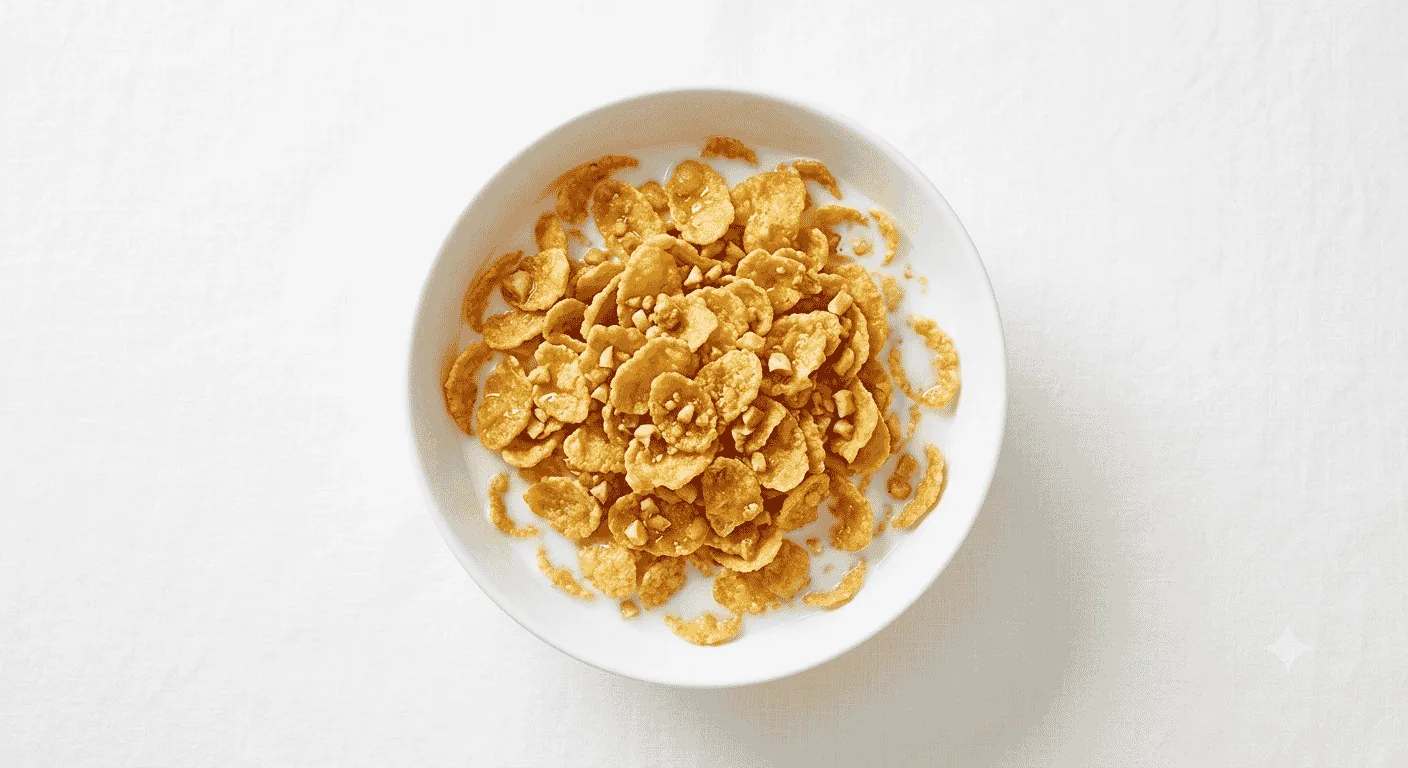
30g of Crunchy Nut, no milk. Cereal figures from Kellogg’s; milk figures are typical UK values. Calorie split calculated by Boone. How
Sugar in milk and whole or dried fruit is not free sugar. Milk on top adds about 6g of sugar that does not count. NHS →
The NHS free sugar limit is 19g a day at age 4 to 6, 24g at 7 to 10 and 30g from 11. There is no limit for under 4s: they should avoid free sugar.
#40 of 41 Kellogg’s cereals for least free sugar.
 Rice Krispies 0.9g fibre, 117 kcal2.4g
 Corn Flakes 0.9g fibre, 113 kcal2.4gSpecial K Granola Mixed Berries 3g fibre, 135 kcal3gSpecial K Protein Nuts, Clusters & Seeds 2.5g fibre, 118 kcal3.6gSultana Bran 3.3g fibre, 105 kcal3.7g
 Fruit 'n Fibre 2.7g fibre, 114 kcal3.8gSpecial K Granola Dark Chocolate 2.9g fibre, 141 kcal3.9g
 Bran Flakes 5.1g fibre, 107 kcal4.2gSpecial K Red Berries 2g fibre, 117 kcal4.2gRice Krispies Multigrain Shapes 2.3g fibre, 119 kcal4.5g
 Special K Original 1.8g fibre, 118 kcal4.5g
 Coco Pops 1.1g fibre, 116 kcal5.1gSpecial K Peach & Apricot 1.7g fibre, 118 kcal5.3g
 All-Bran Original 8.1g fibre, 100 kcal5.4gSpecial K Oats & Honey 1.5g fibre, 114 kcal5.4gCrunchy Nut Granola Fruit & Nut 2.1g fibre, 141 kcal5.7gSpecial K Milk Chocolate 1.6g fibre, 123 kcal5.9gPokémon Chocolate Flavour Cereal 3g fibre, 113 kcal6gOaties Original Crunch 2.5g fibre, 114 kcal6gCrunchy Nut Granola Red Berries 2.3g fibre, 141 kcal6.2gKrave Caramelised Biscuit & White Chocolate 0.9g fibre, 129 kcal6.2gAll-Bran Golden Crunch 3.9g fibre, 122 kcal6.3gOaties Cocoa Crunch 2.7g fibre, 114 kcal6.3gCoco Pops Loops 2.5g fibre, 115 kcal6.3gCoco Pops Mega Pops 2.4g fibre, 115 kcal6.3gCrunchy Nut Granola Chocolate Mocha 1.8g fibre, 150 kcal6.3gCoco Pops Chocos White Choc 1g fibre, 116 kcal6.3g
 Honey Loops 2.3g fibre, 119 kcal6.6gCrunchy Nut Granola Caramelised Hazelnuts 2g fibre, 145 kcal6.6gCoco Pops Chocos 1.8g fibre, 114 kcal6.6gCoco Pops Chocos Mix 1.3g fibre, 116 kcal6.6gKrave Chocolate Hazelnut 1.3g fibre, 132 kcal6.9gCrunchy Nut Chocolate & Hazelnut Granola 1.8g fibre, 145 kcal7.2gKrave Choco Brownie 1.6g fibre, 131 kcal7.2g
 Krave Milk Chocolate 1.1g fibre, 136 kcal7.2gKrave Cookies & Cream 1.1g fibre, 126 kcal7.6gCrunchy Nut Clusters Honey 1.4g fibre, 141 kcal7.8gCrunchy Nut Chocolate Clusters 1.4g fibre, 141 kcal8.6gCrunchy Nut Salted Caramel 0.7g fibre, 122 kcal9.6g
 Crunchy Nut 0.8g fibre, 119 kcal10.5g
 Frosties 0.6g fibre, 113 kcal11.1g
Where a 30g bowl sits against every own-brand cereal from Asda, M&S, Morrisons, Sainsbury’s, Tesco and Waitrose.
More free sugar than 100% of the 318 supermarket cereals.
Less fibre than 92% of the 318 supermarket cereals.
Less protein than 99% of the 318 supermarket cereals.
More salt than 98% of the 318 supermarket cereals.
The 2018 model indicates this cereal is less healthy: it scores 14, at or above the line of 4.
Higher is less healthy; 4 or more would be classed as less healthy under this model. How the score works →
#28 of 41 Kellogg’s cereals for this score (lower is better).
8 ingredients; 0 are additives or industrial ingredients (orange).
Kellogg’s adds vitamins and minerals to this cereal. They are counted as one ingredient and are not a marker of ultra-processing.
Group 3 because it is made from cereal grains with added sugar and salt, but the ingredient list has no flavourings, emulsifiers or other industrial ingredients. Added vitamins and minerals are not counted. How NOVA works →
Nothing on the ingredient list is a NOVA marker of ultra-processing.
Cereal only, before milk. Kellogg’s gives a pack serving of 30g.
| Per | 100g | 25g | 30g | 45g |
|---|---|---|---|---|
| Energy | 398 kcal | 100 kcal | 119 kcal | 179 kcal |
| Fat | 4.5g | 1.1g | 1.4g | 2g |
| of which saturates | 0.7g | 0.2g | 0.2g | 0.3g |
| Carbohydrate | 82g | 20.5g | 24.6g | 36.9g |
| of which sugars | 35g | 8.8g | 10.5g | 15.8g |
| Free sugar (Boone) | 35g | 8.8g | 10.5g | 15.8g |
| Fibre | 2.5g | 0.6g | 0.8g | 1.1g |
| Protein | 6g | 1.5g | 1.8g | 2.7g |
| Salt | 0.75g | 0.19g | 0.23g | 0.34g |
A 30g bowl has 10.5g of sugar, and Boone calculates 10.5g of it is free sugar, about 2.6 teaspoons. That is 55% of the 19g daily limit for a child aged 4 to 6 and 35% of the 30g adult limit.
119 kcal in a 30g bowl, or 178 kcal with 125ml of semi-skimmed milk. Per 100g it is 398 kcal.
A 30g bowl gives 0.8g of fibre and 55% of a 4 to 6 year old’s free sugar limit. Kellogg's Rice Krispies has 2.4g of free sugar a bowl.
No, it is NOVA group 3, processed. It has added sugar and salt but no industrial ingredients.
14 on the UK Nutrient Profiling Model 2018, calculated by Boone per 100g. Scores run from -20 to 40; 4 or more would be classed as less healthy.
Source. Kellogg's UK product information (Kellogg's Vantage), nutrition panel and ingredient list, per 100g as sold.
Collected. Copied by Boone from Kellogg’s published figures. Data checks are led by Murray Dare.
Calculated by Boone. Free sugar, portion figures, milk, traffic lights and the nutrient profile score. Labelled where they appear.
Limits. NHS free sugar and salt limits by age; UK reference intakes for adults.
Track your day in the Boone appCookies on Boone
We use analytics cookies to see how people use the site so we can improve it. They are only set if you accept. Cookie policy