
Figures from Burger King US nutrition information, collected by Boone, checked 6 October 2026
Mott's Applesauce, as published. Burger King US does not publish added sugars, so Boone estimates them from the ingredient list. High and Low follow FDA’s 20% and 5% Daily Value marks. Calorie split calculated by Boone. How
The Mott's Applesauce as published, seen four ways.
None of the three reaches 20% of the Daily Value in one serving, FDA’s mark for high.
Nothing here reaches 20% of the Daily Value in one serving.
Already the lowest in saturated fat of its section on the menu.
Sodium limits by age: 0% for an adult, 0% at age 4 to 8.
For age 4 to 8, 0mg of sodium is 0% of the day’s 1,500mg limit in one serving.
Already the lowest in sodium of its section on the menu.
For age 9 to 13, 0mg of sodium is 0% of the day’s 1,800mg limit in one serving.
Already the lowest in sodium of its section on the menu.
For age 14 to 18, 0mg of sodium is 0% of the day’s 2,300mg limit in one serving.
Already the lowest in sodium of its section on the menu.
Protein counts in your favour here, but the saturated fat is still 0% of the Daily Value.
0g of protein, #147 on the menu. Per calorie the Flame-Grilled Chicken Sandwich gives more: 8.5g per 100 calories against 0.0g.
 Most protein per calorieFlame-Grilled Chicken Sandwich →35g protein in 410 calories
Here the 0mg of sodium counts as useful after sweaty exercise.
13g of carbohydrate, with 0% of the energy from fat.
Sugar naturally in milk, fruit and vegetables is not added sugar. Dietary Guidelines →
For smaller portions: the most nutrition per calorie, against all 251 Burger King US items.
More protein per calorie than 0% of the 251 items on the menu.
More fibre per calorie than 98% of the 251 items on the menu.
Burger King US does not publish vitamins or minerals for this item, so Boone does not estimate them.
Within all three limits for a mixed product. Burger King US does not publish food group amounts, so Boone cannot confirm the food group test.
53 of 251 Burger King US items are within the limits for their category. Portion weight estimated by Boone from similar items.
FDA final rule, December 2024. Food makers must comply by 25 February 2028.
3 ingredients across 1 part; 1 are additives or processed (orange).
Group 3: made from whole foods with added salt, sugar or oil. How NOVA works →
 Mott's Applesauce 0g protein, 0mg sodium50
 Chicken Fries (4 piece) 7g protein, 330mg sodium110
 Cheesy Bacon Tots (4 piece) 4g protein, 500mg sodium130
 Onion Rings (Value) 2g protein, 300mg sodium170
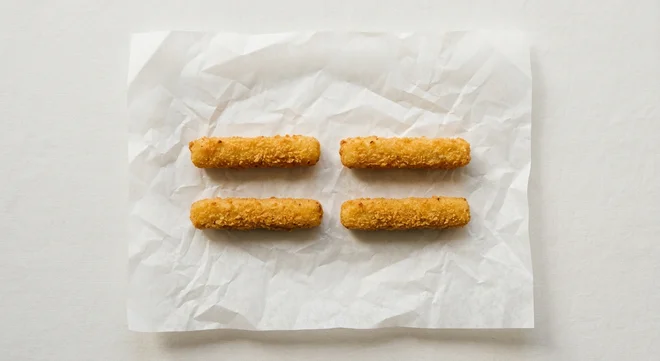 Mozzarella Fries (4 piece) 10g protein, 790mg sodium220
 Chicken Fries (8 piece) 13g protein, 680mg sodium220
 Game Day Chicken Fries (4 piece) 9g protein, 1,120mg sodium220
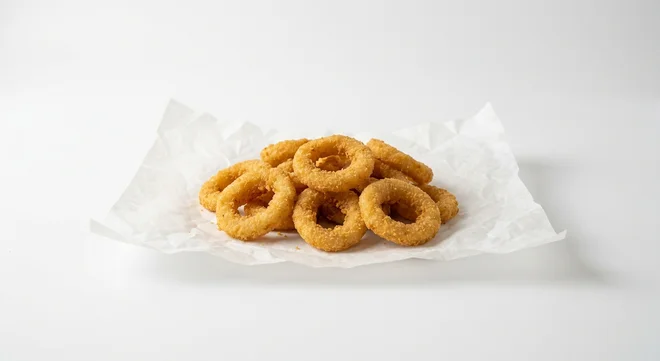 Onion Rings (Small) 3g protein, 410mg sodium230
50 calories as published. That is 2% of the 2,000-calorie Daily Value used on US food labels.
For a child aged 4 to 8 it is 0% of the day’s 1,500mg sodium limit in one item. It has no added sugar.
11g of total sugars, of which 0g is added sugar, as estimated by Boone. That is 0.0 teaspoons and 0% of the 50g Daily Value. The Dietary Guidelines advise no more than 10g of added sugar a meal from age 11.
0g, 0.0g per 100 calories. It ranks #147 of 214 items on the menu for protein. The Flame-Grilled Chicken Sandwich gives the most protein for the calories, 8.5g per 100 calories.
It is within FDA’s added sugars, sodium and saturated fat limits for a mixed product, but Boone cannot confirm the food group requirement. This is Boone’s reading of the FDA criteria; Burger King US makes no ‘healthy’ claim.
No, NOVA group 3. The ingredient list includes flour treatment agents.
None of the 9 major US allergens are declared.
Source. Burger King US nutrition information, per item as sold.
Collected. Copied by Boone from Burger King US’s published figures. Data checks are led by Murray Dare.
Calculated by Boone. Labelled where it appears.
References. FDA Daily Values; USDA estimated calorie needs; Dietary Guidelines for Americans, 2025 to 2030; sodium limits by age from the National Academies; FDA ‘healthy’ claim criteria.
Cookies on Boone
We use analytics cookies to see how people use the site so we can improve it. They are only set if you accept. Cookie policy